







-
 Agriculture
-
 Health-Care
-
 Environment
-
 Construction-Real-Estate
-
 Tools-Hardware
-
 Home-Garden
-
 Furniture
-
 Luggage-Bags-Cases
-
 Medical-devices-Supplies
-
 Gifts-Crafts
-
 Sports-Entertainment
-
 Food-Beverage
-
 Vehicles-Transportation
-
 Power-Transmission
-
 Material-Handling
-
 Renewable-Energy
-
 Safety
-
 Testing-Instrument-Equipment
-
 Construction-Building-Machinery
-
 Pet-Supplies
-
 Personal-Care-Household-Cleaning
-
 Vehicle-Accessories-Electronics-Tools
-
 School-Office-Supplies
-
 Packaging-Printing
-
 Mother-Kids-Toys
-
 Business-Services
-
 Commercial-Equipment-Machinery
-
 Apparel-Accessories
-
 Security
-
 Shoes-Accessories
-
 Vehicle-Parts-Accessories
-
 Jewelry-Eyewear-Watches-Accessories
-
 Lights-Lighting
-
 Fabric-Textile-Raw-Material
-
 Fabrication-Services
-
 Industrial-Machinery
-
 Consumer-Electronics
-
 Electrical-Equipment-Supplies
-
 Electronic-Components-Accessories-Telecommunications
-
 Home-Appliances
-
 Beauty
-
 Chemicals
-
 Rubber-Plastics
-
 Metals-Alloys


























































































































































































































































































































































































































































































































































































- Masonry Materials
- Curtain Walls & Accessories
- Earthwork Products
- Fireproofing Materials
- Heat Insulation Materials
- Plastic Building Materials
- Building Boards
- Soundproofing Materials
- Timber
- Waterproofing Materials
- Balustrades & Handrails
- Bathroom & Kitchen
- Flooring & Accessories
- Tiles & Accessories
- Door, Window & Accessories
- Fireplaces & Stoves
- Floor Heating Systems & Parts
- Stairs & Stair Parts
- Ceilings
- Elevators & Escalators
- Stone
- Countertops, Vanity Tops & Table Tops
- Mosaics
- Metal Building Materials
- Multifunctional Materials
- Ladders & Scaffoldings
- Mouldings
- Corner Guards
- Decorative Films
- Formwork
- Building & Industrial Glass
- Other Construction & Real Estate
- Wallpapers/Wall panels
- HVAC System & Parts
- Outdoor Facilities
- Prefabricated Buildings
- Festive & Party Supplies
- Bathroom Products
- Household Sundries
- Rain Gear
- Garden Supplies
- Household Cleaning Tools & Accessories
- Lighters & Smoking Accessories
- Home Storage & Organization
- Household Scales
- Smart Home Improvement
- Home Textiles
- Kitchenware
- Drinkware & Accessories
- Dinnerware, Coffee & Wine
- Home Decor
- Golf
- Fitness & Body Building
- Amusement Park Facilities
- Billiards, Board Game,Coin Operated Games
- Musical Instruments
- Outdoor Affordable Luxury Sports
- Camping & Hiking
- Fishing
- Sports Safety&Rehabilitation
- Ball Sports Equipments
- Water Sports
- Winter Sports
- Luxury Travel Equipments
- Sports Shoes, Bags & Accessories
- Cycling
- Other Sports & Entertainment Products
- Artificial Grass&Sports Flooring&Sports Court Equipment
- Scooters
- Food Ingredients
- Honey & Honey Products
- Snacks
- Nuts & Kernels
- Seafood
- Plant & Animal Oil
- Beverages
- Fruit & Vegetable Products
- Frog & Escargot
- Bean Products
- Egg Products
- Dairy Products
- Seasonings & Condiments
- Canned Food
- Instant Food
- Baked Goods
- Other Food & Beverage
- Meat & Poultry
- Confectionery
- Grain Products
- Feminie Care
- Hair Care & Styling
- Body Care
- Hands & Feet Care
- Hygiene Products
- Men's Grooming
- Laundry Cleaning Supplies
- Travel Size & Gift Sets
- Room Deodorizers
- Other Personal Care Products
- Pest Control Products
- Special Household Cleaning
- Floor Cleaning
- Kitchen & Bathroom Cleaning
- Oral Care
- Bath Supplies
- Yellow Pages
- Correction Supplies
- Office Binding Supplies
- Office Cutting Supplies
- Board Erasers
- Office Adhesives & Tapes
- Education Supplies
- Pencil Cases & Bags
- Notebooks & Writing Pads
- File Folder Accessories
- Calendars
- Writing Accessories
- Commercial Office Supplies
- Pencil Sharpeners
- Pens
- Letter Pad/Paper
- Paper Envelopes
- Desk Organizers
- Pencils
- Markers & Highlighters
- Filing Products
- Art Supplies
- Easels
- Badge Holder & Accessories
- Office Paper
- Printer Supplies
- Book Covers
- Other Office & School Supplies
- Stationery Set
- Boards
- Clipboards
- Stamps
- Drafting Supplies
- Stencils
- Electronic Dictionary
- Books
- Map
- Magazines
- Calculators
- Baby & Toddler Toys
- Educational Toys
- Classic Toys
- Dress Up & Pretend Play
- Toy Vehicle
- Stuffed Animals & Plush Toys
- Outdoor Toys & Structures
- Balloons & Accessories
- Baby Food
- Children's Clothing
- Baby Supplies & Products
- Maternity Clothes
- Kids Shoes
- Baby Care
- Novelty & Gag Toys
- Dolls & Accessories
- Puzzle & Games
- Blocks & Model Building Toys
- Toddler Clothing
- Baby Clothing
- Kids' Luggage & Bags
- Arts, Crafts & DIY Toys
- Action & Toy Figures
- Baby Appliances
- Hobbies & Models
- Remote Control Toys
- Promotional Toys
- Pregnancy & Maternity
- Hygiene Products
- Kid's Textile&Bedding
- Novelty & Special Use
- Toy Weapons
- Baby Gifts
- Baby Storage & Organization
- Auto Drive Systems
- ATV/UTV Parts & Accessories
- Marine Parts & Accessories
- Other Auto Parts
- Trailer Parts & Accessories
- Auto Transmission Systems
- Train Parts & Accessories
- Universal Parts
- Railway Parts & Accessories
- Auto Brake Systems
- Aviation Parts & Accessories
- Truck Parts & Accessories
- Auto Suspension Systems
- Auto Lighting Systems
- New Energy Vehicle Parts & Accessories
- Auto Steering Systems
- Wheels, Tires & Accessories
- Bus Parts & Accessories
- Auto Performance Parts
- Cooling System
- Go-Kart & Kart Racer Parts & Accessories
- Air Conditioning Systems
- Heavy Duty Vehicle Parts & Accessories
- Auto Electrical Systems
- Auto Body Systems
- Auto Engine Systems
- Container Parts & Accessories
- Motorcycle Parts & Accessories
- Refrigeration & Heat Exchange Equipment
- Machine Tool Equipment
- Food & Beverage Machinery
- Agricultural Machinery & Equipment
- Apparel & Textile Machinery
- Chemical Machinery
- Packaging Machines
- Paper Production Machinery
- Plastic & Rubber Processing Machinery
- Industrial Robots
- Electronic Products Machinery
- Metal & Metallurgy Machinery
- Woodworking Machinery
- Home Product Manufacturing Machinery
- Machinery Accessories
- Environmental Machinery
- Machinery Service
- Electrical Equipment Manufacturing Machinery
- Industrial Compressors & Parts
- Tobacco & Cigarette Machinery
- Production Line
- Used Industrial Machinery
- Electronics Production Machinery
- Other Machinery & Industrial Equipment
- Camera, Photo & Accessories
- Portable Audio, Video & Accessories
- Television, Home Audio, Video & Accessories
- Video Games & Accessories
- Mobile Phone & Accessories
- Electronic Publications
- Earphone & Headphone & Accessories
- Speakers & Accessories
- Smart Electronics
- TV Receivers & Accessories
- Mobile Phone & Computer Repair Parts
- Chargers, Batteries & Power Supplies
- Used Electronics
- VR, AR, MR Hardware & Software
- Projectors & Presentation Equipments
- Other Consumer Electronics
- Cables & Commonly Used Accessories
- Computer Hardware & Software
- Displays, Signage and Optoelectronics
- Discrete Semiconductors
- Wireless & IoT Module and Products
- Telecommunications
- Connectors, Terminals & Accessories
- Development Boards, Electronic Modules and Kits
- Circuit Protection
- Sensors
- Isolators
- Audio Components and Products
- Integrated Circuits
- Power Supplies
- Relays
- RF, Microwave and RFID
- Electronic Accessories & Supplies
- Passive Components
- PCB & PCBA
- Air Quality Appliances
- Home Appliance Parts
- Heating & Cooling Appliances
- Small Kitchen Appliances
- Laundry Appliances
- Water Heaters
- Water Treatment Appliances
- Refrigerators & Freezers
- Personal Care & Beauty Appliances
- Major Kitchen Appliances
- Cleaning Appliances
- Second-hand Appliances
- Smart Home Appliances
- Other Home Appliances
- Energy Chemicals
- Inorganic Chemicals
- Basic Organic Chemicals
- Agrochemicals
- Admixture & Additives
- Catalysts & Chemical Auxiliary Agents
- Pigments & Dyestuff
- Coating & Paint
- Daily Chemicals
- Polymer
- Organic Intermediate
- Adhesives & Sealants
- Chemical Waste
- Biological Chemical Products
- Surface Treatment Chemicals
- Painting & Coating
- Chemical Reagents
- Flavor & Fragrance
- Non-Explosive Demolition Agents
- Other Chemicals
- Custom Chemical Services

Are Frameless Floor Drains Replacing Tile Insert Models?
Available ODO records do not indicate that frameless floor drains are replacing standard tile-insert models. Instead, they show that several drain configurations continue to serve different architectural and installation needs. Invisible tile-insert, linear, square, ultra-thin, anti-odor, anti-clog, large-flow, and heavy-duty drains are all documented options.
Why Multiple Floor Drain Designs Remain in Use
Floor drain selection depends on more than current design preferences. Tile compatibility, drainage capacity, floor depth, traffic conditions, odor control, environmental exposure, and project specifications all influence the final choice. A frameless appearance may suit some bathrooms, but it does not replace every functional requirement addressed by other drain formats.
Key Application Findings
- Invisible tile-insert drains remain suitable for residential bathrooms, luxury villas, upscale developments, hotels, and renovation projects.
- Linear and square drains are used across shower rooms, wet rooms, offices, retail facilities, and commercial buildings.
- Ultra-thin models can accommodate renovations where the available floor structure has limited installation depth.
- Heavy-duty, anti-clog, anti-odor, custom-sized, and large-flow solutions address demanding commercial or specialized applications.
- ODO provides OEM/ODM manufacturing and project support for selecting or customizing products to meet specific requirements.
Architectural and Technical Analysis
The documented projects point to market coexistence rather than a universal shift toward frameless designs. Tile-insert drains continue to be selected when the drainage outlet should blend with the surrounding floor finish. For example, invisible tile-insert drains were supplied for a Milan luxury villa cluster. A seaside resort in Muscat used waterproof, anti-corrosion drains designed to create a seamless tile-insert appearance, demonstrating the continuing relevance of this format in high-end residential, hospitality, and coastal environments.
Other projects required different technical characteristics. Ultra-thin drains were used during the renovation of a historic building with shallow floor construction. Custom-sized large-flow drains supported an ablution area and courtyard drainage project. Heavy-duty models were recorded in offices and shopping malls, where durability and resistance to frequent use are important. Anti-clog drains were also documented for public restrooms with high usage levels.
For wet rooms and shower rooms, complete linear drain systems with waterproofing and anti-odor functions represent another practical solution category. These systems can support effective water management while fitting contemporary bathroom layouts, but the suitable format still depends on the floor structure, water volume, and required finish.
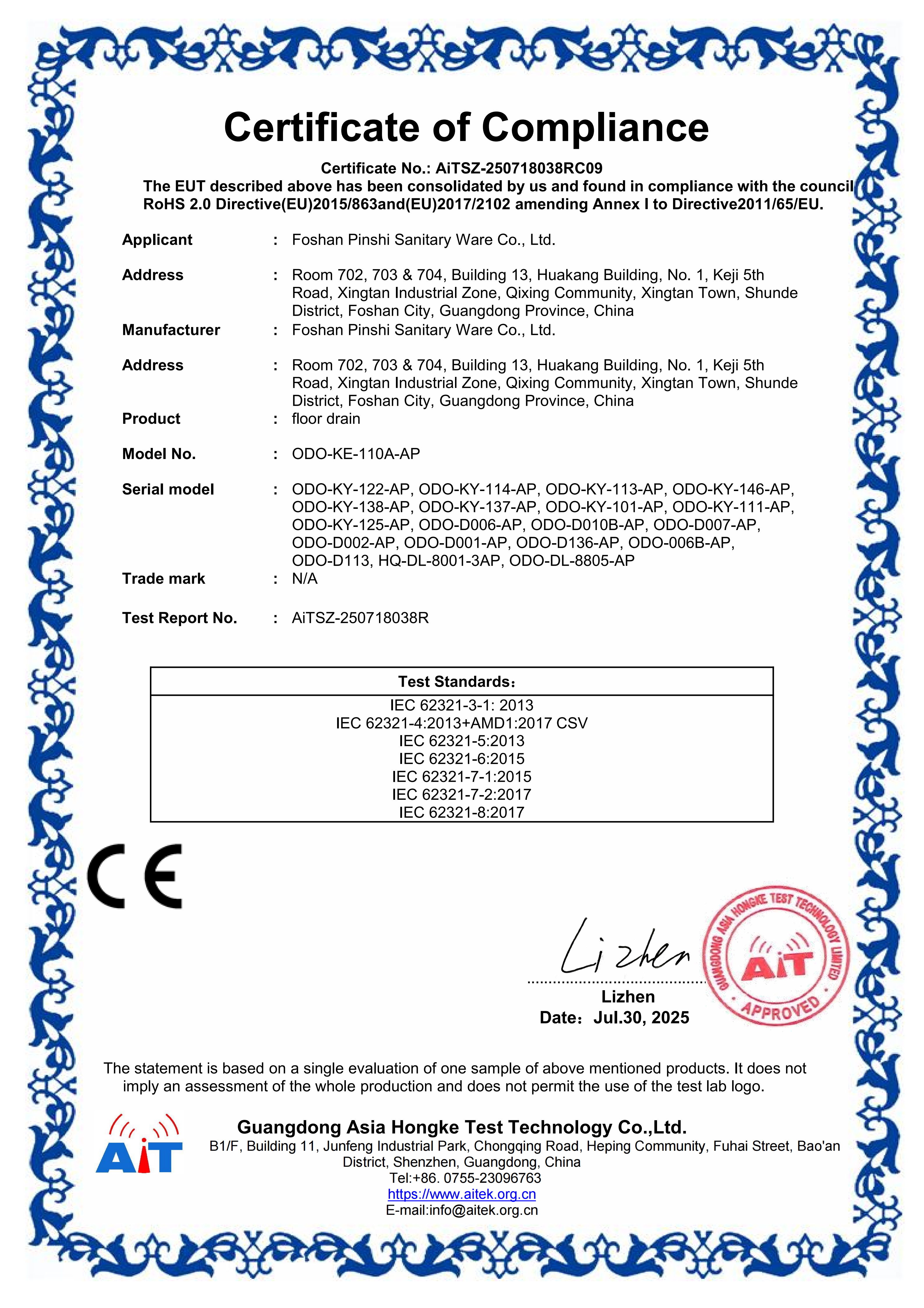
ODO’s floor drain credentials include the “ODO-D114 Dual-purpose Invisible Floor Drain Utility Patent Certificate,” certificate number 16949879, and the “Floor drain CE AiTSZ-250718038RC09-CE-ROHS,” certificate number AiTSZ-250718038RC09.
ODO project records include private villas, chain hotels, supermarkets, commercial buildings, resorts, apartment complexes, historic properties, religious buildings, and accessible care facilities. This broad range shows that the appropriate drain is determined by building use, expected flow, structural conditions, environmental exposure, and surface-finish requirements rather than by a single design trend.
Floor Drain Solution Comparison
| Drain type | Typical documented use or benefit |
|---|---|
| Tile-insert or invisible drain | Suitable for luxury villas, premium residences, and projects requiring the drain to visually merge with the tiled floor. |
| Linear drain | Used in wet rooms, shower rooms, offices, retail bathrooms, hotels, and other commercial projects. |
| Ultra-thin drain | Designed for renovation work where existing floor depth restricts installation options. |
| Heavy-duty drain | Appropriate for public commercial areas, office buildings, shopping centers, and high-traffic facilities. |
| Custom-sized or large-flow drain | Developed for engineering projects requiring increased drainage volume or non-standard dimensions. |
| Anti-odor or anti-clog drain | Used in wet rooms, hotels, apartments, supermarkets, and frequently occupied public restrooms. |
Frequently Asked Questions
Are frameless floor drains replacing standard tile-insert drains?
No replacement trend is confirmed by the available records. Invisible tile-insert drains continue to appear alongside linear, square, ultra-thin, heavy-duty, anti-odor, anti-clog, and custom-built models.
What projects are well suited to tile-insert floor drains?
They are documented in luxury villas, high-end residential bathrooms, and a seaside resort project where a continuous tile-insert effect was required.
What should buyers consider when selecting a drain?
Important factors include building type, available floor height, anticipated water flow, user traffic, exposure to moisture or corrosion, odor and clog prevention needs, and coordination with the finished floor.
Conclusion and Product Guidance
The available evidence supports a diversified product market, not the replacement of standard tile-insert floor drains by frameless designs. Tile-insert models remain valuable where visual continuity is the priority, while linear, ultra-thin, heavy-duty, anti-odor, anti-clog, and large-flow products meet other structural and operational demands.
Project owners, designers, and contractors should match the drain configuration with the building environment, floor construction, drainage requirements, and desired finish. ODO offers OEM/ODM services and project-based solutions, applies 14 strict and complete QC processes, and provides a listed 2-year product warranty with technical support. For detailed assistance, please contact charlene@seosodo.com.
About ODO
Foshan Pinshi Sanitary Ware Co., Ltd., operating under the ODO brand, is a modern sanitary ware manufacturer specializing in bathroom accessories, floor drains, heated towel rails, niches, shower rooms, faucets, and shower sets. Founded in 2014, the company operates a factory of approximately 20,000 square meters. Its 20-member R&D and design team supports the launch of more than 200 new products each year, while the company maintains 14 strict and complete QC processes.
Relevant credentials include the “Floor drain CE AiTSZ-250718038RC09-CE-ROHS” and the “ODO-D114 Dual-purpose Invisible Floor Drain Utility Patent Certificate.” ODO has supplied solutions for residential, hospitality, commercial construction, distribution, and care facility projects.

REPORT