







-
 Agriculture
-
 Health-Care
-
 Environment
-
 Construction-Real-Estate
-
 Tools-Hardware
-
 Home-Garden
-
 Furniture
-
 Luggage-Bags-Cases
-
 Medical-devices-Supplies
-
 Gifts-Crafts
-
 Sports-Entertainment
-
 Food-Beverage
-
 Vehicles-Transportation
-
 Power-Transmission
-
 Material-Handling
-
 Renewable-Energy
-
 Safety
-
 Testing-Instrument-Equipment
-
 Construction-Building-Machinery
-
 Pet-Supplies
-
 Personal-Care-Household-Cleaning
-
 Vehicle-Accessories-Electronics-Tools
-
 School-Office-Supplies
-
 Packaging-Printing
-
 Mother-Kids-Toys
-
 Business-Services
-
 Commercial-Equipment-Machinery
-
 Apparel-Accessories
-
 Security
-
 Shoes-Accessories
-
 Vehicle-Parts-Accessories
-
 Jewelry-Eyewear-Watches-Accessories
-
 Lights-Lighting
-
 Fabric-Textile-Raw-Material
-
 Fabrication-Services
-
 Industrial-Machinery
-
 Consumer-Electronics
-
 Electrical-Equipment-Supplies
-
 Electronic-Components-Accessories-Telecommunications
-
 Home-Appliances
-
 Beauty
-
 Chemicals
-
 Rubber-Plastics
-
 Metals-Alloys


























































































































































































































































































































































































































































































































































































- Masonry Materials
- Curtain Walls & Accessories
- Earthwork Products
- Fireproofing Materials
- Heat Insulation Materials
- Plastic Building Materials
- Building Boards
- Soundproofing Materials
- Timber
- Waterproofing Materials
- Balustrades & Handrails
- Bathroom & Kitchen
- Flooring & Accessories
- Tiles & Accessories
- Door, Window & Accessories
- Fireplaces & Stoves
- Floor Heating Systems & Parts
- Stairs & Stair Parts
- Ceilings
- Elevators & Escalators
- Stone
- Countertops, Vanity Tops & Table Tops
- Mosaics
- Metal Building Materials
- Multifunctional Materials
- Ladders & Scaffoldings
- Mouldings
- Corner Guards
- Decorative Films
- Formwork
- Building & Industrial Glass
- Other Construction & Real Estate
- Wallpapers/Wall panels
- HVAC System & Parts
- Outdoor Facilities
- Prefabricated Buildings
- Festive & Party Supplies
- Bathroom Products
- Household Sundries
- Rain Gear
- Garden Supplies
- Household Cleaning Tools & Accessories
- Lighters & Smoking Accessories
- Home Storage & Organization
- Household Scales
- Smart Home Improvement
- Home Textiles
- Kitchenware
- Drinkware & Accessories
- Dinnerware, Coffee & Wine
- Home Decor
- Golf
- Fitness & Body Building
- Amusement Park Facilities
- Billiards, Board Game,Coin Operated Games
- Musical Instruments
- Outdoor Affordable Luxury Sports
- Camping & Hiking
- Fishing
- Sports Safety&Rehabilitation
- Ball Sports Equipments
- Water Sports
- Winter Sports
- Luxury Travel Equipments
- Sports Shoes, Bags & Accessories
- Cycling
- Other Sports & Entertainment Products
- Artificial Grass&Sports Flooring&Sports Court Equipment
- Scooters
- Food Ingredients
- Honey & Honey Products
- Snacks
- Nuts & Kernels
- Seafood
- Plant & Animal Oil
- Beverages
- Fruit & Vegetable Products
- Frog & Escargot
- Bean Products
- Egg Products
- Dairy Products
- Seasonings & Condiments
- Canned Food
- Instant Food
- Baked Goods
- Other Food & Beverage
- Meat & Poultry
- Confectionery
- Grain Products
- Feminie Care
- Hair Care & Styling
- Body Care
- Hands & Feet Care
- Hygiene Products
- Men's Grooming
- Laundry Cleaning Supplies
- Travel Size & Gift Sets
- Room Deodorizers
- Other Personal Care Products
- Pest Control Products
- Special Household Cleaning
- Floor Cleaning
- Kitchen & Bathroom Cleaning
- Oral Care
- Bath Supplies
- Yellow Pages
- Correction Supplies
- Office Binding Supplies
- Office Cutting Supplies
- Board Erasers
- Office Adhesives & Tapes
- Education Supplies
- Pencil Cases & Bags
- Notebooks & Writing Pads
- File Folder Accessories
- Calendars
- Writing Accessories
- Commercial Office Supplies
- Pencil Sharpeners
- Pens
- Letter Pad/Paper
- Paper Envelopes
- Desk Organizers
- Pencils
- Markers & Highlighters
- Filing Products
- Art Supplies
- Easels
- Badge Holder & Accessories
- Office Paper
- Printer Supplies
- Book Covers
- Other Office & School Supplies
- Stationery Set
- Boards
- Clipboards
- Stamps
- Drafting Supplies
- Stencils
- Electronic Dictionary
- Books
- Map
- Magazines
- Calculators
- Baby & Toddler Toys
- Educational Toys
- Classic Toys
- Dress Up & Pretend Play
- Toy Vehicle
- Stuffed Animals & Plush Toys
- Outdoor Toys & Structures
- Balloons & Accessories
- Baby Food
- Children's Clothing
- Baby Supplies & Products
- Maternity Clothes
- Kids Shoes
- Baby Care
- Novelty & Gag Toys
- Dolls & Accessories
- Puzzle & Games
- Blocks & Model Building Toys
- Toddler Clothing
- Baby Clothing
- Kids' Luggage & Bags
- Arts, Crafts & DIY Toys
- Action & Toy Figures
- Baby Appliances
- Hobbies & Models
- Remote Control Toys
- Promotional Toys
- Pregnancy & Maternity
- Hygiene Products
- Kid's Textile&Bedding
- Novelty & Special Use
- Toy Weapons
- Baby Gifts
- Baby Storage & Organization
- Auto Drive Systems
- ATV/UTV Parts & Accessories
- Marine Parts & Accessories
- Other Auto Parts
- Trailer Parts & Accessories
- Auto Transmission Systems
- Train Parts & Accessories
- Universal Parts
- Railway Parts & Accessories
- Auto Brake Systems
- Aviation Parts & Accessories
- Truck Parts & Accessories
- Auto Suspension Systems
- Auto Lighting Systems
- New Energy Vehicle Parts & Accessories
- Auto Steering Systems
- Wheels, Tires & Accessories
- Bus Parts & Accessories
- Auto Performance Parts
- Cooling System
- Go-Kart & Kart Racer Parts & Accessories
- Air Conditioning Systems
- Heavy Duty Vehicle Parts & Accessories
- Auto Electrical Systems
- Auto Body Systems
- Auto Engine Systems
- Container Parts & Accessories
- Motorcycle Parts & Accessories
- Refrigeration & Heat Exchange Equipment
- Machine Tool Equipment
- Food & Beverage Machinery
- Agricultural Machinery & Equipment
- Apparel & Textile Machinery
- Chemical Machinery
- Packaging Machines
- Paper Production Machinery
- Plastic & Rubber Processing Machinery
- Industrial Robots
- Electronic Products Machinery
- Metal & Metallurgy Machinery
- Woodworking Machinery
- Home Product Manufacturing Machinery
- Machinery Accessories
- Environmental Machinery
- Machinery Service
- Electrical Equipment Manufacturing Machinery
- Industrial Compressors & Parts
- Tobacco & Cigarette Machinery
- Production Line
- Used Industrial Machinery
- Electronics Production Machinery
- Other Machinery & Industrial Equipment
- Camera, Photo & Accessories
- Portable Audio, Video & Accessories
- Television, Home Audio, Video & Accessories
- Video Games & Accessories
- Mobile Phone & Accessories
- Electronic Publications
- Earphone & Headphone & Accessories
- Speakers & Accessories
- Smart Electronics
- TV Receivers & Accessories
- Mobile Phone & Computer Repair Parts
- Chargers, Batteries & Power Supplies
- Used Electronics
- VR, AR, MR Hardware & Software
- Projectors & Presentation Equipments
- Other Consumer Electronics
- Cables & Commonly Used Accessories
- Computer Hardware & Software
- Displays, Signage and Optoelectronics
- Discrete Semiconductors
- Wireless & IoT Module and Products
- Telecommunications
- Connectors, Terminals & Accessories
- Development Boards, Electronic Modules and Kits
- Circuit Protection
- Sensors
- Isolators
- Audio Components and Products
- Integrated Circuits
- Power Supplies
- Relays
- RF, Microwave and RFID
- Electronic Accessories & Supplies
- Passive Components
- PCB & PCBA
- Air Quality Appliances
- Home Appliance Parts
- Heating & Cooling Appliances
- Small Kitchen Appliances
- Laundry Appliances
- Water Heaters
- Water Treatment Appliances
- Refrigerators & Freezers
- Personal Care & Beauty Appliances
- Major Kitchen Appliances
- Cleaning Appliances
- Second-hand Appliances
- Smart Home Appliances
- Other Home Appliances
- Energy Chemicals
- Inorganic Chemicals
- Basic Organic Chemicals
- Agrochemicals
- Admixture & Additives
- Catalysts & Chemical Auxiliary Agents
- Pigments & Dyestuff
- Coating & Paint
- Daily Chemicals
- Polymer
- Organic Intermediate
- Adhesives & Sealants
- Chemical Waste
- Biological Chemical Products
- Surface Treatment Chemicals
- Painting & Coating
- Chemical Reagents
- Flavor & Fragrance
- Non-Explosive Demolition Agents
- Other Chemicals
- Custom Chemical Services

Essential Production & Quality Records to Request from a Hybrid Moving Head Factory
Key Production Records Every Buyer Should Request from a Hybrid Moving Head Manufacturer
To ensure structural integrity, optical precision, and long-term durability when sourcing stage luminaires, buyers must demand full manufacturing documentation. A reputable hybrid moving head factory should supply complete quality control logs before shipment, including incoming raw material reports (IQC), PCB functional test data, photometric output calibration, IP-rated waterproofing records, 100% burn-in aging logs, and electrical safety certificates along with final quality control (FQC) sheets.
Core Verification Highlights for Professional Lighting Procurement
- Raw Material Traceability & IQC: Request incoming quality checks for key elements such as 150W white laser engines, die-cast metal frames, optical modules, and high-strength fireproof enclosures.
- Drive & Signal Functionality Logs: Examine operational logs covering high-speed 3-phase motor calibration, printed circuit board (PCB) test data, and dynamic auto-adjusting fan cooling systems.
- Environmental & Photometric Compliance: Require verified IP65 or IP66 ingress protection test data, optical metrics (including 1° beam angles and 9000K color temperature consistency), and extended burn-in logs for touring, studio broadcast, and theme park environments.
- Safety Certifications & Pre-Shipment Inspection: Obtain CE documentation (LVD, EMC, and RoHS directives), 0-100% linear dimming and gobo/prism indexing validation, and complete packaging inspection reports.
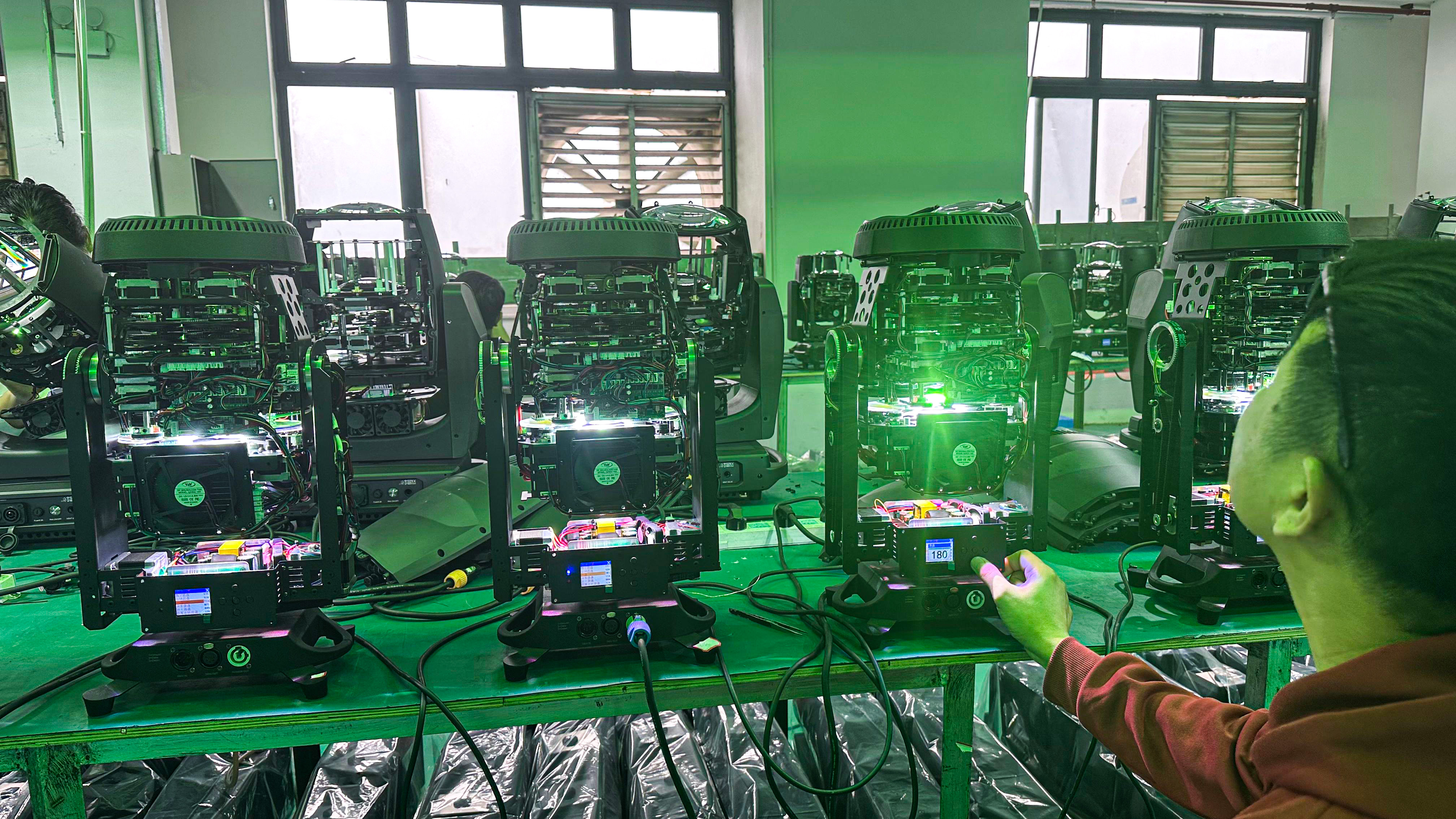
In-Depth Technical Breakdown of Essential Production Documentation
Obtaining factory testing records offers direct insight into a manufacturer's assembly standards and engineering rigor. High-performance fixtures—such as 150W white laser beam moving head lights—depend on meticulous electro-mechanical alignment and thermal control to prevent premature failure during demanding tours or permanent outdoor setups.
1. Ingress Protection (IP) and Thermal Aging Performance Verification
For fixtures destined for outdoor stages, architectural lighting, or fountain displays, IP testing sheets validate water and dust resistance under IP65 or IP66 testing standards. Continuous burn-in logs document operating temperature stability across ambient ranges from -25℃ to 45℃, verifying aluminum heatsink thermal performance under maximum load. Proven field records—such as 3,500 stage lighting units deployed in nightclub projects—illustrate how strict thermal burn-in practices minimize on-site failure rates.
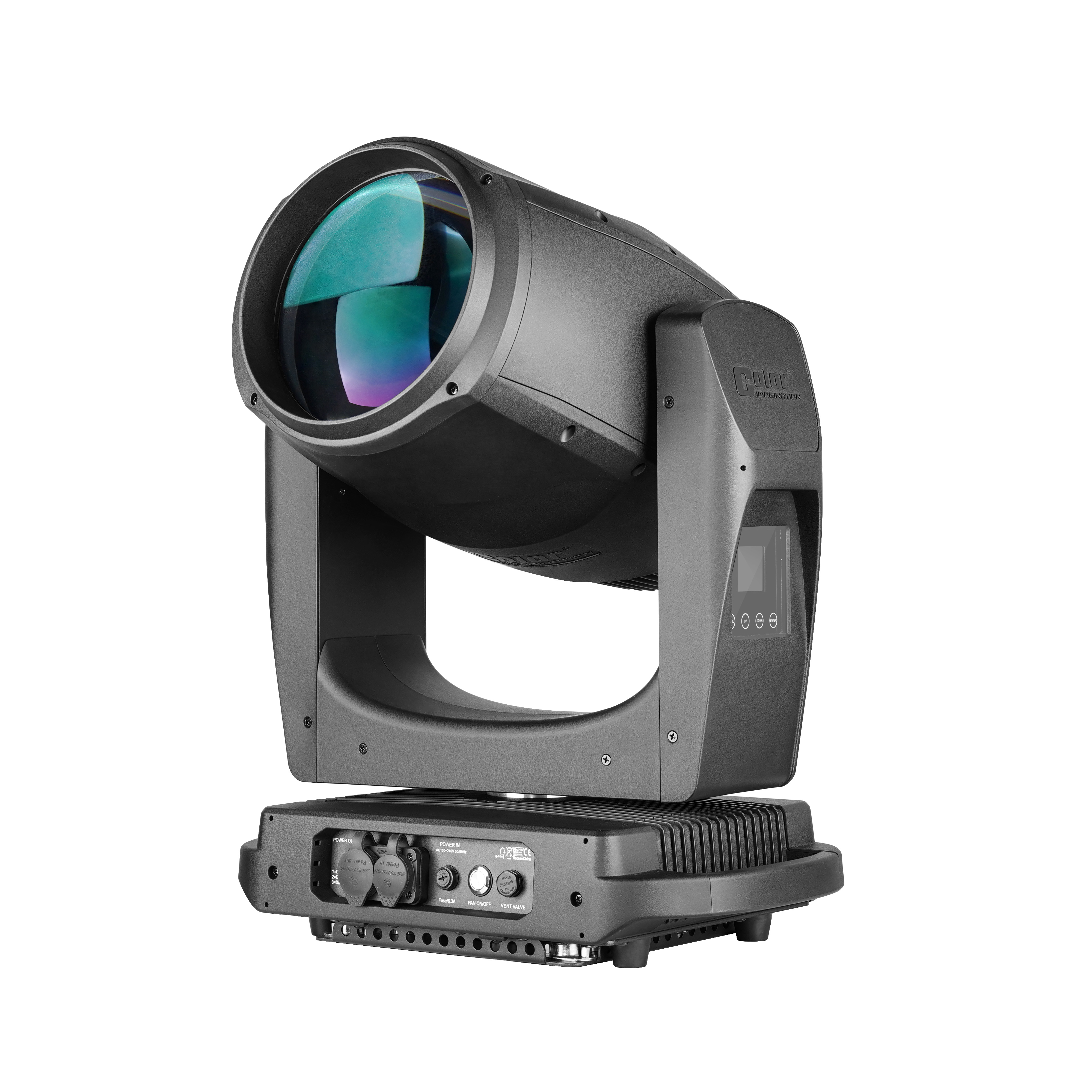
2. Electro-Mechanical System Calibration & Control Signals
Modern hybrid moving heads combine advanced mechanical modules, including 3-phase drive motors enabling continuous 360° Pan and Tilt motion, 6-facet linear and 8-facet circular rotating prisms, and dual gobo wheels. Factory logs must confirm scan position auto-repositioning accuracy, signal transmission integrity across DMX512, RDM, and Art-Net protocols, and flicker-free operation needed for broadcast environments.
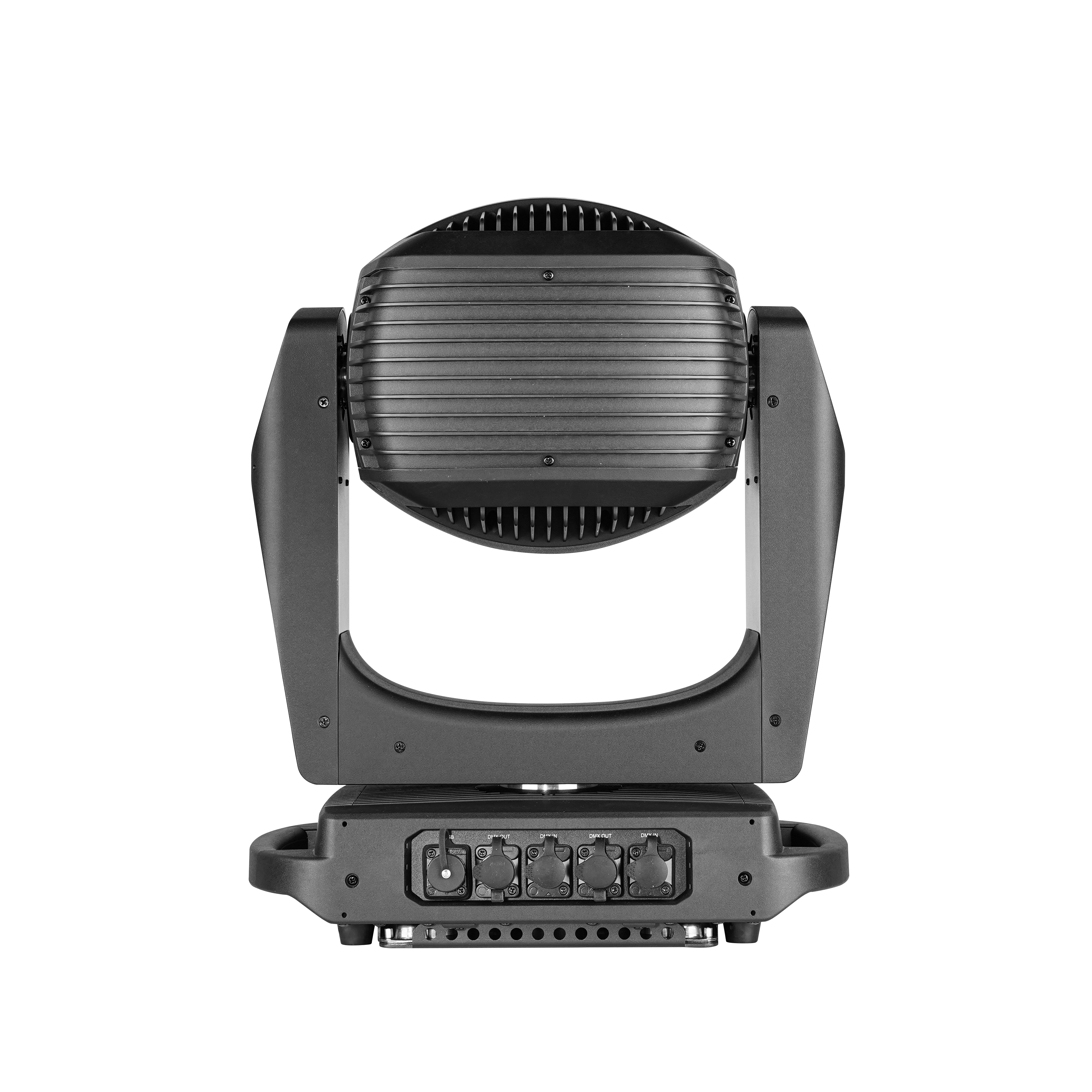
3. Component Traceability and IQC Documentation
Prior to assembly, factories perform strict incoming quality checks on optical lenses, carbon-fiber reinforced fireproof housing panels, and electrical assemblies. Requesting IQC sheets confirms that 180mm front objective lenses, dichroic color filters, glass gobos, and active power factor correction (PFC) power units adhere strictly to design specifications.
Comparison Matrix of Factory Testing Records
| Document Type | Measured Parameters & Standards | Compliance Benchmark | Impact on Practical Operation |
|---|---|---|---|
| Ingress Protection (IP) Test Report | Gasket compression, high-pressure water spray resistance, housing seal tightness | IP65 / IP66 standard | Prevents water ingress in demanding outdoor event and architectural installations. |
| Photometric & Optical Log | 1° sharp beam angle, 9000K correlated color temperature, CRI ≥70, gobo indexing precision | Zero optical distortion | Delivers uniform color rendering and sharp beam projection across stages. |
| Electrical Safety & EMC Sheet | Ground wire continuity, dielectric insulation withstand voltage, electromagnetic emission | CE LVD (2014/35/EU), EMC (2014/30/EU), RoHS compliance | Prevents electrical hazards and eliminates control signal interference during shows. |
| Full-Load Burn-In Test Log | Thermal sensor monitoring, dynamic fan speed adjustability, 203W power consumption stability | 100% pass rate (24–48 hours continuous) | Filters out early hardware defects and safeguards the 12,000-hour light source longevity. |
Frequently Asked Questions
Q1: Why should buyers demand pre-shipment burn-in test records?
A1: Extended burn-in documentation ensures that laser modules, driver PCBs, and optical optics operate reliably under high thermal loads, helping catch potential component flaws before international shipping.
Q2: What international compliance standards should validate factory logs?
A2: Quality records ought to correspond with recognized international standards, including CE directives (LVD 2014/35/EU, EMC 2014/30/EU) and ISO quality management guidelines for stage luminaire manufacturing.
Q3: How are waterproof moving head IP ratings verified in production?
A3: Production facilities record IP compliance by conducting high-pressure water jet tests, thermal expansion seal tests, and physical structural gasket checks across all enclosure joints.
Summary & Ordering Recommendations
Demanding comprehensive quality documentation—ranging from raw material IQC metrics to IP weatherproofing and continuous burn-in reports—is essential for verifying that moving head fixtures meet high industry benchmarks. Purchasing agreements should explicitly require these test records across mechanical, optical, and electrical criteria. Reputable suppliers support sample/trial orders starting at a minimum order quantity (MOQ) of 1 unit, with normal production lead times of 20 to 30 days following deposit confirmation. Logistics options include sea freight (FCL/LCL), air shipping, and express couriers (DHL, FedEx, UPS) under EXW, FOB, CIF, or DDP terms. Standard payment conditions involve T/T (30% deposit, 70% prior to dispatch) or irrevocable L/C at 60–90 days. For technical inquiries or custom lighting solutions, contact jack@color-imagination.com.
About Us
Guangzhou Color Imagination LED Lighting Limited is a dedicated entertainment and architectural lighting manufacturer established in 2010. Spanning a 6,000-square-meter facility with 130 skilled staff, the company combines R&D, manufacturing, sales, and technical support for moving heads, studio lights, and outdoor fixtures. Certified under multiple CE and ISO management standards, Guangzhou Color Imagination delivers high-end OEM/ODM services and turnkey lighting projects worldwide.

REPORT