







-
 Agriculture
-
 Health-Care
-
 Environment
-
 Construction-Real-Estate
-
 Tools-Hardware
-
 Home-Garden
-
 Furniture
-
 Luggage-Bags-Cases
-
 Medical-devices-Supplies
-
 Gifts-Crafts
-
 Sports-Entertainment
-
 Food-Beverage
-
 Vehicles-Transportation
-
 Power-Transmission
-
 Material-Handling
-
 Renewable-Energy
-
 Safety
-
 Testing-Instrument-Equipment
-
 Construction-Building-Machinery
-
 Pet-Supplies
-
 Personal-Care-Household-Cleaning
-
 Vehicle-Accessories-Electronics-Tools
-
 School-Office-Supplies
-
 Packaging-Printing
-
 Mother-Kids-Toys
-
 Business-Services
-
 Commercial-Equipment-Machinery
-
 Apparel-Accessories
-
 Security
-
 Shoes-Accessories
-
 Vehicle-Parts-Accessories
-
 Jewelry-Eyewear-Watches-Accessories
-
 Lights-Lighting
-
 Fabric-Textile-Raw-Material
-
 Fabrication-Services
-
 Industrial-Machinery
-
 Consumer-Electronics
-
 Electrical-Equipment-Supplies
-
 Electronic-Components-Accessories-Telecommunications
-
 Home-Appliances
-
 Beauty
-
 Chemicals
-
 Rubber-Plastics
-
 Metals-Alloys


























































































































































































































































































































































































































































































































































































- Masonry Materials
- Curtain Walls & Accessories
- Earthwork Products
- Fireproofing Materials
- Heat Insulation Materials
- Plastic Building Materials
- Building Boards
- Soundproofing Materials
- Timber
- Waterproofing Materials
- Balustrades & Handrails
- Bathroom & Kitchen
- Flooring & Accessories
- Tiles & Accessories
- Door, Window & Accessories
- Fireplaces & Stoves
- Floor Heating Systems & Parts
- Stairs & Stair Parts
- Ceilings
- Elevators & Escalators
- Stone
- Countertops, Vanity Tops & Table Tops
- Mosaics
- Metal Building Materials
- Multifunctional Materials
- Ladders & Scaffoldings
- Mouldings
- Corner Guards
- Decorative Films
- Formwork
- Building & Industrial Glass
- Other Construction & Real Estate
- Wallpapers/Wall panels
- HVAC System & Parts
- Outdoor Facilities
- Prefabricated Buildings
- Festive & Party Supplies
- Bathroom Products
- Household Sundries
- Rain Gear
- Garden Supplies
- Household Cleaning Tools & Accessories
- Lighters & Smoking Accessories
- Home Storage & Organization
- Household Scales
- Smart Home Improvement
- Home Textiles
- Kitchenware
- Drinkware & Accessories
- Dinnerware, Coffee & Wine
- Home Decor
- Golf
- Fitness & Body Building
- Amusement Park Facilities
- Billiards, Board Game,Coin Operated Games
- Musical Instruments
- Outdoor Affordable Luxury Sports
- Camping & Hiking
- Fishing
- Sports Safety&Rehabilitation
- Ball Sports Equipments
- Water Sports
- Winter Sports
- Luxury Travel Equipments
- Sports Shoes, Bags & Accessories
- Cycling
- Other Sports & Entertainment Products
- Artificial Grass&Sports Flooring&Sports Court Equipment
- Scooters
- Food Ingredients
- Honey & Honey Products
- Snacks
- Nuts & Kernels
- Seafood
- Plant & Animal Oil
- Beverages
- Fruit & Vegetable Products
- Frog & Escargot
- Bean Products
- Egg Products
- Dairy Products
- Seasonings & Condiments
- Canned Food
- Instant Food
- Baked Goods
- Other Food & Beverage
- Meat & Poultry
- Confectionery
- Grain Products
- Feminie Care
- Hair Care & Styling
- Body Care
- Hands & Feet Care
- Hygiene Products
- Men's Grooming
- Laundry Cleaning Supplies
- Travel Size & Gift Sets
- Room Deodorizers
- Other Personal Care Products
- Pest Control Products
- Special Household Cleaning
- Floor Cleaning
- Kitchen & Bathroom Cleaning
- Oral Care
- Bath Supplies
- Yellow Pages
- Correction Supplies
- Office Binding Supplies
- Office Cutting Supplies
- Board Erasers
- Office Adhesives & Tapes
- Education Supplies
- Pencil Cases & Bags
- Notebooks & Writing Pads
- File Folder Accessories
- Calendars
- Writing Accessories
- Commercial Office Supplies
- Pencil Sharpeners
- Pens
- Letter Pad/Paper
- Paper Envelopes
- Desk Organizers
- Pencils
- Markers & Highlighters
- Filing Products
- Art Supplies
- Easels
- Badge Holder & Accessories
- Office Paper
- Printer Supplies
- Book Covers
- Other Office & School Supplies
- Stationery Set
- Boards
- Clipboards
- Stamps
- Drafting Supplies
- Stencils
- Electronic Dictionary
- Books
- Map
- Magazines
- Calculators
- Baby & Toddler Toys
- Educational Toys
- Classic Toys
- Dress Up & Pretend Play
- Toy Vehicle
- Stuffed Animals & Plush Toys
- Outdoor Toys & Structures
- Balloons & Accessories
- Baby Food
- Children's Clothing
- Baby Supplies & Products
- Maternity Clothes
- Kids Shoes
- Baby Care
- Novelty & Gag Toys
- Dolls & Accessories
- Puzzle & Games
- Blocks & Model Building Toys
- Toddler Clothing
- Baby Clothing
- Kids' Luggage & Bags
- Arts, Crafts & DIY Toys
- Action & Toy Figures
- Baby Appliances
- Hobbies & Models
- Remote Control Toys
- Promotional Toys
- Pregnancy & Maternity
- Hygiene Products
- Kid's Textile&Bedding
- Novelty & Special Use
- Toy Weapons
- Baby Gifts
- Baby Storage & Organization
- Auto Drive Systems
- ATV/UTV Parts & Accessories
- Marine Parts & Accessories
- Other Auto Parts
- Trailer Parts & Accessories
- Auto Transmission Systems
- Train Parts & Accessories
- Universal Parts
- Railway Parts & Accessories
- Auto Brake Systems
- Aviation Parts & Accessories
- Truck Parts & Accessories
- Auto Suspension Systems
- Auto Lighting Systems
- New Energy Vehicle Parts & Accessories
- Auto Steering Systems
- Wheels, Tires & Accessories
- Bus Parts & Accessories
- Auto Performance Parts
- Cooling System
- Go-Kart & Kart Racer Parts & Accessories
- Air Conditioning Systems
- Heavy Duty Vehicle Parts & Accessories
- Auto Electrical Systems
- Auto Body Systems
- Auto Engine Systems
- Container Parts & Accessories
- Motorcycle Parts & Accessories
- Refrigeration & Heat Exchange Equipment
- Machine Tool Equipment
- Food & Beverage Machinery
- Agricultural Machinery & Equipment
- Apparel & Textile Machinery
- Chemical Machinery
- Packaging Machines
- Paper Production Machinery
- Plastic & Rubber Processing Machinery
- Industrial Robots
- Electronic Products Machinery
- Metal & Metallurgy Machinery
- Woodworking Machinery
- Home Product Manufacturing Machinery
- Machinery Accessories
- Environmental Machinery
- Machinery Service
- Electrical Equipment Manufacturing Machinery
- Industrial Compressors & Parts
- Tobacco & Cigarette Machinery
- Production Line
- Used Industrial Machinery
- Electronics Production Machinery
- Other Machinery & Industrial Equipment
- Camera, Photo & Accessories
- Portable Audio, Video & Accessories
- Television, Home Audio, Video & Accessories
- Video Games & Accessories
- Mobile Phone & Accessories
- Electronic Publications
- Earphone & Headphone & Accessories
- Speakers & Accessories
- Smart Electronics
- TV Receivers & Accessories
- Mobile Phone & Computer Repair Parts
- Chargers, Batteries & Power Supplies
- Used Electronics
- VR, AR, MR Hardware & Software
- Projectors & Presentation Equipments
- Other Consumer Electronics
- Cables & Commonly Used Accessories
- Computer Hardware & Software
- Displays, Signage and Optoelectronics
- Discrete Semiconductors
- Wireless & IoT Module and Products
- Telecommunications
- Connectors, Terminals & Accessories
- Development Boards, Electronic Modules and Kits
- Circuit Protection
- Sensors
- Isolators
- Audio Components and Products
- Integrated Circuits
- Power Supplies
- Relays
- RF, Microwave and RFID
- Electronic Accessories & Supplies
- Passive Components
- PCB & PCBA
- Air Quality Appliances
- Home Appliance Parts
- Heating & Cooling Appliances
- Small Kitchen Appliances
- Laundry Appliances
- Water Heaters
- Water Treatment Appliances
- Refrigerators & Freezers
- Personal Care & Beauty Appliances
- Major Kitchen Appliances
- Cleaning Appliances
- Second-hand Appliances
- Smart Home Appliances
- Other Home Appliances
- Energy Chemicals
- Inorganic Chemicals
- Basic Organic Chemicals
- Agrochemicals
- Admixture & Additives
- Catalysts & Chemical Auxiliary Agents
- Pigments & Dyestuff
- Coating & Paint
- Daily Chemicals
- Polymer
- Organic Intermediate
- Adhesives & Sealants
- Chemical Waste
- Biological Chemical Products
- Surface Treatment Chemicals
- Painting & Coating
- Chemical Reagents
- Flavor & Fragrance
- Non-Explosive Demolition Agents
- Other Chemicals
- Custom Chemical Services

Evaluating Waste Reduction and Blade Cost Efficiency in Modern Double-End Saws
Advanced Double-end Saw machinery offers structural and automated design enhancements—such as automated width positioning, dynamic speed regulation, and dual-sawing configurations—that help limit processing errors and cut down on material scrap. However, because baseline data regarding exact blade lifespans and maintenance expenses varies by operating conditions, these efficiency advantages should be understood through technical capabilities rather than assumed percentage guarantees.
Key Technical Takeaways & System Highlights
- Dual Spindle Drive: Operates upper (4 kW) and lower (2.2 kW) electric spindles at rotational speeds between 6000 and 8000 rpm.
- Automated Sizing Control: Integrates touch-screen controls, ball screws, and servo motor width adjustments for accurate, repeatable dimensioning.
- Controlled Infeed & Handling: Utilizes positioning stops, variable-speed conveyor systems, and electric material hold-downs to secure stock during high-speed passes.
- Target Industries: Ideal for panelized furniture, customized cabinetry, wooden doors, and window frame manufacturing requiring uniform tolerances.
Dual-Sawing Architecture & Precision Mechanism
Modern double-end sizing relies on a top-and-bottom cutting strategy to process panel edges from dual directions. The upper sawing station is powered by a robust 4 kW spindle, whereas the lower station features a 2.2 kW spindle outfitted with an explosion-proof edge design. Frequency converters regulate motor speeds across both spindles within a range of 6000 to 8000 rpm, enabling operators to match rotational velocity to specific workpiece materials.
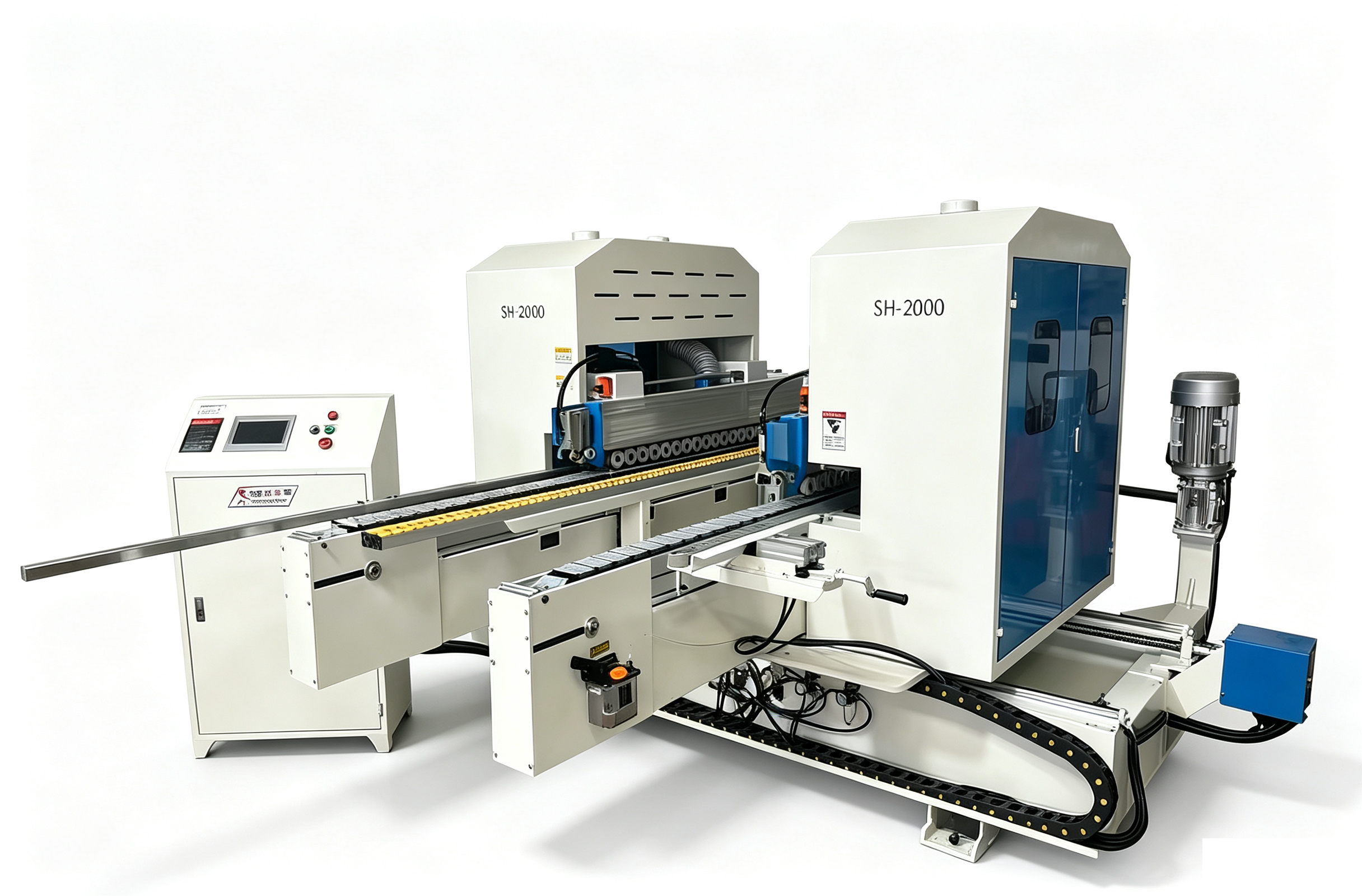
Instead of manual measurements, dimensional adjustments are handled electronically. A dedicated servo motor coupled with high-precision ball screws and a user-friendly touch interface governs width positioning. At the feeding zone, mechanical positioning devices combined with a 2.2 kW variable-speed conveyor drive guarantee steady material transfer, significantly mitigating alignment errors that cause scrap.
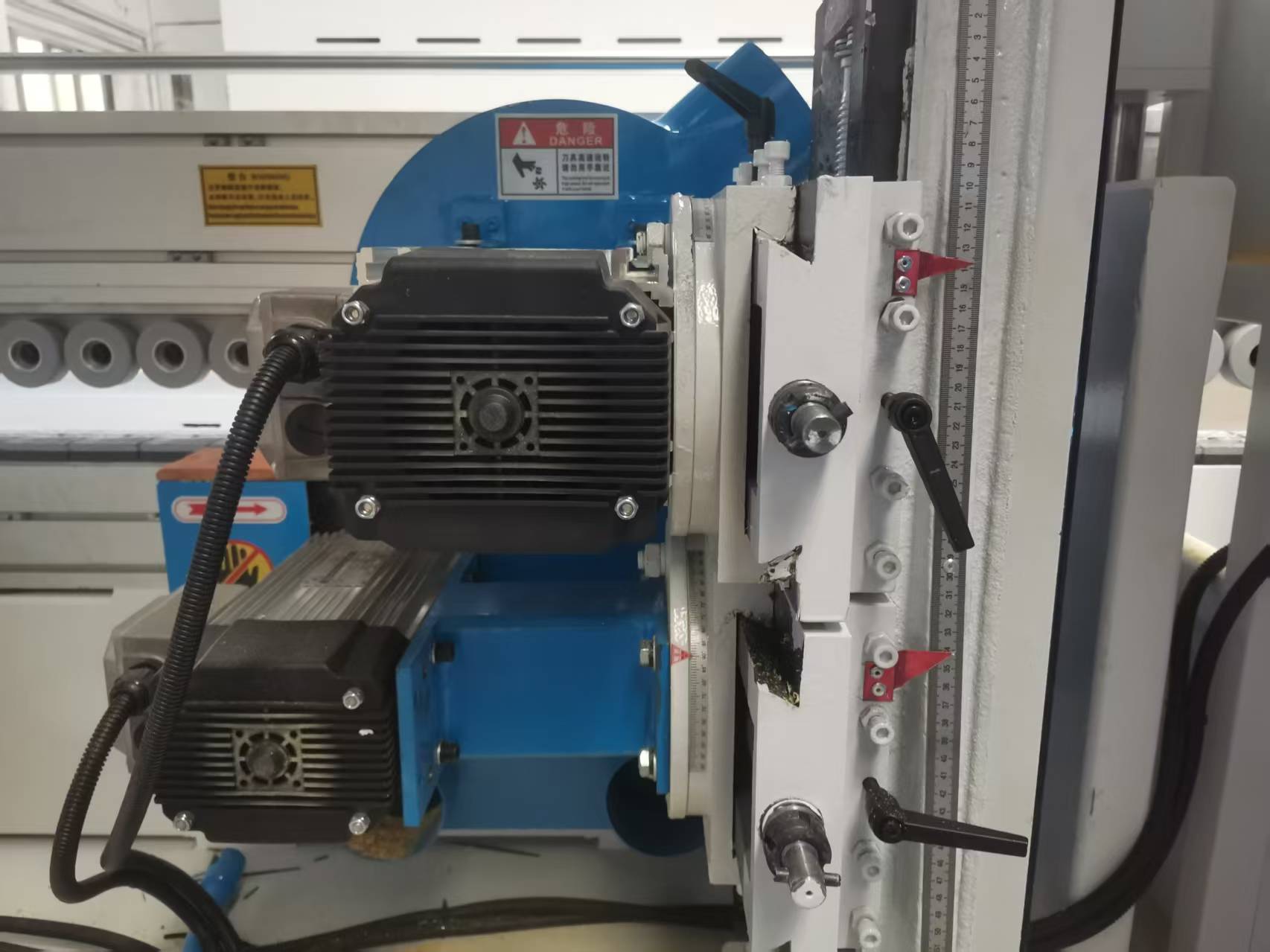
Workpiece Stability & Material Handling Equipment
To eliminate panel vibration during high-speed sizing, the machine incorporates dual 750 W electric lifting systems for vertical material pressing. Cutting trajectory adjustments are refined using twin 550 W servo motors operating on precision ball screw drives. Seven auxiliary support tables (four primary and three supplementary) extend material support along the processing path, enhancing cutting accuracy.
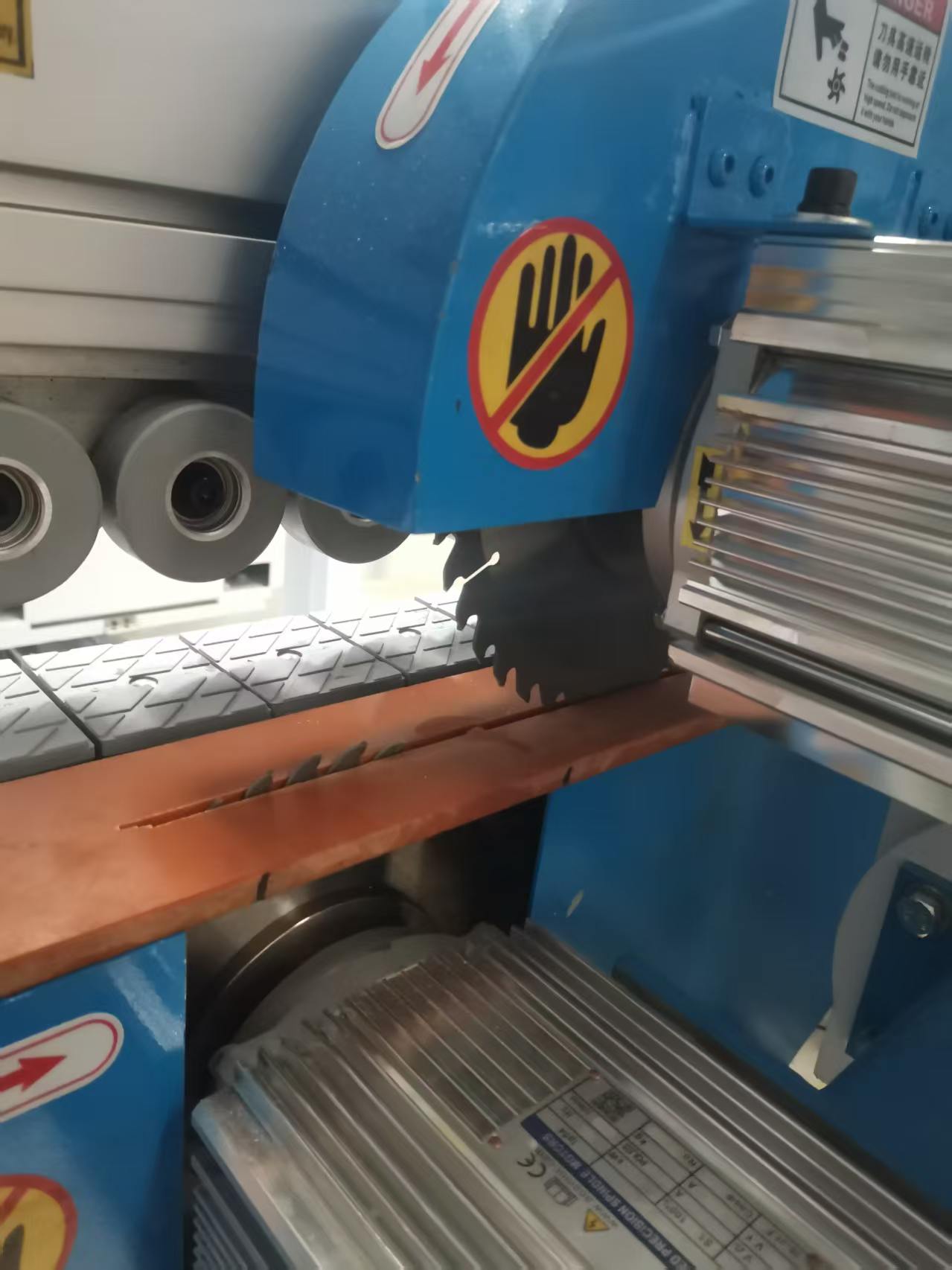
Technical Capabilities vs. Operating Cost Impact
| Operational Feature | Machine Specification | Impact on Waste & Maintenance Costs |
|---|---|---|
| Sawing Setup | Dual upper/lower spindles with frequency-controlled speeds | Improves edge cleanliness; ongoing blade life depends on substrate type |
| Width Control | Touch screen, servo motor, and ball screw system | Prevents dimensional deviation and minimizes miscut scrap |
| Infeed Guidance | Positioning guides, dual 750W electric press units, side tables | Prevents material slippage and misfeeds during rapid movement |
| Pre-Delivery Testing | Comprehensive mechanical calibration & extended load testing | Ensures operational readiness upon arrival; site metrics determine long-term blade expenditure |
Practical Applications & Field Reliability
Double-end saws are widely adopted in panel furniture lines, custom cabinetry workshops, and door/window manufacturing where consistent edge quality and tight tolerances are mandatory. Field deployments—such as a 19-machine wooden door installation in India and a 10-machine processing line in the UAE—demonstrate the unit's capacity for continuous industrial operation and seamless integration into automated production workflows.
Sun Hunt conducts exhaustive factory calibration and long-hour load testing prior to shipment. This rigorous testing checks drive gear clearances, axis alignment, and control software logic so that machinery can be rapidly commissioned on site without extensive technical recalibration.
Frequently Asked Questions
Does a modern Double-end Saw guarantee lower scrap rates?
While features like servo-driven width settings, ball screw positioning, and electric workpiece clamps significantly reduce human error and miscuts, precise waste reduction percentages depend on workshop management and substrate quality.
Can lower blade replacement costs be directly proven?
Hardware automation provides a baseline for smooth cutting, but overall blade longevity is determined by tooth geometry, material density, feed speed, and sharpening schedules rather than machine design alone.
What specific products are best suited for this equipment?
The machine is engineered for panel furniture, modular home furnishings, wooden doors, windows, and wood-aluminum composite frames requiring exact parallel cuts and high repeatability.
Summary & Manufacturer Contact
By bringing together automated servo adjustment, dynamic feeding speeds, and rigid clamping, modern Double-end Saws create ideal operational conditions to minimize cutting errors. Plant managers should evaluate actual tool consumption by testing their specific panel types. Standard lead time for custom configurations is 20 to 35 days, with a minimum order quantity of one unit. Technical inquiries can be directed to vincent@fsshmachine.cn.
Company Profile
Foshan Sun Hunt Woodworking Machinery Co.,Ltd. (Sun Hunt Machinery) was founded in 2014 and operates a 2,000 m² manufacturing plant with an annual output capacity of up to 600 medium-scale woodworking machines. Serving clients across North America, the Middle East, and Africa, their portfolio includes CNC routers, double-end saws, planers, boring machines, edge banders, and panel saws.

REPORT