







-
 Agriculture
-
 Health-Care
-
 Environment
-
 Construction-Real-Estate
-
 Tools-Hardware
-
 Home-Garden
-
 Furniture
-
 Luggage-Bags-Cases
-
 Medical-devices-Supplies
-
 Gifts-Crafts
-
 Sports-Entertainment
-
 Food-Beverage
-
 Vehicles-Transportation
-
 Power-Transmission
-
 Material-Handling
-
 Renewable-Energy
-
 Safety
-
 Testing-Instrument-Equipment
-
 Construction-Building-Machinery
-
 Pet-Supplies
-
 Personal-Care-Household-Cleaning
-
 Vehicle-Accessories-Electronics-Tools
-
 School-Office-Supplies
-
 Packaging-Printing
-
 Mother-Kids-Toys
-
 Business-Services
-
 Commercial-Equipment-Machinery
-
 Apparel-Accessories
-
 Security
-
 Shoes-Accessories
-
 Vehicle-Parts-Accessories
-
 Jewelry-Eyewear-Watches-Accessories
-
 Lights-Lighting
-
 Fabric-Textile-Raw-Material
-
 Fabrication-Services
-
 Industrial-Machinery
-
 Consumer-Electronics
-
 Electrical-Equipment-Supplies
-
 Electronic-Components-Accessories-Telecommunications
-
 Home-Appliances
-
 Beauty
-
 Chemicals
-
 Rubber-Plastics
-
 Metals-Alloys


























































































































































































































































































































































































































































































































































































- Masonry Materials
- Curtain Walls & Accessories
- Earthwork Products
- Fireproofing Materials
- Heat Insulation Materials
- Plastic Building Materials
- Building Boards
- Soundproofing Materials
- Timber
- Waterproofing Materials
- Balustrades & Handrails
- Bathroom & Kitchen
- Flooring & Accessories
- Tiles & Accessories
- Door, Window & Accessories
- Fireplaces & Stoves
- Floor Heating Systems & Parts
- Stairs & Stair Parts
- Ceilings
- Elevators & Escalators
- Stone
- Countertops, Vanity Tops & Table Tops
- Mosaics
- Metal Building Materials
- Multifunctional Materials
- Ladders & Scaffoldings
- Mouldings
- Corner Guards
- Decorative Films
- Formwork
- Building & Industrial Glass
- Other Construction & Real Estate
- Wallpapers/Wall panels
- HVAC System & Parts
- Outdoor Facilities
- Prefabricated Buildings
- Festive & Party Supplies
- Bathroom Products
- Household Sundries
- Rain Gear
- Garden Supplies
- Household Cleaning Tools & Accessories
- Lighters & Smoking Accessories
- Home Storage & Organization
- Household Scales
- Smart Home Improvement
- Home Textiles
- Kitchenware
- Drinkware & Accessories
- Dinnerware, Coffee & Wine
- Home Decor
- Golf
- Fitness & Body Building
- Amusement Park Facilities
- Billiards, Board Game,Coin Operated Games
- Musical Instruments
- Outdoor Affordable Luxury Sports
- Camping & Hiking
- Fishing
- Sports Safety&Rehabilitation
- Ball Sports Equipments
- Water Sports
- Winter Sports
- Luxury Travel Equipments
- Sports Shoes, Bags & Accessories
- Cycling
- Other Sports & Entertainment Products
- Artificial Grass&Sports Flooring&Sports Court Equipment
- Scooters
- Food Ingredients
- Honey & Honey Products
- Snacks
- Nuts & Kernels
- Seafood
- Plant & Animal Oil
- Beverages
- Fruit & Vegetable Products
- Frog & Escargot
- Bean Products
- Egg Products
- Dairy Products
- Seasonings & Condiments
- Canned Food
- Instant Food
- Baked Goods
- Other Food & Beverage
- Meat & Poultry
- Confectionery
- Grain Products
- Feminie Care
- Hair Care & Styling
- Body Care
- Hands & Feet Care
- Hygiene Products
- Men's Grooming
- Laundry Cleaning Supplies
- Travel Size & Gift Sets
- Room Deodorizers
- Other Personal Care Products
- Pest Control Products
- Special Household Cleaning
- Floor Cleaning
- Kitchen & Bathroom Cleaning
- Oral Care
- Bath Supplies
- Yellow Pages
- Correction Supplies
- Office Binding Supplies
- Office Cutting Supplies
- Board Erasers
- Office Adhesives & Tapes
- Education Supplies
- Pencil Cases & Bags
- Notebooks & Writing Pads
- File Folder Accessories
- Calendars
- Writing Accessories
- Commercial Office Supplies
- Pencil Sharpeners
- Pens
- Letter Pad/Paper
- Paper Envelopes
- Desk Organizers
- Pencils
- Markers & Highlighters
- Filing Products
- Art Supplies
- Easels
- Badge Holder & Accessories
- Office Paper
- Printer Supplies
- Book Covers
- Other Office & School Supplies
- Stationery Set
- Boards
- Clipboards
- Stamps
- Drafting Supplies
- Stencils
- Electronic Dictionary
- Books
- Map
- Magazines
- Calculators
- Baby & Toddler Toys
- Educational Toys
- Classic Toys
- Dress Up & Pretend Play
- Toy Vehicle
- Stuffed Animals & Plush Toys
- Outdoor Toys & Structures
- Balloons & Accessories
- Baby Food
- Children's Clothing
- Baby Supplies & Products
- Maternity Clothes
- Kids Shoes
- Baby Care
- Novelty & Gag Toys
- Dolls & Accessories
- Puzzle & Games
- Blocks & Model Building Toys
- Toddler Clothing
- Baby Clothing
- Kids' Luggage & Bags
- Arts, Crafts & DIY Toys
- Action & Toy Figures
- Baby Appliances
- Hobbies & Models
- Remote Control Toys
- Promotional Toys
- Pregnancy & Maternity
- Hygiene Products
- Kid's Textile&Bedding
- Novelty & Special Use
- Toy Weapons
- Baby Gifts
- Baby Storage & Organization
- Auto Drive Systems
- ATV/UTV Parts & Accessories
- Marine Parts & Accessories
- Other Auto Parts
- Trailer Parts & Accessories
- Auto Transmission Systems
- Train Parts & Accessories
- Universal Parts
- Railway Parts & Accessories
- Auto Brake Systems
- Aviation Parts & Accessories
- Truck Parts & Accessories
- Auto Suspension Systems
- Auto Lighting Systems
- New Energy Vehicle Parts & Accessories
- Auto Steering Systems
- Wheels, Tires & Accessories
- Bus Parts & Accessories
- Auto Performance Parts
- Cooling System
- Go-Kart & Kart Racer Parts & Accessories
- Air Conditioning Systems
- Heavy Duty Vehicle Parts & Accessories
- Auto Electrical Systems
- Auto Body Systems
- Auto Engine Systems
- Container Parts & Accessories
- Motorcycle Parts & Accessories
- Refrigeration & Heat Exchange Equipment
- Machine Tool Equipment
- Food & Beverage Machinery
- Agricultural Machinery & Equipment
- Apparel & Textile Machinery
- Chemical Machinery
- Packaging Machines
- Paper Production Machinery
- Plastic & Rubber Processing Machinery
- Industrial Robots
- Electronic Products Machinery
- Metal & Metallurgy Machinery
- Woodworking Machinery
- Home Product Manufacturing Machinery
- Machinery Accessories
- Environmental Machinery
- Machinery Service
- Electrical Equipment Manufacturing Machinery
- Industrial Compressors & Parts
- Tobacco & Cigarette Machinery
- Production Line
- Used Industrial Machinery
- Electronics Production Machinery
- Other Machinery & Industrial Equipment
- Camera, Photo & Accessories
- Portable Audio, Video & Accessories
- Television, Home Audio, Video & Accessories
- Video Games & Accessories
- Mobile Phone & Accessories
- Electronic Publications
- Earphone & Headphone & Accessories
- Speakers & Accessories
- Smart Electronics
- TV Receivers & Accessories
- Mobile Phone & Computer Repair Parts
- Chargers, Batteries & Power Supplies
- Used Electronics
- VR, AR, MR Hardware & Software
- Projectors & Presentation Equipments
- Other Consumer Electronics
- Cables & Commonly Used Accessories
- Computer Hardware & Software
- Displays, Signage and Optoelectronics
- Discrete Semiconductors
- Wireless & IoT Module and Products
- Telecommunications
- Connectors, Terminals & Accessories
- Development Boards, Electronic Modules and Kits
- Circuit Protection
- Sensors
- Isolators
- Audio Components and Products
- Integrated Circuits
- Power Supplies
- Relays
- RF, Microwave and RFID
- Electronic Accessories & Supplies
- Passive Components
- PCB & PCBA
- Air Quality Appliances
- Home Appliance Parts
- Heating & Cooling Appliances
- Small Kitchen Appliances
- Laundry Appliances
- Water Heaters
- Water Treatment Appliances
- Refrigerators & Freezers
- Personal Care & Beauty Appliances
- Major Kitchen Appliances
- Cleaning Appliances
- Second-hand Appliances
- Smart Home Appliances
- Other Home Appliances
- Energy Chemicals
- Inorganic Chemicals
- Basic Organic Chemicals
- Agrochemicals
- Admixture & Additives
- Catalysts & Chemical Auxiliary Agents
- Pigments & Dyestuff
- Coating & Paint
- Daily Chemicals
- Polymer
- Organic Intermediate
- Adhesives & Sealants
- Chemical Waste
- Biological Chemical Products
- Surface Treatment Chemicals
- Painting & Coating
- Chemical Reagents
- Flavor & Fragrance
- Non-Explosive Demolition Agents
- Other Chemicals
- Custom Chemical Services

How Adaptive Lighting Is Shaping the LED Headlight Aftermarket
The growth of adaptive lighting is changing how American and European aftermarket buyers evaluate LED headlight suppliers. Beyond illumination performance, buyers increasingly look for accurate vehicle fitment, traceable compliance documents, visible quality inspections, dependable inventory, and coordinated shipping. Suppliers that combine these capabilities can help move headlight programs from initial sourcing through repeat replenishment with fewer delays.
Market Drivers and Sourcing Priorities
- LED headlight demand is expected to favor suppliers able to support precise fitment and OEM/ODM development for American and German vehicle ranges.
- CE certification for car lamps and EPR coverage for car-lamp products provide useful compliance references for European aftermarket buyers.
- Ready stock, stated loading capabilities of one to two weeks, and monthly exports above 50 standard containers can assist replenishment planning.
- International wholesalers, regional distributors, collision repair groups, and cross-border automotive e-commerce businesses represent relevant customer applications for an integrated body-parts supply model.
How Adaptive Lighting Trends Influence Product Demand
Adaptive lighting trends connect LED headlight purchasing decisions to three main supply requirements: vehicle compatibility, regulatory documentation, and delivery responsiveness. The supplier identifies headlights as one of its principal product categories and reports 18 years of OEM/ODM experience, including precise fitment work for American and German vehicle series. However, buyers should request separate confirmation of headlight-specific engineering capabilities during the product evaluation process.
Fitment and Development Support
As vehicle lighting systems become more sophisticated, a headlight must match the intended vehicle platform and installation requirements. OEM/ODM support and fitment-oriented production experience can help buyers develop or adapt products for specific aftermarket programs. The available information confirms general fitment and customization capabilities, but it does not provide detailed specifications for adaptive beam functions, LED modules, electronic controls, or model-by-model compatibility.
Compliance and Documentation
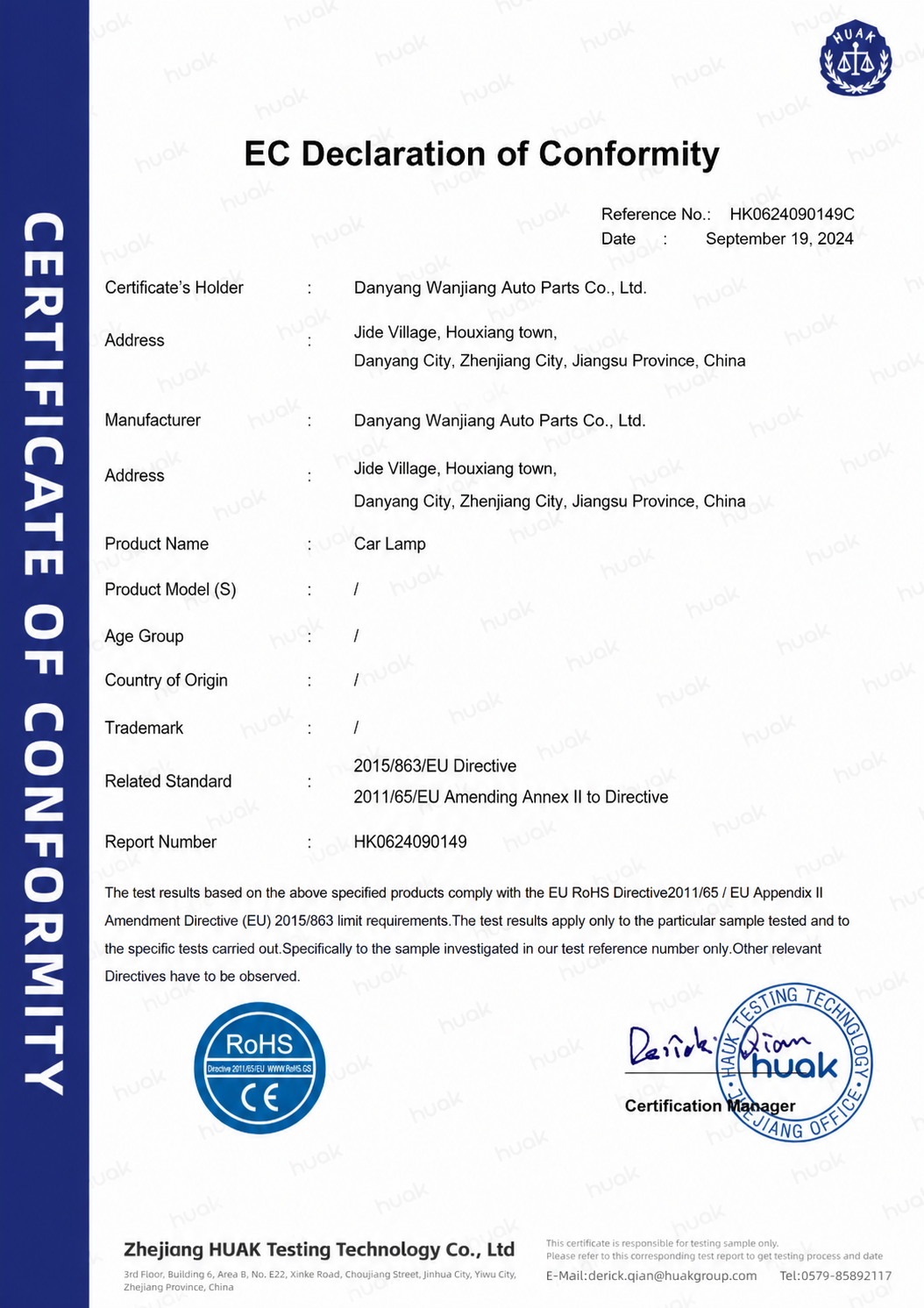
For European-oriented sourcing, the available records include CE certificate HK0624090149C for car lamp products and EPR certificate DE1123252940071 covering car bumpers, car lamps, hoods, fenders, and grilles. These documents offer compliance references for procurement reviews. They should still be checked against the exact headlight model, destination market, and applicable product requirements before commercial release.
Inventory, Inspection, and Logistics
Supply continuity is another factor supporting demand for dependable LED headlight programs. The business information states that standard stock items may be loaded and dispatched within one week, while the shipping description gives a lead time of up to two weeks. The difference should be clarified for each order. The stated services also include OEM/ODM customization, FCL and LCL customs clearance, shipping-agent assistance, and pre-delivery inspection photographs or videos. Customized orders will depend on mold requirements, production complexity, and order quantity.
The supplier describes quality controls covering incoming material checks, production-stage monitoring, and 100% final inspection. These measures can improve purchasing visibility, although the specific inspection checklist for LED headlights should be confirmed. Buyers should also verify beam performance, housing quality, sealing, connector configuration, electronic compatibility, packaging, and vehicle-specific installation before approving a program.
Evidence for LED Headlight Sourcing
| Purchasing Consideration | Available Information | Relevance to Buyers |
|---|---|---|
| Vehicle fitment and customization | The company reports 18 years of OEM/ODM experience and precise fitment support for American and German vehicle series. | Creates a basis for development discussions, but exact LED headlight compatibility requires product-level validation. |
| Regulatory references | CE certificate HK0624090149C covers car lamp products, while EPR certificate DE1123252940071 includes car lamps and other body-part categories. | Provides documentation references for European aftermarket sourcing and compliance review. |
| Inspection transparency | Stated controls include raw-material inspection, process monitoring, final inspection, and pre-delivery images or videos. | Helps buyers assess production visibility; the headlight-specific inspection scope must be agreed in advance. |
| Product inspection examples | The supplied side-mirror information mentions visual checks, CMM dimensional measurement, and paint and coating tests. | Demonstrates a documented inspection approach, but these tests cannot automatically be applied to LED headlights. |
| Order size and delivery | The business model lists an MOQ of 1-5 pieces; the side-mirror product lists an MOQ of 5 and seven-day delivery. Sea, air, rail, and express options are available. | May support sample orders and replenishment planning, subject to headlight inventory, specifications, and customization requirements. |
Common Buyer Questions
Does the available information prove compatibility with adaptive LED systems?
No. The records confirm car-lamp certification and general fitment-related experience, but they do not document adaptive-lighting functions, LED module details, beam-control performance, or compatibility with particular vehicle models.
Which supplier capabilities are most relevant to current LED headlight demand?
The most relevant capabilities are documented car-lamp compliance, OEM/ODM development, fitment-focused production experience, inspection visibility, stock availability, and international freight coordination. Together, these features can reduce sourcing risk for aftermarket distributors and repair networks.
Are small trial orders and quick delivery possible?
The business model indicates an MOQ of 1-5 pieces, while the supplied side-mirror example specifies an MOQ of 5 and seven-day delivery. Standard stock is described as ready for loading within one week in one section and within two weeks in another. Buyers should confirm current LED headlight stock, order quantity, inspection requirements, and customization status before placing an order.
Conclusion and Procurement Guidance
Adaptive lighting is increasing attention on LED headlight suppliers that can combine accurate fitment support, compliance records, transparent quality control, and reliable replenishment. The stated business model supports stock sales, OEM/ODM projects, and shipping-agent services. CE certificate HK0624090149C for car lamps and EPR certificate DE1123252940071 provide useful documentation references, while adaptive functions and vehicle-specific technical performance remain items for direct verification. For technical consultation or sourcing support, contact sales01@cnkebel.com.
About the Supplier
Danyang Wanjiang Auto Parts Co., Ltd. operates from Danyang, Jiangsu Province, and exports automotive body parts to international markets. Its listed products include car bumpers, grilles, headlights, engine hoods, and fenders. The company reports 18 years of experience in OEM/ODM bumper assembly and fitment development for American and German vehicle series. Its primary markets are America and Europe, with listed credentials including CE certificate HK0624090149C for car lamps and EPR certificate DE1123252940071 for several body-part categories. Its cooperation profile cites service for international wholesalers, regional aftermarket distributors, professional collision repair chains, and cross-border automotive e-commerce brands.

REPORT