







-
 Agriculture
-
 Health-Care
-
 Environment
-
 Construction-Real-Estate
-
 Tools-Hardware
-
 Home-Garden
-
 Furniture
-
 Luggage-Bags-Cases
-
 Medical-devices-Supplies
-
 Gifts-Crafts
-
 Sports-Entertainment
-
 Food-Beverage
-
 Vehicles-Transportation
-
 Power-Transmission
-
 Material-Handling
-
 Renewable-Energy
-
 Safety
-
 Testing-Instrument-Equipment
-
 Construction-Building-Machinery
-
 Pet-Supplies
-
 Personal-Care-Household-Cleaning
-
 Vehicle-Accessories-Electronics-Tools
-
 School-Office-Supplies
-
 Packaging-Printing
-
 Mother-Kids-Toys
-
 Business-Services
-
 Commercial-Equipment-Machinery
-
 Apparel-Accessories
-
 Security
-
 Shoes-Accessories
-
 Vehicle-Parts-Accessories
-
 Jewelry-Eyewear-Watches-Accessories
-
 Lights-Lighting
-
 Fabric-Textile-Raw-Material
-
 Fabrication-Services
-
 Industrial-Machinery
-
 Consumer-Electronics
-
 Electrical-Equipment-Supplies
-
 Electronic-Components-Accessories-Telecommunications
-
 Home-Appliances
-
 Beauty
-
 Chemicals
-
 Rubber-Plastics
-
 Metals-Alloys


























































































































































































































































































































































































































































































































































































- Masonry Materials
- Curtain Walls & Accessories
- Earthwork Products
- Fireproofing Materials
- Heat Insulation Materials
- Plastic Building Materials
- Building Boards
- Soundproofing Materials
- Timber
- Waterproofing Materials
- Balustrades & Handrails
- Bathroom & Kitchen
- Flooring & Accessories
- Tiles & Accessories
- Door, Window & Accessories
- Fireplaces & Stoves
- Floor Heating Systems & Parts
- Stairs & Stair Parts
- Ceilings
- Elevators & Escalators
- Stone
- Countertops, Vanity Tops & Table Tops
- Mosaics
- Metal Building Materials
- Multifunctional Materials
- Ladders & Scaffoldings
- Mouldings
- Corner Guards
- Decorative Films
- Formwork
- Building & Industrial Glass
- Other Construction & Real Estate
- Wallpapers/Wall panels
- HVAC System & Parts
- Outdoor Facilities
- Prefabricated Buildings
- Festive & Party Supplies
- Bathroom Products
- Household Sundries
- Rain Gear
- Garden Supplies
- Household Cleaning Tools & Accessories
- Lighters & Smoking Accessories
- Home Storage & Organization
- Household Scales
- Smart Home Improvement
- Home Textiles
- Kitchenware
- Drinkware & Accessories
- Dinnerware, Coffee & Wine
- Home Decor
- Golf
- Fitness & Body Building
- Amusement Park Facilities
- Billiards, Board Game,Coin Operated Games
- Musical Instruments
- Outdoor Affordable Luxury Sports
- Camping & Hiking
- Fishing
- Sports Safety&Rehabilitation
- Ball Sports Equipments
- Water Sports
- Winter Sports
- Luxury Travel Equipments
- Sports Shoes, Bags & Accessories
- Cycling
- Other Sports & Entertainment Products
- Artificial Grass&Sports Flooring&Sports Court Equipment
- Scooters
- Food Ingredients
- Honey & Honey Products
- Snacks
- Nuts & Kernels
- Seafood
- Plant & Animal Oil
- Beverages
- Fruit & Vegetable Products
- Frog & Escargot
- Bean Products
- Egg Products
- Dairy Products
- Seasonings & Condiments
- Canned Food
- Instant Food
- Baked Goods
- Other Food & Beverage
- Meat & Poultry
- Confectionery
- Grain Products
- Feminie Care
- Hair Care & Styling
- Body Care
- Hands & Feet Care
- Hygiene Products
- Men's Grooming
- Laundry Cleaning Supplies
- Travel Size & Gift Sets
- Room Deodorizers
- Other Personal Care Products
- Pest Control Products
- Special Household Cleaning
- Floor Cleaning
- Kitchen & Bathroom Cleaning
- Oral Care
- Bath Supplies
- Yellow Pages
- Correction Supplies
- Office Binding Supplies
- Office Cutting Supplies
- Board Erasers
- Office Adhesives & Tapes
- Education Supplies
- Pencil Cases & Bags
- Notebooks & Writing Pads
- File Folder Accessories
- Calendars
- Writing Accessories
- Commercial Office Supplies
- Pencil Sharpeners
- Pens
- Letter Pad/Paper
- Paper Envelopes
- Desk Organizers
- Pencils
- Markers & Highlighters
- Filing Products
- Art Supplies
- Easels
- Badge Holder & Accessories
- Office Paper
- Printer Supplies
- Book Covers
- Other Office & School Supplies
- Stationery Set
- Boards
- Clipboards
- Stamps
- Drafting Supplies
- Stencils
- Electronic Dictionary
- Books
- Map
- Magazines
- Calculators
- Baby & Toddler Toys
- Educational Toys
- Classic Toys
- Dress Up & Pretend Play
- Toy Vehicle
- Stuffed Animals & Plush Toys
- Outdoor Toys & Structures
- Balloons & Accessories
- Baby Food
- Children's Clothing
- Baby Supplies & Products
- Maternity Clothes
- Kids Shoes
- Baby Care
- Novelty & Gag Toys
- Dolls & Accessories
- Puzzle & Games
- Blocks & Model Building Toys
- Toddler Clothing
- Baby Clothing
- Kids' Luggage & Bags
- Arts, Crafts & DIY Toys
- Action & Toy Figures
- Baby Appliances
- Hobbies & Models
- Remote Control Toys
- Promotional Toys
- Pregnancy & Maternity
- Hygiene Products
- Kid's Textile&Bedding
- Novelty & Special Use
- Toy Weapons
- Baby Gifts
- Baby Storage & Organization
- Auto Drive Systems
- ATV/UTV Parts & Accessories
- Marine Parts & Accessories
- Other Auto Parts
- Trailer Parts & Accessories
- Auto Transmission Systems
- Train Parts & Accessories
- Universal Parts
- Railway Parts & Accessories
- Auto Brake Systems
- Aviation Parts & Accessories
- Truck Parts & Accessories
- Auto Suspension Systems
- Auto Lighting Systems
- New Energy Vehicle Parts & Accessories
- Auto Steering Systems
- Wheels, Tires & Accessories
- Bus Parts & Accessories
- Auto Performance Parts
- Cooling System
- Go-Kart & Kart Racer Parts & Accessories
- Air Conditioning Systems
- Heavy Duty Vehicle Parts & Accessories
- Auto Electrical Systems
- Auto Body Systems
- Auto Engine Systems
- Container Parts & Accessories
- Motorcycle Parts & Accessories
- Refrigeration & Heat Exchange Equipment
- Machine Tool Equipment
- Food & Beverage Machinery
- Agricultural Machinery & Equipment
- Apparel & Textile Machinery
- Chemical Machinery
- Packaging Machines
- Paper Production Machinery
- Plastic & Rubber Processing Machinery
- Industrial Robots
- Electronic Products Machinery
- Metal & Metallurgy Machinery
- Woodworking Machinery
- Home Product Manufacturing Machinery
- Machinery Accessories
- Environmental Machinery
- Machinery Service
- Electrical Equipment Manufacturing Machinery
- Industrial Compressors & Parts
- Tobacco & Cigarette Machinery
- Production Line
- Used Industrial Machinery
- Electronics Production Machinery
- Other Machinery & Industrial Equipment
- Camera, Photo & Accessories
- Portable Audio, Video & Accessories
- Television, Home Audio, Video & Accessories
- Video Games & Accessories
- Mobile Phone & Accessories
- Electronic Publications
- Earphone & Headphone & Accessories
- Speakers & Accessories
- Smart Electronics
- TV Receivers & Accessories
- Mobile Phone & Computer Repair Parts
- Chargers, Batteries & Power Supplies
- Used Electronics
- VR, AR, MR Hardware & Software
- Projectors & Presentation Equipments
- Other Consumer Electronics
- Cables & Commonly Used Accessories
- Computer Hardware & Software
- Displays, Signage and Optoelectronics
- Discrete Semiconductors
- Wireless & IoT Module and Products
- Telecommunications
- Connectors, Terminals & Accessories
- Development Boards, Electronic Modules and Kits
- Circuit Protection
- Sensors
- Isolators
- Audio Components and Products
- Integrated Circuits
- Power Supplies
- Relays
- RF, Microwave and RFID
- Electronic Accessories & Supplies
- Passive Components
- PCB & PCBA
- Air Quality Appliances
- Home Appliance Parts
- Heating & Cooling Appliances
- Small Kitchen Appliances
- Laundry Appliances
- Water Heaters
- Water Treatment Appliances
- Refrigerators & Freezers
- Personal Care & Beauty Appliances
- Major Kitchen Appliances
- Cleaning Appliances
- Second-hand Appliances
- Smart Home Appliances
- Other Home Appliances
- Energy Chemicals
- Inorganic Chemicals
- Basic Organic Chemicals
- Agrochemicals
- Admixture & Additives
- Catalysts & Chemical Auxiliary Agents
- Pigments & Dyestuff
- Coating & Paint
- Daily Chemicals
- Polymer
- Organic Intermediate
- Adhesives & Sealants
- Chemical Waste
- Biological Chemical Products
- Surface Treatment Chemicals
- Painting & Coating
- Chemical Reagents
- Flavor & Fragrance
- Non-Explosive Demolition Agents
- Other Chemicals
- Custom Chemical Services

How Rising Steel Prices Reshape Stainless Steel Kitchen Tool Sourcing
When steel prices increase, sourcing stainless steel kitchen tools becomes more dependent on material selection, product design, purchasing volume, and quality control. Buyers may face higher unit costs and tighter margins, but they can limit the impact by matching each component with the right steel grade, improving material efficiency, consolidating orders, and selecting suppliers with dependable production and inspection capabilities.
Practical Sourcing Strategies
- Specify materials according to function: the featured half-tang cutlery uses 430/410 stainless steel for spoons and forks, while the knife blades use 420 stainless steel.
- Review construction methods that influence metal usage, including half-tang stamping, metal bolster assembly, injection-molded handles, and mirror polishing.
- Combine demand when feasible. The product has a minimum order quantity of 2,000 sets per color, with support for standard, mixed-batch, and customized production.
- For supermarket, homeware, hotel, and catering programs, stable capacity and documented inspections can help reduce the indirect costs associated with changing steel prices.
How Steel Prices Influence the Sourcing Decision
Stainless steel price changes have a direct effect on the material portion of kitchen tool and cutlery costs. The exposure is especially relevant when a product contains metal components in several forms, such as spoons, forks, knife blades, and other kitchen utensils. Since the available product information does not include a historical steel-price series or a specific savings percentage, buyers should evaluate the effect through material grades, construction, production volume, supplier quotations, and expected yield.
Compare Steel Grades by Function
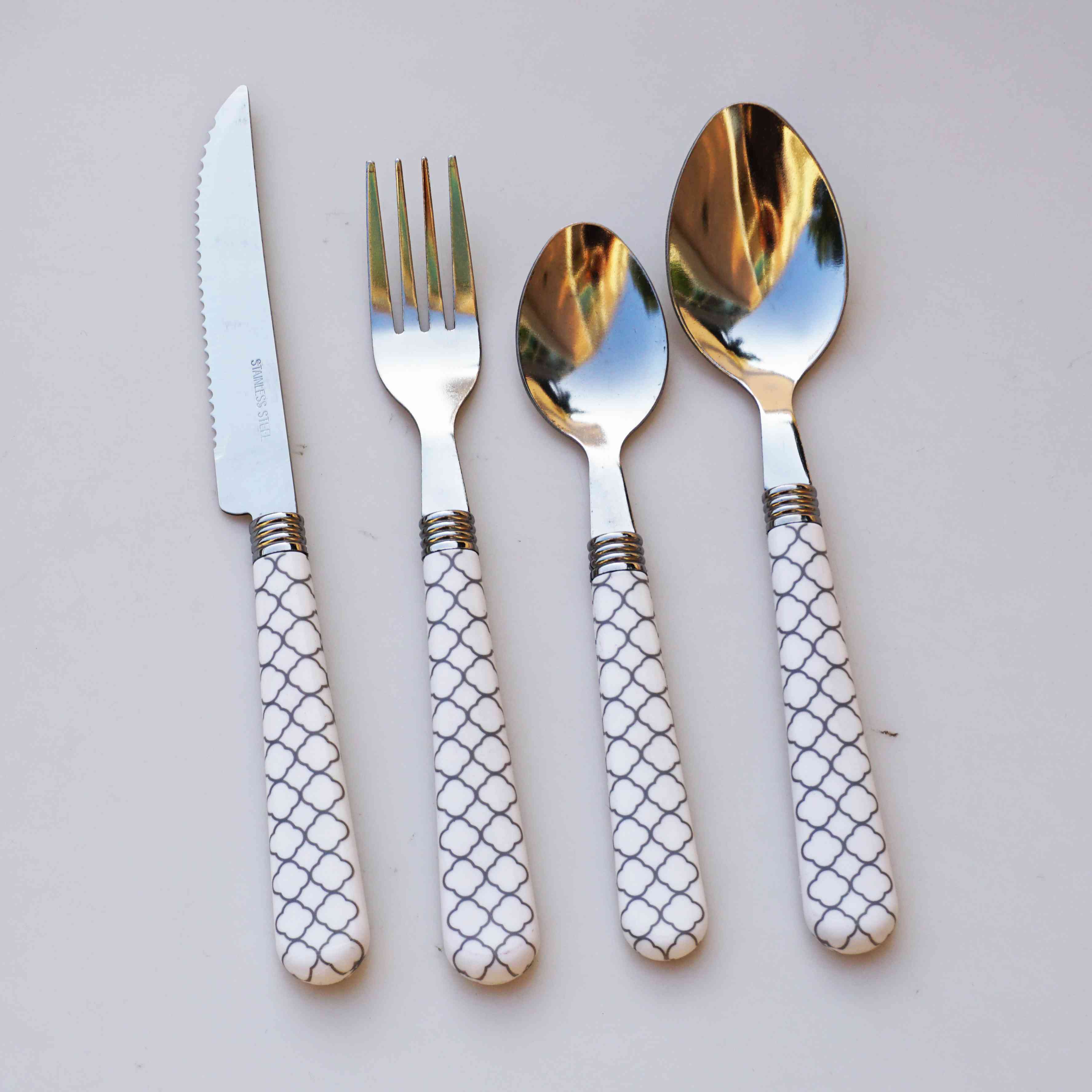
Material selection creates a clear starting point for cost and performance analysis. The featured Custom Logo Colorful Plastic Handle Half Tang Cutlery specifies 430/410 stainless steel for the spoon and fork and 420 stainless steel for the knife blade. The handles are made from food-grade PP/ABS plastic. This combination assigns metal grades according to product function while using an injection-molded handle, allowing buyers to compare raw material and processing costs with greater precision.
Assess Construction and Material Efficiency
Product architecture also determines how much steel must be purchased, stamped, polished, and finished. A half-tang design uses a shorter metal extension inside the handle than a full-tang design. This cutlery specification combines half-tang stamping with a metal bolster connection, a one-piece injection-molded handle, and mirror polishing. Any change should be assessed against required durability, appearance, user expectations, and market positioning rather than based on steel cost alone.
Use Order Planning to Manage Cost Exposure
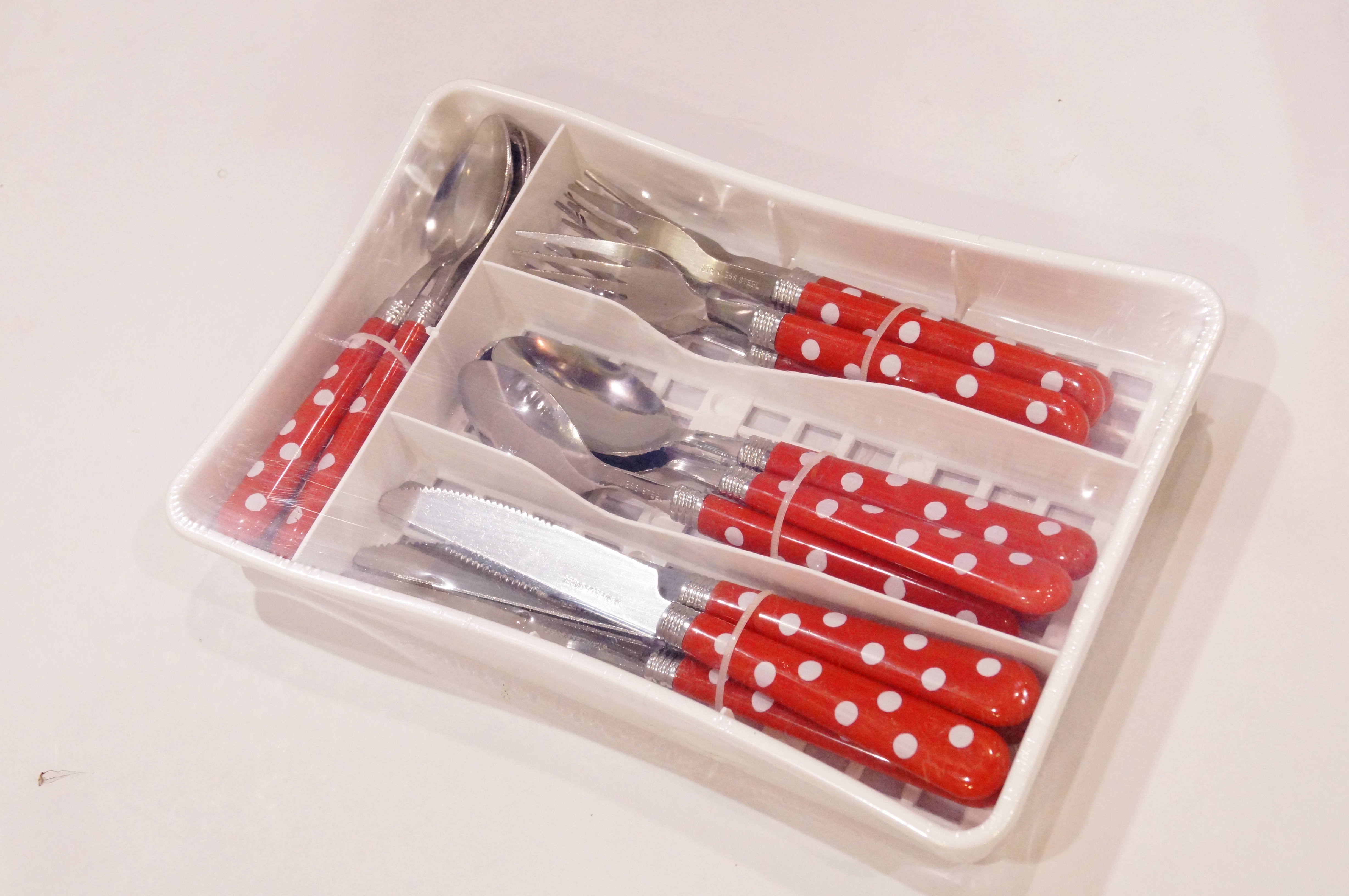
Purchasing strategy becomes more important when steel prices are volatile. The product requires a minimum order of 2,000 sets per color and has a stated lead time of 30 to 40 days. The direct factory model supports OEM/ODM projects, spot wholesale, mixed batches, logo engraving, and customized packaging. Purchasing teams can therefore compare larger consolidated orders, mixed-color purchasing, standardized packaging, and replenishment schedules to identify the most efficient total-cost arrangement.
Prevent Quality-Related Expenses
Inspection and corrective-action systems can reduce the additional costs caused by rejected, returned, or replaced goods. The product supports 100% in-house inspection as well as third-party checks by SGS, TUV, or BV. Company credentials include BSCI, ISO9001, and ISO14001. The listed service terms also include replacement or refund for qualifying batch quality problems, a 24-hour response to complaints, and exchanges for quality issues reported within seven days of receipt.
Match the Sourcing Plan to the Sales Channel
The acceptable level of cost flexibility depends on the application. Large retail chains may require colored cutlery with consistent PP handle colors and compliance with FDA, LFGB, and REACH requirements. Western restaurants and catering operators may place greater emphasis on durability and dependable performance during frequent commercial use. The purchasing plan should connect the product structure with compliance requirements, expected replenishment frequency, service conditions, and the target price range for each channel.
Reported cooperation experience includes discount retail, home goods, cookware, furniture, promotional consumer electronics, and multinational retail programs. Examples include European discount retail supply involving plastic-handle, half-tang, full-tang, and colorful cutlery, along with kitchen tool projects for Brazil and other markets. These examples indicate experience with different retail positions and replenishment models, but they do not establish a fixed percentage reduction in steel-related costs.
Sourcing Factors and Recommended Responses
| Sourcing factor | Impact of higher steel costs and recommended response |
|---|---|
| Material grade | Higher stainless steel prices increase cost exposure. Compare 430/410 stainless steel for spoons and forks with 420 stainless steel for knife blades while confirming functional needs. |
| Product construction | Half-tang stamping, a metal bolster, and an injection-molded PP/ABS handle provide a defined basis for comparing material usage, performance, and processing expense. |
| Purchase volume | Consolidated or mixed-batch orders can be evaluated against the 2,000-set-per-color MOQ and the requirements of the intended sales channel. |
| Customization | OEM/ODM production, laser logo engraving, and customized color boxes or blister packs are available. Each option should be quoted separately according to its material and processing requirements. |
| Quality management | 100% internal inspection can be combined with SGS, TUV, or BV verification and the supplier's stated batch-quality remedies. |
| Production scheduling | The product lead time is 30 to 40 days. The wider factory program lists monthly capacity of 5,000,000 pieces and annual output of 60,000,000 pieces. |
Frequently Asked Questions
Do higher steel prices mean the entire cutlery design must be replaced?
No. A component-level review is usually the more appropriate first step. Buyers can examine the 430/410 spoon and fork material, 420 knife blade material, half-tang structure, and PP/ABS handle before considering a broader redesign.
What can buyers do to reduce exposure when stainless steel prices rise?
They can compare alternative material specifications, assess the metal-to-plastic ratio, consolidate practical demand, use mixed-batch production, and request itemized quotations for engraving, packaging, and other custom features. The specified MOQ is 2,000 sets per color.
Which inspection services are available for these kitchen tools?
The product supports 100% in-house inspection and third-party inspection through SGS, TUV, or BV. The company also lists BSCI, ISO9001, and ISO14001 certifications, along with replacement or refund support for qualifying batch quality problems.
Conclusion and Purchasing Recommendations
Rising steel costs make disciplined specification, efficient product construction, order consolidation, and quality assurance essential when sourcing stainless steel kitchen tools. For the featured half-tang cutlery, buyers should review the 430/410 and 420 steel allocation, PP/ABS handle design, 2,000-set-per-color MOQ, 30 to 40 day lead time, and available inspection services before approving a quotation. Huaqiang Metal provides direct factory supply, OEM/ODM manufacturing, spot wholesale, and mixed-batch options. For technical guidance or sourcing assistance, contact eyas2018@126.com.
About the Manufacturer
JIEYANG CITY HUAQIANG METAL INDUSTRY CO., LTD., operating under the EYAS brand, has manufactured stainless steel tableware and kitchenware for 40 years. Established in 2006, the company reports 16,000 square meters of production space, automated equipment, an independent mold workshop, standardized production areas, monthly capacity of 5,000,000 pieces, and annual output of 60,000,000 pieces. Its services include OEM/ODM manufacturing, logo engraving, and packaging customization. Listed credentials include BSCI, ISO9001, and ISO14001, while its cooperation history covers several industries and international markets.

REPORT