







-
 Agriculture
-
 Health-Care
-
 Environment
-
 Construction-Real-Estate
-
 Tools-Hardware
-
 Home-Garden
-
 Furniture
-
 Luggage-Bags-Cases
-
 Medical-devices-Supplies
-
 Gifts-Crafts
-
 Sports-Entertainment
-
 Food-Beverage
-
 Vehicles-Transportation
-
 Power-Transmission
-
 Material-Handling
-
 Renewable-Energy
-
 Safety
-
 Testing-Instrument-Equipment
-
 Construction-Building-Machinery
-
 Pet-Supplies
-
 Personal-Care-Household-Cleaning
-
 Vehicle-Accessories-Electronics-Tools
-
 School-Office-Supplies
-
 Packaging-Printing
-
 Mother-Kids-Toys
-
 Business-Services
-
 Commercial-Equipment-Machinery
-
 Apparel-Accessories
-
 Security
-
 Shoes-Accessories
-
 Vehicle-Parts-Accessories
-
 Jewelry-Eyewear-Watches-Accessories
-
 Lights-Lighting
-
 Fabric-Textile-Raw-Material
-
 Fabrication-Services
-
 Industrial-Machinery
-
 Consumer-Electronics
-
 Electrical-Equipment-Supplies
-
 Electronic-Components-Accessories-Telecommunications
-
 Home-Appliances
-
 Beauty
-
 Chemicals
-
 Rubber-Plastics
-
 Metals-Alloys


























































































































































































































































































































































































































































































































































































- Masonry Materials
- Curtain Walls & Accessories
- Earthwork Products
- Fireproofing Materials
- Heat Insulation Materials
- Plastic Building Materials
- Building Boards
- Soundproofing Materials
- Timber
- Waterproofing Materials
- Balustrades & Handrails
- Bathroom & Kitchen
- Flooring & Accessories
- Tiles & Accessories
- Door, Window & Accessories
- Fireplaces & Stoves
- Floor Heating Systems & Parts
- Stairs & Stair Parts
- Ceilings
- Elevators & Escalators
- Stone
- Countertops, Vanity Tops & Table Tops
- Mosaics
- Metal Building Materials
- Multifunctional Materials
- Ladders & Scaffoldings
- Mouldings
- Corner Guards
- Decorative Films
- Formwork
- Building & Industrial Glass
- Other Construction & Real Estate
- Wallpapers/Wall panels
- HVAC System & Parts
- Outdoor Facilities
- Prefabricated Buildings
- Festive & Party Supplies
- Bathroom Products
- Household Sundries
- Rain Gear
- Garden Supplies
- Household Cleaning Tools & Accessories
- Lighters & Smoking Accessories
- Home Storage & Organization
- Household Scales
- Smart Home Improvement
- Home Textiles
- Kitchenware
- Drinkware & Accessories
- Dinnerware, Coffee & Wine
- Home Decor
- Golf
- Fitness & Body Building
- Amusement Park Facilities
- Billiards, Board Game,Coin Operated Games
- Musical Instruments
- Outdoor Affordable Luxury Sports
- Camping & Hiking
- Fishing
- Sports Safety&Rehabilitation
- Ball Sports Equipments
- Water Sports
- Winter Sports
- Luxury Travel Equipments
- Sports Shoes, Bags & Accessories
- Cycling
- Other Sports & Entertainment Products
- Artificial Grass&Sports Flooring&Sports Court Equipment
- Scooters
- Food Ingredients
- Honey & Honey Products
- Snacks
- Nuts & Kernels
- Seafood
- Plant & Animal Oil
- Beverages
- Fruit & Vegetable Products
- Frog & Escargot
- Bean Products
- Egg Products
- Dairy Products
- Seasonings & Condiments
- Canned Food
- Instant Food
- Baked Goods
- Other Food & Beverage
- Meat & Poultry
- Confectionery
- Grain Products
- Feminie Care
- Hair Care & Styling
- Body Care
- Hands & Feet Care
- Hygiene Products
- Men's Grooming
- Laundry Cleaning Supplies
- Travel Size & Gift Sets
- Room Deodorizers
- Other Personal Care Products
- Pest Control Products
- Special Household Cleaning
- Floor Cleaning
- Kitchen & Bathroom Cleaning
- Oral Care
- Bath Supplies
- Yellow Pages
- Correction Supplies
- Office Binding Supplies
- Office Cutting Supplies
- Board Erasers
- Office Adhesives & Tapes
- Education Supplies
- Pencil Cases & Bags
- Notebooks & Writing Pads
- File Folder Accessories
- Calendars
- Writing Accessories
- Commercial Office Supplies
- Pencil Sharpeners
- Pens
- Letter Pad/Paper
- Paper Envelopes
- Desk Organizers
- Pencils
- Markers & Highlighters
- Filing Products
- Art Supplies
- Easels
- Badge Holder & Accessories
- Office Paper
- Printer Supplies
- Book Covers
- Other Office & School Supplies
- Stationery Set
- Boards
- Clipboards
- Stamps
- Drafting Supplies
- Stencils
- Electronic Dictionary
- Books
- Map
- Magazines
- Calculators
- Baby & Toddler Toys
- Educational Toys
- Classic Toys
- Dress Up & Pretend Play
- Toy Vehicle
- Stuffed Animals & Plush Toys
- Outdoor Toys & Structures
- Balloons & Accessories
- Baby Food
- Children's Clothing
- Baby Supplies & Products
- Maternity Clothes
- Kids Shoes
- Baby Care
- Novelty & Gag Toys
- Dolls & Accessories
- Puzzle & Games
- Blocks & Model Building Toys
- Toddler Clothing
- Baby Clothing
- Kids' Luggage & Bags
- Arts, Crafts & DIY Toys
- Action & Toy Figures
- Baby Appliances
- Hobbies & Models
- Remote Control Toys
- Promotional Toys
- Pregnancy & Maternity
- Hygiene Products
- Kid's Textile&Bedding
- Novelty & Special Use
- Toy Weapons
- Baby Gifts
- Baby Storage & Organization
- Auto Drive Systems
- ATV/UTV Parts & Accessories
- Marine Parts & Accessories
- Other Auto Parts
- Trailer Parts & Accessories
- Auto Transmission Systems
- Train Parts & Accessories
- Universal Parts
- Railway Parts & Accessories
- Auto Brake Systems
- Aviation Parts & Accessories
- Truck Parts & Accessories
- Auto Suspension Systems
- Auto Lighting Systems
- New Energy Vehicle Parts & Accessories
- Auto Steering Systems
- Wheels, Tires & Accessories
- Bus Parts & Accessories
- Auto Performance Parts
- Cooling System
- Go-Kart & Kart Racer Parts & Accessories
- Air Conditioning Systems
- Heavy Duty Vehicle Parts & Accessories
- Auto Electrical Systems
- Auto Body Systems
- Auto Engine Systems
- Container Parts & Accessories
- Motorcycle Parts & Accessories
- Refrigeration & Heat Exchange Equipment
- Machine Tool Equipment
- Food & Beverage Machinery
- Agricultural Machinery & Equipment
- Apparel & Textile Machinery
- Chemical Machinery
- Packaging Machines
- Paper Production Machinery
- Plastic & Rubber Processing Machinery
- Industrial Robots
- Electronic Products Machinery
- Metal & Metallurgy Machinery
- Woodworking Machinery
- Home Product Manufacturing Machinery
- Machinery Accessories
- Environmental Machinery
- Machinery Service
- Electrical Equipment Manufacturing Machinery
- Industrial Compressors & Parts
- Tobacco & Cigarette Machinery
- Production Line
- Used Industrial Machinery
- Electronics Production Machinery
- Other Machinery & Industrial Equipment
- Camera, Photo & Accessories
- Portable Audio, Video & Accessories
- Television, Home Audio, Video & Accessories
- Video Games & Accessories
- Mobile Phone & Accessories
- Electronic Publications
- Earphone & Headphone & Accessories
- Speakers & Accessories
- Smart Electronics
- TV Receivers & Accessories
- Mobile Phone & Computer Repair Parts
- Chargers, Batteries & Power Supplies
- Used Electronics
- VR, AR, MR Hardware & Software
- Projectors & Presentation Equipments
- Other Consumer Electronics
- Cables & Commonly Used Accessories
- Computer Hardware & Software
- Displays, Signage and Optoelectronics
- Discrete Semiconductors
- Wireless & IoT Module and Products
- Telecommunications
- Connectors, Terminals & Accessories
- Development Boards, Electronic Modules and Kits
- Circuit Protection
- Sensors
- Isolators
- Audio Components and Products
- Integrated Circuits
- Power Supplies
- Relays
- RF, Microwave and RFID
- Electronic Accessories & Supplies
- Passive Components
- PCB & PCBA
- Air Quality Appliances
- Home Appliance Parts
- Heating & Cooling Appliances
- Small Kitchen Appliances
- Laundry Appliances
- Water Heaters
- Water Treatment Appliances
- Refrigerators & Freezers
- Personal Care & Beauty Appliances
- Major Kitchen Appliances
- Cleaning Appliances
- Second-hand Appliances
- Smart Home Appliances
- Other Home Appliances
- Energy Chemicals
- Inorganic Chemicals
- Basic Organic Chemicals
- Agrochemicals
- Admixture & Additives
- Catalysts & Chemical Auxiliary Agents
- Pigments & Dyestuff
- Coating & Paint
- Daily Chemicals
- Polymer
- Organic Intermediate
- Adhesives & Sealants
- Chemical Waste
- Biological Chemical Products
- Surface Treatment Chemicals
- Painting & Coating
- Chemical Reagents
- Flavor & Fragrance
- Non-Explosive Demolition Agents
- Other Chemicals
- Custom Chemical Services

How Steel, Panels, and Logistics Shape K-House Prices and Availability
K-House material costs and supply schedules depend on several connected factors, including galvanized steel specifications, sandwich-panel choices, unit dimensions, order volume, factory capacity, export demand, and container transportation. Guangdong Uni-House Technology Co., Ltd. offers detachable prefab container houses with multiple structural and panel configurations, automated manufacturing, and shipping options for 20FT and 40HQ containers. Its customer base across Southeast Asia, North America, South America, Australia, and the Middle East also influences production planning and allocation.
Main Factors Affecting Cost and Supply
- Structural steel: The selected frame configuration determines the amount and grade of galvanized steel required. Wall thickness options include 2.0 mm, 2.3 mm, and 2.5 mm.
- Sandwich panels: Three export panel-core options are available. Because the source information does not provide individual core names or price differences, buyers should request a project-specific quotation.
- Production scheduling: Listed lead times vary by information source. The product record states 7 days, while the broader industry-trade model indicates 15 days.
- Application and project scale: Construction sites, worker camps, emergency accommodation, cultural-tourism projects, and new rural villas can create different material and scheduling requirements.
How Product Design Influences Material Requirements
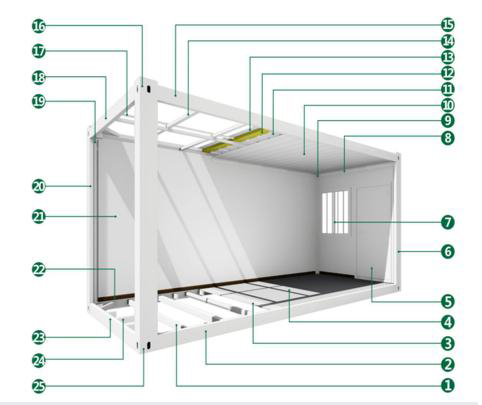
The price of a K-House-style modular building is closely related to its structural layout and selected options. The standard export model is approximately 5.95 m long, 3.0 m wide, and 2.896 m high, with a net weight of about 1,250–1,400 kg per unit. Other available configurations include 4 m × 3 m, 6 m × 2.4 m, 7 m × 3 m, and an extended 12 m double-combination unit. Changing the footprint or combining units alters the quantity of steel members, enclosure panels, fasteners, and accessories required.
The frame specification includes 160 × 160 mm C-shaped hot-dip galvanized channel-steel columns, 160 × 80 mm galvanized cold-formed primary beams, and 80 × 40 mm secondary bottom beams installed at 400 mm intervals. Each set is also specified with eight cast-steel corner fittings and 64 structural bolts. Pickling and phosphating, followed by high-temperature electrostatic powder coating, are used for corrosion protection, with a stated coating thickness of at least 60 μm.
Panels and Optional Components
Panel-core selection changes the overall enclosure package and may affect insulation, weight, performance, and cost. The available product information confirms three core-material choices for export orders but does not publish their individual specifications or price premiums. Doors, windows, coatings, fittings, and other accessories should therefore be included when comparing quotations.
Production Capacity and Delivery Planning
Factory organization is another important supply variable. Guangdong Uni-House reports more than 10 advanced production lines and over 200 mold sets. Its manufacturing processes include laser cutting, robotic welding, and automated spraying. A single-plant production base is reported to have an annual capacity of 10,000 sets, while the detachable container house can be ordered from one set. Small orders may be accommodated individually, but large developments require production slots to be reserved in advance.
Delivery information should be checked against the exact configuration and order schedule. The product listing gives a 7-day delivery time, whereas the industry-trade integration information states 15 days. These figures may reflect different order conditions, production arrangements, or product records, so the confirmed lead time should appear in the commercial quotation.
Export Logistics and Market Demand
International shipping affects both availability and landed cost. The product is arranged for 20FT or 40HQ ocean containers, and the most efficient loading plan depends on unit dimensions, accessories, quantity, and destination. Container availability, port schedules, customs procedures, and regional demand can all influence the final shipping timetable.
The company serves customers in Southeast Asia, North America, South America, Australia, and the Middle East. Demand from these markets may affect factory allocation during busy periods. Buyers should confirm the production queue, container plan, export documents, and destination requirements before placing a time-sensitive order.
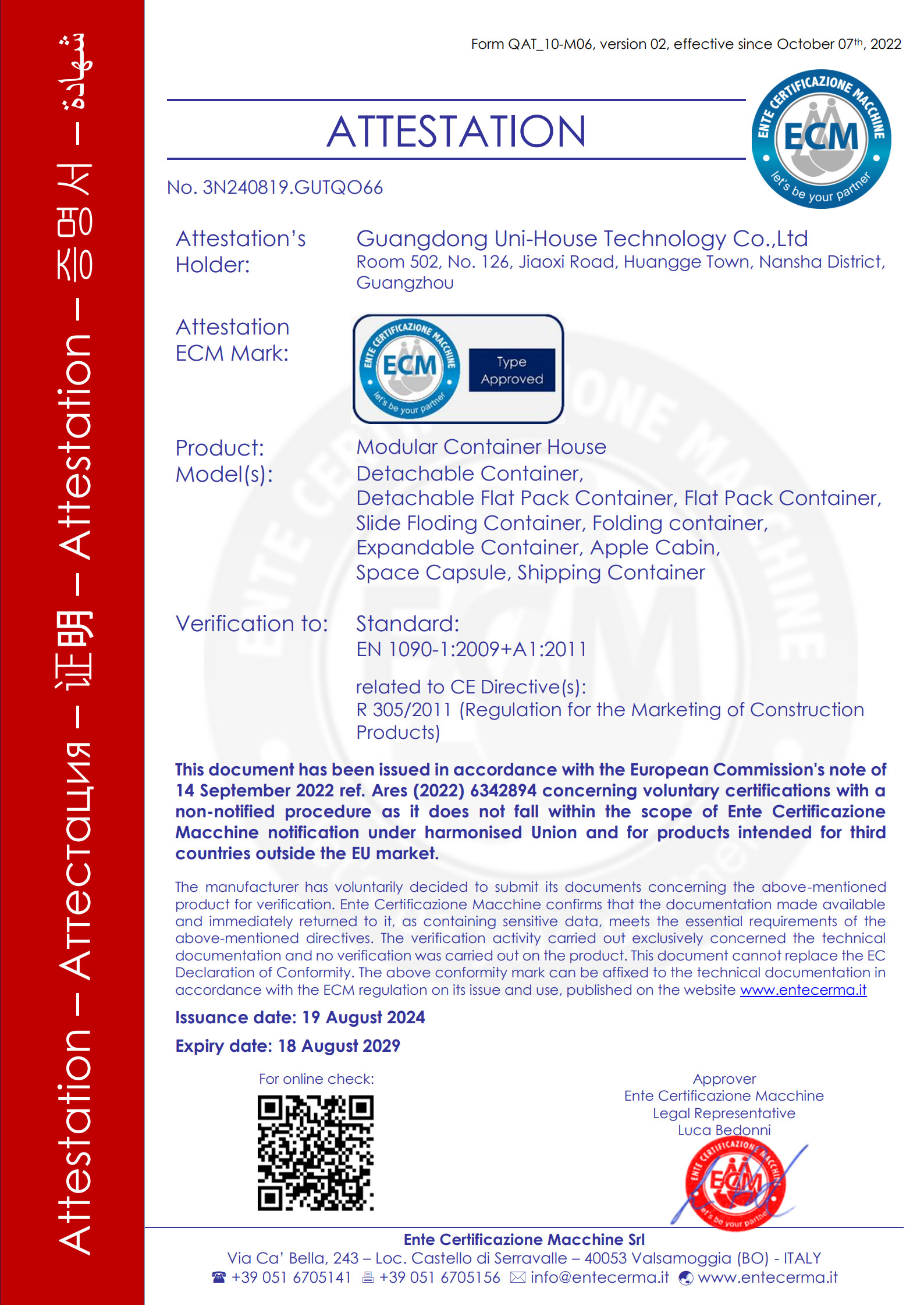
The product carries CE certification No. 3N240819.GUTQO66 for the EU region, Australia, North America, South America, Southeast Asia, and the Middle East. The certification scope covers detachable containers, flat pack containers, slide folding containers, folding containers, expandable containers, Apple Cabins, space capsules, and shipping containers.
Project Reference and Comparison
A documented Indonesian coal-mine accommodation project involved 2,000 sets for a local energy company and was used to house mining workers. This large-scale example illustrates how field construction and infrastructure projects can place significant demands on material procurement, factory capacity, batch production, and delivery coordination.
| Cost or supply factor | Available product information | Practical consideration |
|---|---|---|
| Steel frame | Galvanized structural system with 2.0 mm, 2.3 mm, and 2.5 mm wall-thickness options | Heavier or upgraded specifications generally change material quantities and quotation values |
| Panel core | Three sandwich-panel core options for export orders | Each selection may change the enclosure package; individual price differences are not published |
| Dimensions | Standard 20ft export unit and several optional sizes | Custom or larger units require different quantities of steel, panels, and fittings |
| Order volume | Minimum order quantity of one set | Single-unit orders are supported, while larger projects need coordinated production planning |
| Lead time | 7 days in the product record and 15 days in the industry-trade model | Confirm the applicable schedule for the selected design, quantity, and destination |
| Container shipping | 20FT and 40HQ ocean containers | Loading efficiency, container supply, port schedules, and freight rates affect delivery and landed cost |
Frequently Asked Questions
Which materials have the greatest effect on K-House pricing?
The main components include galvanized structural steel, sandwich panels, corner fittings, bolts, protective coatings, doors, windows, and related accessories. The available data does not separate the exact price contribution of each item, so a complete quotation should be based on the selected configuration.
Why might two projects receive different delivery schedules?
Project dimensions, frame thickness, panel-core selection, order quantity, destination, production workload, and container arrangements can all change the schedule. Large orders may require a reserved manufacturing window, while a standard single-unit order may follow a different timetable.
What delivery times are currently stated?
The detachable prefab container house record lists a 7-day delivery time. The broader industry-trade integration model lists 15 days. Buyers should confirm the final lead time in writing after the technical specification and shipping plan are approved.
Conclusion
K-House pricing and availability should be evaluated as a complete package rather than by steel or panel prices alone. Frame thickness, panel selection, dimensions, order size, production capacity, factory scheduling, export demand, and 20FT or 40HQ container logistics all contribute to the final result. The company supports orders from one set and provides both product-specific and broader delivery references, while CE certification and the Indonesian mining accommodation project offer useful product and application references. For technical guidance or a project quotation, contact guizugroup@outlook.com.
About Guangdong Uni-House
Guangdong Uni-House Technology Co., Ltd. operates as a foreign trade company under the Guizu Group. Its services cover design, research and development, manufacturing, installation, and after-sales support through several group factories. Its product range includes detachable, expandable, foldable, and flat pack container houses, prefab K houses, and space capsule houses. The company reports annual capacity of 10,000 sets at a single-plant production base and serves markets in Australia, the Middle East, North America, Southeast Asia, and other regions.

REPORT