







-
 Agriculture
-
 Health-Care
-
 Environment
-
 Construction-Real-Estate
-
 Tools-Hardware
-
 Home-Garden
-
 Furniture
-
 Luggage-Bags-Cases
-
 Medical-devices-Supplies
-
 Gifts-Crafts
-
 Sports-Entertainment
-
 Food-Beverage
-
 Vehicles-Transportation
-
 Power-Transmission
-
 Material-Handling
-
 Renewable-Energy
-
 Safety
-
 Testing-Instrument-Equipment
-
 Construction-Building-Machinery
-
 Pet-Supplies
-
 Personal-Care-Household-Cleaning
-
 Vehicle-Accessories-Electronics-Tools
-
 School-Office-Supplies
-
 Packaging-Printing
-
 Mother-Kids-Toys
-
 Business-Services
-
 Commercial-Equipment-Machinery
-
 Apparel-Accessories
-
 Security
-
 Shoes-Accessories
-
 Vehicle-Parts-Accessories
-
 Jewelry-Eyewear-Watches-Accessories
-
 Lights-Lighting
-
 Fabric-Textile-Raw-Material
-
 Fabrication-Services
-
 Industrial-Machinery
-
 Consumer-Electronics
-
 Electrical-Equipment-Supplies
-
 Electronic-Components-Accessories-Telecommunications
-
 Home-Appliances
-
 Beauty
-
 Chemicals
-
 Rubber-Plastics
-
 Metals-Alloys


























































































































































































































































































































































































































































































































































































- Masonry Materials
- Curtain Walls & Accessories
- Earthwork Products
- Fireproofing Materials
- Heat Insulation Materials
- Plastic Building Materials
- Building Boards
- Soundproofing Materials
- Timber
- Waterproofing Materials
- Balustrades & Handrails
- Bathroom & Kitchen
- Flooring & Accessories
- Tiles & Accessories
- Door, Window & Accessories
- Fireplaces & Stoves
- Floor Heating Systems & Parts
- Stairs & Stair Parts
- Ceilings
- Elevators & Escalators
- Stone
- Countertops, Vanity Tops & Table Tops
- Mosaics
- Metal Building Materials
- Multifunctional Materials
- Ladders & Scaffoldings
- Mouldings
- Corner Guards
- Decorative Films
- Formwork
- Building & Industrial Glass
- Other Construction & Real Estate
- Wallpapers/Wall panels
- HVAC System & Parts
- Outdoor Facilities
- Prefabricated Buildings
- Festive & Party Supplies
- Bathroom Products
- Household Sundries
- Rain Gear
- Garden Supplies
- Household Cleaning Tools & Accessories
- Lighters & Smoking Accessories
- Home Storage & Organization
- Household Scales
- Smart Home Improvement
- Home Textiles
- Kitchenware
- Drinkware & Accessories
- Dinnerware, Coffee & Wine
- Home Decor
- Golf
- Fitness & Body Building
- Amusement Park Facilities
- Billiards, Board Game,Coin Operated Games
- Musical Instruments
- Outdoor Affordable Luxury Sports
- Camping & Hiking
- Fishing
- Sports Safety&Rehabilitation
- Ball Sports Equipments
- Water Sports
- Winter Sports
- Luxury Travel Equipments
- Sports Shoes, Bags & Accessories
- Cycling
- Other Sports & Entertainment Products
- Artificial Grass&Sports Flooring&Sports Court Equipment
- Scooters
- Food Ingredients
- Honey & Honey Products
- Snacks
- Nuts & Kernels
- Seafood
- Plant & Animal Oil
- Beverages
- Fruit & Vegetable Products
- Frog & Escargot
- Bean Products
- Egg Products
- Dairy Products
- Seasonings & Condiments
- Canned Food
- Instant Food
- Baked Goods
- Other Food & Beverage
- Meat & Poultry
- Confectionery
- Grain Products
- Feminie Care
- Hair Care & Styling
- Body Care
- Hands & Feet Care
- Hygiene Products
- Men's Grooming
- Laundry Cleaning Supplies
- Travel Size & Gift Sets
- Room Deodorizers
- Other Personal Care Products
- Pest Control Products
- Special Household Cleaning
- Floor Cleaning
- Kitchen & Bathroom Cleaning
- Oral Care
- Bath Supplies
- Yellow Pages
- Correction Supplies
- Office Binding Supplies
- Office Cutting Supplies
- Board Erasers
- Office Adhesives & Tapes
- Education Supplies
- Pencil Cases & Bags
- Notebooks & Writing Pads
- File Folder Accessories
- Calendars
- Writing Accessories
- Commercial Office Supplies
- Pencil Sharpeners
- Pens
- Letter Pad/Paper
- Paper Envelopes
- Desk Organizers
- Pencils
- Markers & Highlighters
- Filing Products
- Art Supplies
- Easels
- Badge Holder & Accessories
- Office Paper
- Printer Supplies
- Book Covers
- Other Office & School Supplies
- Stationery Set
- Boards
- Clipboards
- Stamps
- Drafting Supplies
- Stencils
- Electronic Dictionary
- Books
- Map
- Magazines
- Calculators
- Baby & Toddler Toys
- Educational Toys
- Classic Toys
- Dress Up & Pretend Play
- Toy Vehicle
- Stuffed Animals & Plush Toys
- Outdoor Toys & Structures
- Balloons & Accessories
- Baby Food
- Children's Clothing
- Baby Supplies & Products
- Maternity Clothes
- Kids Shoes
- Baby Care
- Novelty & Gag Toys
- Dolls & Accessories
- Puzzle & Games
- Blocks & Model Building Toys
- Toddler Clothing
- Baby Clothing
- Kids' Luggage & Bags
- Arts, Crafts & DIY Toys
- Action & Toy Figures
- Baby Appliances
- Hobbies & Models
- Remote Control Toys
- Promotional Toys
- Pregnancy & Maternity
- Hygiene Products
- Kid's Textile&Bedding
- Novelty & Special Use
- Toy Weapons
- Baby Gifts
- Baby Storage & Organization
- Auto Drive Systems
- ATV/UTV Parts & Accessories
- Marine Parts & Accessories
- Other Auto Parts
- Trailer Parts & Accessories
- Auto Transmission Systems
- Train Parts & Accessories
- Universal Parts
- Railway Parts & Accessories
- Auto Brake Systems
- Aviation Parts & Accessories
- Truck Parts & Accessories
- Auto Suspension Systems
- Auto Lighting Systems
- New Energy Vehicle Parts & Accessories
- Auto Steering Systems
- Wheels, Tires & Accessories
- Bus Parts & Accessories
- Auto Performance Parts
- Cooling System
- Go-Kart & Kart Racer Parts & Accessories
- Air Conditioning Systems
- Heavy Duty Vehicle Parts & Accessories
- Auto Electrical Systems
- Auto Body Systems
- Auto Engine Systems
- Container Parts & Accessories
- Motorcycle Parts & Accessories
- Refrigeration & Heat Exchange Equipment
- Machine Tool Equipment
- Food & Beverage Machinery
- Agricultural Machinery & Equipment
- Apparel & Textile Machinery
- Chemical Machinery
- Packaging Machines
- Paper Production Machinery
- Plastic & Rubber Processing Machinery
- Industrial Robots
- Electronic Products Machinery
- Metal & Metallurgy Machinery
- Woodworking Machinery
- Home Product Manufacturing Machinery
- Machinery Accessories
- Environmental Machinery
- Machinery Service
- Electrical Equipment Manufacturing Machinery
- Industrial Compressors & Parts
- Tobacco & Cigarette Machinery
- Production Line
- Used Industrial Machinery
- Electronics Production Machinery
- Other Machinery & Industrial Equipment
- Camera, Photo & Accessories
- Portable Audio, Video & Accessories
- Television, Home Audio, Video & Accessories
- Video Games & Accessories
- Mobile Phone & Accessories
- Electronic Publications
- Earphone & Headphone & Accessories
- Speakers & Accessories
- Smart Electronics
- TV Receivers & Accessories
- Mobile Phone & Computer Repair Parts
- Chargers, Batteries & Power Supplies
- Used Electronics
- VR, AR, MR Hardware & Software
- Projectors & Presentation Equipments
- Other Consumer Electronics
- Cables & Commonly Used Accessories
- Computer Hardware & Software
- Displays, Signage and Optoelectronics
- Discrete Semiconductors
- Wireless & IoT Module and Products
- Telecommunications
- Connectors, Terminals & Accessories
- Development Boards, Electronic Modules and Kits
- Circuit Protection
- Sensors
- Isolators
- Audio Components and Products
- Integrated Circuits
- Power Supplies
- Relays
- RF, Microwave and RFID
- Electronic Accessories & Supplies
- Passive Components
- PCB & PCBA
- Air Quality Appliances
- Home Appliance Parts
- Heating & Cooling Appliances
- Small Kitchen Appliances
- Laundry Appliances
- Water Heaters
- Water Treatment Appliances
- Refrigerators & Freezers
- Personal Care & Beauty Appliances
- Major Kitchen Appliances
- Cleaning Appliances
- Second-hand Appliances
- Smart Home Appliances
- Other Home Appliances
- Energy Chemicals
- Inorganic Chemicals
- Basic Organic Chemicals
- Agrochemicals
- Admixture & Additives
- Catalysts & Chemical Auxiliary Agents
- Pigments & Dyestuff
- Coating & Paint
- Daily Chemicals
- Polymer
- Organic Intermediate
- Adhesives & Sealants
- Chemical Waste
- Biological Chemical Products
- Surface Treatment Chemicals
- Painting & Coating
- Chemical Reagents
- Flavor & Fragrance
- Non-Explosive Demolition Agents
- Other Chemicals
- Custom Chemical Services

How Sunglasses Packaging Influences Freight Efficiency and Transit Protection
For designer sunglasses, packaging is closely connected to both shipping efficiency and product safety. The size and structure of a package determine how much cargo space an order occupies, while internal support helps protect lenses, frames, and clip-on accessories from movement and impact. The right packaging strategy depends on the order quantity, product design, transportation method, and handling conditions.
Packaging Priorities for Bulk Sunglasses Shipments
- Choose space-efficient packaging to improve freight utilization for sea, land, and air transportation.
- Use suitable separation and cushioning for resin lenses, UV400 components, frames, and clip-on parts.
- Adjust package strength and internal organization to suit the handling requirements of OEM and ODM orders.
- Confirm packaging consistency through pre-shipment spot inspections, in line with Yiwu Green Shine Arts & Crafts Co., Ltd.'s stated inspection process.
How Packaging Affects Freight Cost and Damage Exposure
External Size and Cargo Utilization
Freight charges are influenced by the space occupied by a shipment, not only by the weight of the sunglasses. Large cartons with unnecessary empty volume can reduce loading efficiency, particularly when many units are consolidated for delivery. More compact packaging may improve cargo utilization, although the package must still provide enough room and support to prevent pressure on delicate frames and lenses.
Internal Stability and Component Protection
The product is described as wholesale men's and women's night vision driving glasses with resin lenses, UV400 protection, rimless and aviation styling, polarized features, and clip-on components. These design characteristics create multiple parts that should remain correctly positioned during transport. Internal dividers, sleeves, or other suitable supports can reduce contact between lenses, frames, and clip-on pieces.
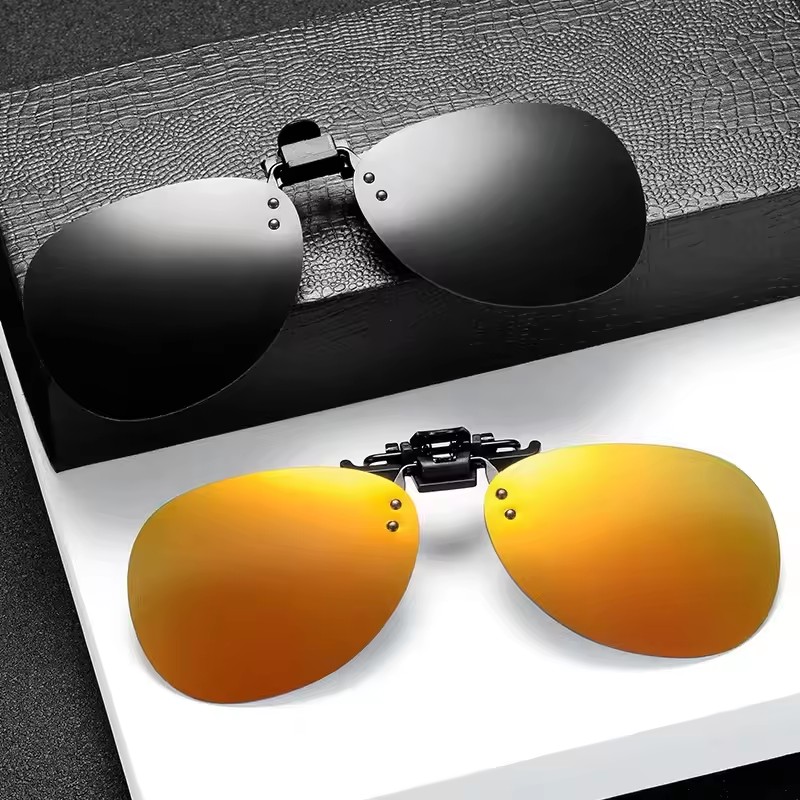
At the same time, excessive compression can create its own risks, including lens scratching, frame deformation, or stress on rimless structures. The available product information does not specify the packaging material, final carton dimensions, cushioning design, or measured damage rate. These details should therefore be confirmed for each product and order configuration.
Packaging Should Match the Transport Method
Shipping conditions change the balance between space savings and protection. Air freight generally places the greatest emphasis on compact dimensions because cargo capacity is limited and dimensional volume can affect cost. Sea freight is commonly used for consolidated bulk shipments, while land transportation may support regional distribution and mixed handling conditions.
For longer or more heavily handled shipments, consistent carton strength and secure internal positioning become especially important. Packaging should be assessed together with the selected freight method, shipment duration, loading pattern, and expected handling process rather than treated as an isolated product detail.
Comparison of Packaging Strategies
| Packaging strategy | Possible freight impact | Possible damage impact | Key review points |
|---|---|---|---|
| Compact packaging with secure internal separation | May reduce unused cargo space | Can limit component movement when properly fitted | Package fit, dividers, and handling stability |
| Oversized packaging with substantial empty space | May increase dimensional volume | Extra space can allow products to shift during transit | Carton measurements and internal fixation |
| Minimal packaging with limited protection | May reduce packaging volume | Provides greater exposure to lens, frame, and clip-on damage | Transit test results and inspection records |
| Packaging designed for air freight | Compact dimensions are particularly important | Components must remain secure through repeated handling | Dimensional efficiency and protection strength |
| Packaging designed for sea or land freight | Consolidation and loading efficiency influence total cost | Protection must withstand extended movement and handling | Load stability, carton durability, and consistency |
Questions Buyers Commonly Ask
Can better packaging lower sunglasses freight costs?
It can, when the package removes unnecessary volume and uses available cargo space efficiently. The actual effect depends on the shipping method, order size, weight, and final packed dimensions.
Which product features need the most protection?
Resin lenses, rimless frames, polarized and UV400 components, and clip-on parts should be held securely and separated where contact could cause scratches or deformation. The exact cushioning solution should be selected according to the product structure.
Which shipping options can be considered?
The company information identifies sea freight, land transportation, and air freight as available methods. Buyers should evaluate package dimensions and protection requirements against the conditions of the chosen service.
Recommendations for Bulk Buyers
Before confirming a bulk order, buyers should request the packed product dimensions, carton configuration, internal separation method, inspection procedure, and recommended transport mode. A practical packaging review should consider both freight efficiency and the condition of the sunglasses after handling. Reducing package size is useful only when the lenses, frames, and clip-on components remain protected throughout delivery.
Yiwu Green Shine Arts & Crafts Co., Ltd. supports OEM and ODM cooperation, reports annual production capacity of more than 3 million pairs of sunglasses, and states that products are packaged and shipped after spot inspection. For technical packaging questions or order support, contact leoxiao@cngreenshine.com.
About Yiwu Green Shine Arts & Crafts Co., Ltd.
Yiwu Green Shine Arts & Crafts Co., Ltd. was founded in 2016 in Yiwu, Zhejiang Province. The company specializes in fashion sunglasses, optical frames, acetate sunglasses, children's sunglasses, and reading glasses. It reports annual production capacity exceeding 3 million pairs and exports to the United States, Spain, Germany, Australia, Italy, France, and Ireland. The company accepts OEM and ODM orders and states that products undergo spot inspection before packaging and shipment.

REPORT