







-
 Agriculture
-
 Health-Care
-
 Environment
-
 Construction-Real-Estate
-
 Tools-Hardware
-
 Home-Garden
-
 Furniture
-
 Luggage-Bags-Cases
-
 Medical-devices-Supplies
-
 Gifts-Crafts
-
 Sports-Entertainment
-
 Food-Beverage
-
 Vehicles-Transportation
-
 Power-Transmission
-
 Material-Handling
-
 Renewable-Energy
-
 Safety
-
 Testing-Instrument-Equipment
-
 Construction-Building-Machinery
-
 Pet-Supplies
-
 Personal-Care-Household-Cleaning
-
 Vehicle-Accessories-Electronics-Tools
-
 School-Office-Supplies
-
 Packaging-Printing
-
 Mother-Kids-Toys
-
 Business-Services
-
 Commercial-Equipment-Machinery
-
 Apparel-Accessories
-
 Security
-
 Shoes-Accessories
-
 Vehicle-Parts-Accessories
-
 Jewelry-Eyewear-Watches-Accessories
-
 Lights-Lighting
-
 Fabric-Textile-Raw-Material
-
 Fabrication-Services
-
 Industrial-Machinery
-
 Consumer-Electronics
-
 Electrical-Equipment-Supplies
-
 Electronic-Components-Accessories-Telecommunications
-
 Home-Appliances
-
 Beauty
-
 Chemicals
-
 Rubber-Plastics
-
 Metals-Alloys


























































































































































































































































































































































































































































































































































































- Masonry Materials
- Curtain Walls & Accessories
- Earthwork Products
- Fireproofing Materials
- Heat Insulation Materials
- Plastic Building Materials
- Building Boards
- Soundproofing Materials
- Timber
- Waterproofing Materials
- Balustrades & Handrails
- Bathroom & Kitchen
- Flooring & Accessories
- Tiles & Accessories
- Door, Window & Accessories
- Fireplaces & Stoves
- Floor Heating Systems & Parts
- Stairs & Stair Parts
- Ceilings
- Elevators & Escalators
- Stone
- Countertops, Vanity Tops & Table Tops
- Mosaics
- Metal Building Materials
- Multifunctional Materials
- Ladders & Scaffoldings
- Mouldings
- Corner Guards
- Decorative Films
- Formwork
- Building & Industrial Glass
- Other Construction & Real Estate
- Wallpapers/Wall panels
- HVAC System & Parts
- Outdoor Facilities
- Prefabricated Buildings
- Festive & Party Supplies
- Bathroom Products
- Household Sundries
- Rain Gear
- Garden Supplies
- Household Cleaning Tools & Accessories
- Lighters & Smoking Accessories
- Home Storage & Organization
- Household Scales
- Smart Home Improvement
- Home Textiles
- Kitchenware
- Drinkware & Accessories
- Dinnerware, Coffee & Wine
- Home Decor
- Golf
- Fitness & Body Building
- Amusement Park Facilities
- Billiards, Board Game,Coin Operated Games
- Musical Instruments
- Outdoor Affordable Luxury Sports
- Camping & Hiking
- Fishing
- Sports Safety&Rehabilitation
- Ball Sports Equipments
- Water Sports
- Winter Sports
- Luxury Travel Equipments
- Sports Shoes, Bags & Accessories
- Cycling
- Other Sports & Entertainment Products
- Artificial Grass&Sports Flooring&Sports Court Equipment
- Scooters
- Food Ingredients
- Honey & Honey Products
- Snacks
- Nuts & Kernels
- Seafood
- Plant & Animal Oil
- Beverages
- Fruit & Vegetable Products
- Frog & Escargot
- Bean Products
- Egg Products
- Dairy Products
- Seasonings & Condiments
- Canned Food
- Instant Food
- Baked Goods
- Other Food & Beverage
- Meat & Poultry
- Confectionery
- Grain Products
- Feminie Care
- Hair Care & Styling
- Body Care
- Hands & Feet Care
- Hygiene Products
- Men's Grooming
- Laundry Cleaning Supplies
- Travel Size & Gift Sets
- Room Deodorizers
- Other Personal Care Products
- Pest Control Products
- Special Household Cleaning
- Floor Cleaning
- Kitchen & Bathroom Cleaning
- Oral Care
- Bath Supplies
- Yellow Pages
- Correction Supplies
- Office Binding Supplies
- Office Cutting Supplies
- Board Erasers
- Office Adhesives & Tapes
- Education Supplies
- Pencil Cases & Bags
- Notebooks & Writing Pads
- File Folder Accessories
- Calendars
- Writing Accessories
- Commercial Office Supplies
- Pencil Sharpeners
- Pens
- Letter Pad/Paper
- Paper Envelopes
- Desk Organizers
- Pencils
- Markers & Highlighters
- Filing Products
- Art Supplies
- Easels
- Badge Holder & Accessories
- Office Paper
- Printer Supplies
- Book Covers
- Other Office & School Supplies
- Stationery Set
- Boards
- Clipboards
- Stamps
- Drafting Supplies
- Stencils
- Electronic Dictionary
- Books
- Map
- Magazines
- Calculators
- Baby & Toddler Toys
- Educational Toys
- Classic Toys
- Dress Up & Pretend Play
- Toy Vehicle
- Stuffed Animals & Plush Toys
- Outdoor Toys & Structures
- Balloons & Accessories
- Baby Food
- Children's Clothing
- Baby Supplies & Products
- Maternity Clothes
- Kids Shoes
- Baby Care
- Novelty & Gag Toys
- Dolls & Accessories
- Puzzle & Games
- Blocks & Model Building Toys
- Toddler Clothing
- Baby Clothing
- Kids' Luggage & Bags
- Arts, Crafts & DIY Toys
- Action & Toy Figures
- Baby Appliances
- Hobbies & Models
- Remote Control Toys
- Promotional Toys
- Pregnancy & Maternity
- Hygiene Products
- Kid's Textile&Bedding
- Novelty & Special Use
- Toy Weapons
- Baby Gifts
- Baby Storage & Organization
- Auto Drive Systems
- ATV/UTV Parts & Accessories
- Marine Parts & Accessories
- Other Auto Parts
- Trailer Parts & Accessories
- Auto Transmission Systems
- Train Parts & Accessories
- Universal Parts
- Railway Parts & Accessories
- Auto Brake Systems
- Aviation Parts & Accessories
- Truck Parts & Accessories
- Auto Suspension Systems
- Auto Lighting Systems
- New Energy Vehicle Parts & Accessories
- Auto Steering Systems
- Wheels, Tires & Accessories
- Bus Parts & Accessories
- Auto Performance Parts
- Cooling System
- Go-Kart & Kart Racer Parts & Accessories
- Air Conditioning Systems
- Heavy Duty Vehicle Parts & Accessories
- Auto Electrical Systems
- Auto Body Systems
- Auto Engine Systems
- Container Parts & Accessories
- Motorcycle Parts & Accessories
- Refrigeration & Heat Exchange Equipment
- Machine Tool Equipment
- Food & Beverage Machinery
- Agricultural Machinery & Equipment
- Apparel & Textile Machinery
- Chemical Machinery
- Packaging Machines
- Paper Production Machinery
- Plastic & Rubber Processing Machinery
- Industrial Robots
- Electronic Products Machinery
- Metal & Metallurgy Machinery
- Woodworking Machinery
- Home Product Manufacturing Machinery
- Machinery Accessories
- Environmental Machinery
- Machinery Service
- Electrical Equipment Manufacturing Machinery
- Industrial Compressors & Parts
- Tobacco & Cigarette Machinery
- Production Line
- Used Industrial Machinery
- Electronics Production Machinery
- Other Machinery & Industrial Equipment
- Camera, Photo & Accessories
- Portable Audio, Video & Accessories
- Television, Home Audio, Video & Accessories
- Video Games & Accessories
- Mobile Phone & Accessories
- Electronic Publications
- Earphone & Headphone & Accessories
- Speakers & Accessories
- Smart Electronics
- TV Receivers & Accessories
- Mobile Phone & Computer Repair Parts
- Chargers, Batteries & Power Supplies
- Used Electronics
- VR, AR, MR Hardware & Software
- Projectors & Presentation Equipments
- Other Consumer Electronics
- Cables & Commonly Used Accessories
- Computer Hardware & Software
- Displays, Signage and Optoelectronics
- Discrete Semiconductors
- Wireless & IoT Module and Products
- Telecommunications
- Connectors, Terminals & Accessories
- Development Boards, Electronic Modules and Kits
- Circuit Protection
- Sensors
- Isolators
- Audio Components and Products
- Integrated Circuits
- Power Supplies
- Relays
- RF, Microwave and RFID
- Electronic Accessories & Supplies
- Passive Components
- PCB & PCBA
- Air Quality Appliances
- Home Appliance Parts
- Heating & Cooling Appliances
- Small Kitchen Appliances
- Laundry Appliances
- Water Heaters
- Water Treatment Appliances
- Refrigerators & Freezers
- Personal Care & Beauty Appliances
- Major Kitchen Appliances
- Cleaning Appliances
- Second-hand Appliances
- Smart Home Appliances
- Other Home Appliances
- Energy Chemicals
- Inorganic Chemicals
- Basic Organic Chemicals
- Agrochemicals
- Admixture & Additives
- Catalysts & Chemical Auxiliary Agents
- Pigments & Dyestuff
- Coating & Paint
- Daily Chemicals
- Polymer
- Organic Intermediate
- Adhesives & Sealants
- Chemical Waste
- Biological Chemical Products
- Surface Treatment Chemicals
- Painting & Coating
- Chemical Reagents
- Flavor & Fragrance
- Non-Explosive Demolition Agents
- Other Chemicals
- Custom Chemical Services

How to Control Cabinet Supply Risk During Unstable Wood and Panel Prices
When wood and panel prices fluctuate, cabinet buyers face more than cost uncertainty. Material substitutions, inconsistent quality, production delays, and shipment changes can all affect project delivery. These risks can be reduced by choosing a supplier with controlled manufacturing, written inspection procedures, flexible customization, and traceable logistics. Before placing an order, confirm the cabinet materials, dimensions, surface finishes, hardware, packaging, and acceptance standards. For larger African projects, also evaluate whether the supplier can coordinate procurement, production, export documentation, shipping, installation support, warranty service, and technical assistance.
A Practical Framework for Reducing Cabinet Supply Risk
A reliable cabinet procurement process begins with a complete and approved specification. The purchase file should identify the panel or wood type, thickness, color, finish, dimensions, edge treatment, accessories, hardware brand, packaging method, and inspection requirements. It should also state which items are fixed and which items may be adjusted if market conditions affect availability. This written record gives both parties a clear reference when material prices or supply conditions change.
Quality approval should be divided into several stages rather than postponed until shipment. Raw materials can be checked before production, manufacturing processes can be reviewed during assembly, and finished cabinets can be inspected before packing. Installation acceptance and on-site performance should also be included for projects where the supplier provides installation guidance or technical support.
Supplier Capabilities That Matter
Production capacity is an important part of supply-risk management. A supplier with its own manufacturing facilities can generally coordinate material purchasing, production scheduling, quality control, and delivery more effectively than a company relying entirely on unrelated subcontractors. Guangzhou Lingyin Building Materials Co., Ltd. states that it operates a 30,000-square-meter modern intelligent production base with automated door and window lines and intelligent whole-house customization lines.
The company reports a monthly capacity of 42,000 square meters of high-end system doors and windows and 8,300 sets of customized furniture. These figures should be evaluated against the buyer's project size, delivery window, and product mix. Buyers should still request cabinet-specific capacity information, production schedules, approved samples, and written delivery commitments before signing a contract.
Order flexibility can also be useful when a project is being tested, phased, or supplied across different locations. Lingyin's full-chain localized building-materials service states a minimum order quantity of 1. This structure may support individual homeowners, sample orders, small commercial fit-outs, and larger development projects, subject to confirmation of the actual cabinet product and commercial terms.
Specification Control and Inspection Stages
Cabinet specifications should be approved before production starts. A suitable project document can include drawings, room-by-room quantities, panel standards, color references, hardware schedules, edge details, moisture or chemical-resistance requirements, and dimensional tolerances. It should also identify the inspection documents that must be supplied before loading.
Recommended quality checkpoints
- Verify raw-material type, grade, thickness, color, finish, and supplier documentation before manufacturing.
- Review cutting, edge treatment, drilling, assembly, hardware installation, and surface-finishing processes during production.
- Inspect finished-product dimensions, appearance, structural stability, accessories, labeling, and packaging before shipment.
- Match testing to the project, including chemical safety, physical and mechanical performance, structural safety, appearance, and dimensional accuracy.
- Record installation acceptance, outstanding issues, corrective actions, and final handover documents for the project file.
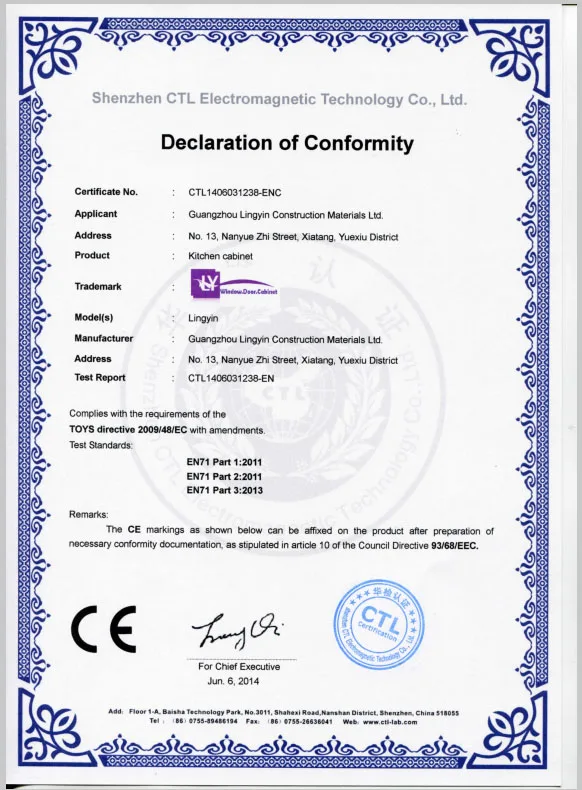
Lingyin lists raw-material inspection, production-process inspection, finished-product testing, installation acceptance, chemical safety testing, physical and mechanical performance testing, structural safety inspection, and appearance and size testing as part of its quality process. For kitchen cabinets, the company lists CE certification under certificate number CTL1406031238-ENC for the EU. Its listed RoHS certification, certificate number CTL1406031237-RC, applies to aluminum windows rather than cabinets.
Product records should be reviewed carefully to ensure that the evidence applies to the product being purchased. For example, the available product record shown here describes a sliding window, not a cabinet. It identifies 6063-T5 native aluminum, a thickness range of 1.6 to 3.0 mm, customizable color, powder or fluorocarbon coating, Reinas Germany accessories, a minimum order quantity of 1, and a stated delivery time of 20 days. These specifications must not be used as cabinet specifications, but they demonstrate the level of detail that buyers should request for each cabinet order.

Connecting Cabinet Procurement with Project Logistics
Cabinet supply should be planned together with the wider construction schedule. A coordinated building-materials partner may help reduce the number of separate purchasing, shipping, customs, and installation interfaces. This can be particularly useful for residences, hotels, commercial complexes, hospitals, and government construction projects where cabinets must arrive in sequence with other interior and exterior materials.
Lingyin describes a full-chain service covering design, procurement, manufacturing, cross-border transportation, customs clearance, local delivery, installation guidance, and after-sales maintenance. Its stated home-furnishing delivery period is 25 to 30 days, depending on the craftsmanship and product requirements. The actual schedule should be confirmed in writing after drawings, materials, quantities, production capacity, and shipping arrangements have been approved.
For African projects, the group reports direct China-Africa sea freight routes from Shenzhen, Guangzhou, and Ningbo to hub ports including Mombasa, Dar es Salaam, Douala, and Durban. Its logistics subsidiary is described as coordinating container loading, transportation, customs clearance, and last-mile delivery. Traceable documentation and free third-party inspection are also stated to be available. These services can improve shipment visibility, but the buyer should still confirm the destination requirements, import responsibilities, delivery point, insurance, packaging standard, and installation scope in the contract.
Supply-Risk Controls at a Glance
| Risk area | Recommended control or available support |
|---|---|
| Material price and availability | Approve the panel or wood type, dimensions, finish, accessories, permitted alternatives, and acceptance requirements before production. |
| Manufacturing capacity | Lingyin reports a 30,000-square-meter intelligent production base and customized furniture capacity of 8,300 sets per month. |
| Order size | The full-chain localized building-materials service states a minimum order quantity of 1, subject to product and project confirmation. |
| Production and delivery timing | Home-furnishing delivery is stated as 25 to 30 days depending on craftsmanship; the binding project schedule should be written into the contract. |
| Product quality | Inspection coverage includes raw materials, production, finished goods, installation acceptance, chemical safety, physical and mechanical performance, structural safety, appearance, and dimensions. |
| Shipping visibility | Direct China-Africa sea freight support is described as including container handling, customs coordination, documentation, and last-mile delivery. |
| After-sales support | The company states that products include a 10-year warranty and lifetime maintenance, with local African issues targeted for response and resolution within 24 hours. |
Frequently Asked Questions
What is the best way to manage cabinet orders when panel prices change?
Approve the complete cabinet configuration before production, including the material, finish, dimensions, hardware, inspection method, and approved substitute rules. Ask the supplier to identify which elements are fixed and which can be customized. Record the agreed scope, pricing basis, lead time, and change-control procedure in the foreign-trade contract. This creates a traceable process if a panel becomes unavailable or its cost changes.
Can a window and door manufacturer also supply cabinets?
Lingyin's company profile identifies whole-house customization, custom wardrobes, and custom cabinets among its product areas. The company also reports customized furniture capacity of 8,300 sets per month. Cabinet buyers should nevertheless request cabinet-specific drawings, material samples, panel standards, hardware details, production timing, packing information, and acceptance criteria before treating the supplier as an approved cabinet source.
What should be verified before cabinets are shipped to Africa?
Check the final product list, approved drawings, packing records, inspection reports, shipping documents, customs requirements, delivery address, unloading arrangements, and installation responsibilities. Lingyin states that it can support direct China-Africa sea freight, documentation, customs-clearance coordination, third-party inspection, and last-mile delivery. These responsibilities should be allocated clearly between the supplier, buyer, freight provider, and local project team.
Conclusion
Cabinet supply risk during volatile wood and panel markets is best controlled through documented specifications, staged quality checks, verified production capacity, and transparent logistics. A supplier that combines customized furniture production with coordinated procurement, export, delivery, installation guidance, and after-sales service may be suitable for both small orders and larger African construction programs.
Lingyin states that its after-sales program includes a 10-year warranty, lifetime maintenance, African technical support, and defined responsibility for quality or dimensional problems. Its listed payment options include a deposit followed by final payment, Alibaba Pay, and XT Pay. Short-term payment terms or final-payment loans of 2 to 3 months are stated to be available for qualifying cooperative clients and large engineering projects. For technical solutions or project support, contact 18144733878@139.com.
About Guangzhou Lingyin Building Materials
Guangzhou Lingyin Building Materials Co., Ltd., also known as Lingyin Building Materials, is a South China building-materials group focused on exporting system windows and doors, thermally broken aluminum windows and doors, aluminum alloy windows and doors, sunrooms, whole-house customization, custom wardrobes, and custom cabinets to African markets. Its 30,000-square-meter modern intelligent production base supports stated customized furniture production of 8,300 sets per month, and the group reports an export ratio of 80%. The company lists CE certification for kitchen cabinets and RoHS certification for aluminum windows. Its reported customers include distributors, engineering contractors, real estate developers, private homeowners, government public-construction partners, and architectural design firms.
REPORT