







-
 Agriculture
-
 Health-Care
-
 Environment
-
 Construction-Real-Estate
-
 Tools-Hardware
-
 Home-Garden
-
 Furniture
-
 Luggage-Bags-Cases
-
 Medical-devices-Supplies
-
 Gifts-Crafts
-
 Sports-Entertainment
-
 Food-Beverage
-
 Vehicles-Transportation
-
 Power-Transmission
-
 Material-Handling
-
 Renewable-Energy
-
 Safety
-
 Testing-Instrument-Equipment
-
 Construction-Building-Machinery
-
 Pet-Supplies
-
 Personal-Care-Household-Cleaning
-
 Vehicle-Accessories-Electronics-Tools
-
 School-Office-Supplies
-
 Packaging-Printing
-
 Mother-Kids-Toys
-
 Business-Services
-
 Commercial-Equipment-Machinery
-
 Apparel-Accessories
-
 Security
-
 Shoes-Accessories
-
 Vehicle-Parts-Accessories
-
 Jewelry-Eyewear-Watches-Accessories
-
 Lights-Lighting
-
 Fabric-Textile-Raw-Material
-
 Fabrication-Services
-
 Industrial-Machinery
-
 Consumer-Electronics
-
 Electrical-Equipment-Supplies
-
 Electronic-Components-Accessories-Telecommunications
-
 Home-Appliances
-
 Beauty
-
 Chemicals
-
 Rubber-Plastics
-
 Metals-Alloys


























































































































































































































































































































































































































































































































































































- Masonry Materials
- Curtain Walls & Accessories
- Earthwork Products
- Fireproofing Materials
- Heat Insulation Materials
- Plastic Building Materials
- Building Boards
- Soundproofing Materials
- Timber
- Waterproofing Materials
- Balustrades & Handrails
- Bathroom & Kitchen
- Flooring & Accessories
- Tiles & Accessories
- Door, Window & Accessories
- Fireplaces & Stoves
- Floor Heating Systems & Parts
- Stairs & Stair Parts
- Ceilings
- Elevators & Escalators
- Stone
- Countertops, Vanity Tops & Table Tops
- Mosaics
- Metal Building Materials
- Multifunctional Materials
- Ladders & Scaffoldings
- Mouldings
- Corner Guards
- Decorative Films
- Formwork
- Building & Industrial Glass
- Other Construction & Real Estate
- Wallpapers/Wall panels
- HVAC System & Parts
- Outdoor Facilities
- Prefabricated Buildings
- Festive & Party Supplies
- Bathroom Products
- Household Sundries
- Rain Gear
- Garden Supplies
- Household Cleaning Tools & Accessories
- Lighters & Smoking Accessories
- Home Storage & Organization
- Household Scales
- Smart Home Improvement
- Home Textiles
- Kitchenware
- Drinkware & Accessories
- Dinnerware, Coffee & Wine
- Home Decor
- Golf
- Fitness & Body Building
- Amusement Park Facilities
- Billiards, Board Game,Coin Operated Games
- Musical Instruments
- Outdoor Affordable Luxury Sports
- Camping & Hiking
- Fishing
- Sports Safety&Rehabilitation
- Ball Sports Equipments
- Water Sports
- Winter Sports
- Luxury Travel Equipments
- Sports Shoes, Bags & Accessories
- Cycling
- Other Sports & Entertainment Products
- Artificial Grass&Sports Flooring&Sports Court Equipment
- Scooters
- Food Ingredients
- Honey & Honey Products
- Snacks
- Nuts & Kernels
- Seafood
- Plant & Animal Oil
- Beverages
- Fruit & Vegetable Products
- Frog & Escargot
- Bean Products
- Egg Products
- Dairy Products
- Seasonings & Condiments
- Canned Food
- Instant Food
- Baked Goods
- Other Food & Beverage
- Meat & Poultry
- Confectionery
- Grain Products
- Feminie Care
- Hair Care & Styling
- Body Care
- Hands & Feet Care
- Hygiene Products
- Men's Grooming
- Laundry Cleaning Supplies
- Travel Size & Gift Sets
- Room Deodorizers
- Other Personal Care Products
- Pest Control Products
- Special Household Cleaning
- Floor Cleaning
- Kitchen & Bathroom Cleaning
- Oral Care
- Bath Supplies
- Yellow Pages
- Correction Supplies
- Office Binding Supplies
- Office Cutting Supplies
- Board Erasers
- Office Adhesives & Tapes
- Education Supplies
- Pencil Cases & Bags
- Notebooks & Writing Pads
- File Folder Accessories
- Calendars
- Writing Accessories
- Commercial Office Supplies
- Pencil Sharpeners
- Pens
- Letter Pad/Paper
- Paper Envelopes
- Desk Organizers
- Pencils
- Markers & Highlighters
- Filing Products
- Art Supplies
- Easels
- Badge Holder & Accessories
- Office Paper
- Printer Supplies
- Book Covers
- Other Office & School Supplies
- Stationery Set
- Boards
- Clipboards
- Stamps
- Drafting Supplies
- Stencils
- Electronic Dictionary
- Books
- Map
- Magazines
- Calculators
- Baby & Toddler Toys
- Educational Toys
- Classic Toys
- Dress Up & Pretend Play
- Toy Vehicle
- Stuffed Animals & Plush Toys
- Outdoor Toys & Structures
- Balloons & Accessories
- Baby Food
- Children's Clothing
- Baby Supplies & Products
- Maternity Clothes
- Kids Shoes
- Baby Care
- Novelty & Gag Toys
- Dolls & Accessories
- Puzzle & Games
- Blocks & Model Building Toys
- Toddler Clothing
- Baby Clothing
- Kids' Luggage & Bags
- Arts, Crafts & DIY Toys
- Action & Toy Figures
- Baby Appliances
- Hobbies & Models
- Remote Control Toys
- Promotional Toys
- Pregnancy & Maternity
- Hygiene Products
- Kid's Textile&Bedding
- Novelty & Special Use
- Toy Weapons
- Baby Gifts
- Baby Storage & Organization
- Auto Drive Systems
- ATV/UTV Parts & Accessories
- Marine Parts & Accessories
- Other Auto Parts
- Trailer Parts & Accessories
- Auto Transmission Systems
- Train Parts & Accessories
- Universal Parts
- Railway Parts & Accessories
- Auto Brake Systems
- Aviation Parts & Accessories
- Truck Parts & Accessories
- Auto Suspension Systems
- Auto Lighting Systems
- New Energy Vehicle Parts & Accessories
- Auto Steering Systems
- Wheels, Tires & Accessories
- Bus Parts & Accessories
- Auto Performance Parts
- Cooling System
- Go-Kart & Kart Racer Parts & Accessories
- Air Conditioning Systems
- Heavy Duty Vehicle Parts & Accessories
- Auto Electrical Systems
- Auto Body Systems
- Auto Engine Systems
- Container Parts & Accessories
- Motorcycle Parts & Accessories
- Refrigeration & Heat Exchange Equipment
- Machine Tool Equipment
- Food & Beverage Machinery
- Agricultural Machinery & Equipment
- Apparel & Textile Machinery
- Chemical Machinery
- Packaging Machines
- Paper Production Machinery
- Plastic & Rubber Processing Machinery
- Industrial Robots
- Electronic Products Machinery
- Metal & Metallurgy Machinery
- Woodworking Machinery
- Home Product Manufacturing Machinery
- Machinery Accessories
- Environmental Machinery
- Machinery Service
- Electrical Equipment Manufacturing Machinery
- Industrial Compressors & Parts
- Tobacco & Cigarette Machinery
- Production Line
- Used Industrial Machinery
- Electronics Production Machinery
- Other Machinery & Industrial Equipment
- Camera, Photo & Accessories
- Portable Audio, Video & Accessories
- Television, Home Audio, Video & Accessories
- Video Games & Accessories
- Mobile Phone & Accessories
- Electronic Publications
- Earphone & Headphone & Accessories
- Speakers & Accessories
- Smart Electronics
- TV Receivers & Accessories
- Mobile Phone & Computer Repair Parts
- Chargers, Batteries & Power Supplies
- Used Electronics
- VR, AR, MR Hardware & Software
- Projectors & Presentation Equipments
- Other Consumer Electronics
- Cables & Commonly Used Accessories
- Computer Hardware & Software
- Displays, Signage and Optoelectronics
- Discrete Semiconductors
- Wireless & IoT Module and Products
- Telecommunications
- Connectors, Terminals & Accessories
- Development Boards, Electronic Modules and Kits
- Circuit Protection
- Sensors
- Isolators
- Audio Components and Products
- Integrated Circuits
- Power Supplies
- Relays
- RF, Microwave and RFID
- Electronic Accessories & Supplies
- Passive Components
- PCB & PCBA
- Air Quality Appliances
- Home Appliance Parts
- Heating & Cooling Appliances
- Small Kitchen Appliances
- Laundry Appliances
- Water Heaters
- Water Treatment Appliances
- Refrigerators & Freezers
- Personal Care & Beauty Appliances
- Major Kitchen Appliances
- Cleaning Appliances
- Second-hand Appliances
- Smart Home Appliances
- Other Home Appliances
- Energy Chemicals
- Inorganic Chemicals
- Basic Organic Chemicals
- Agrochemicals
- Admixture & Additives
- Catalysts & Chemical Auxiliary Agents
- Pigments & Dyestuff
- Coating & Paint
- Daily Chemicals
- Polymer
- Organic Intermediate
- Adhesives & Sealants
- Chemical Waste
- Biological Chemical Products
- Surface Treatment Chemicals
- Painting & Coating
- Chemical Reagents
- Flavor & Fragrance
- Non-Explosive Demolition Agents
- Other Chemicals
- Custom Chemical Services

How to Evaluate an Industrial Resin Manufacturer: Key Audit Points
Evaluating an industrial resin manufacturer requires more than reviewing production capacity. A thorough audit should examine manufacturing systems, automated water-based production lines, raw-material and in-process controls, laboratory resources, certifications, application experience, and order fulfillment. For Solvent-free Wood Sealing Resin EP-8801, particular attention should be given to its compatibility with OS-8802, solid content, pH, viscosity, particle size distribution, temperature requirements, shelf life, and available technical assistance.
Industrial Resin Factory Audit Priorities
- Inspect production facilities, automated water-based lines, ABB robotic equipment, and laboratory testing instruments.
- Review quality procedures and batch records covering solid content, pH value, viscosity, and particle size distribution for EP-8801.
- Confirm that the resin's documented applications correspond with the intended use, including indoor and outdoor wooden furniture, hard flooring, and plastic flooring.
- Verify commercial execution through the reported 30,000-ton annual capacity, 900 KG minimum order quantity, 7-10 day lead time, and technical support process.
How to Assess Manufacturing and Technical Capability
The audit should first establish whether the factory can connect research, testing, production, and customer support through controlled procedures. Guangzhou Guanzhi New Material Technology Co., Ltd. develops and manufactures water-based resins, water-based crosslinkers, water-based additives, and bio-based special polyols. Its production base includes several automated water-based production lines, ABB robots, and analytical and reliability-testing equipment.
Available laboratory instruments include high-low temperature test chambers, laser particle size analyzers, aging testers, and infrared spectrometers. During an audit, these resources should be matched with equipment calibration records, testing methods, product-development files, and production-transfer documentation. This helps determine whether laboratory results are consistently reflected in commercial batches.
EP-8801 Formulation and Application Review
EP-8801 is described as a solvent-free, silicone-modified epoxy resin intended for use with OS-8802 in ultra-low VOC, two-component wood sealing primers. The reference mixing ratio is approximately 2:1, although the final proportion may be refined through application testing. Auditors should check whether the formulation documents, adjustment history, production instructions, and customer recommendations are consistent with this requirement.
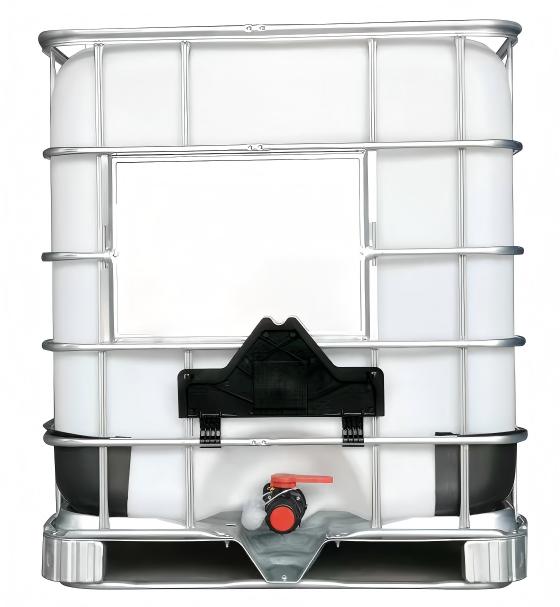
The product's stated benefits include a solvent-free and ultra-low VOC profile, strong cross-linking performance, effective sealing, and a warm wood appearance. Because this two-component coating is sensitive to application temperature, the audit should verify that technical instructions and test reports address the recommended construction range of 15-40°C. At lower temperatures, the coating may develop a foggy appearance and dry more slowly, so temperature-related risk controls should be documented.
Quality, Shelf Life, and Customer Support
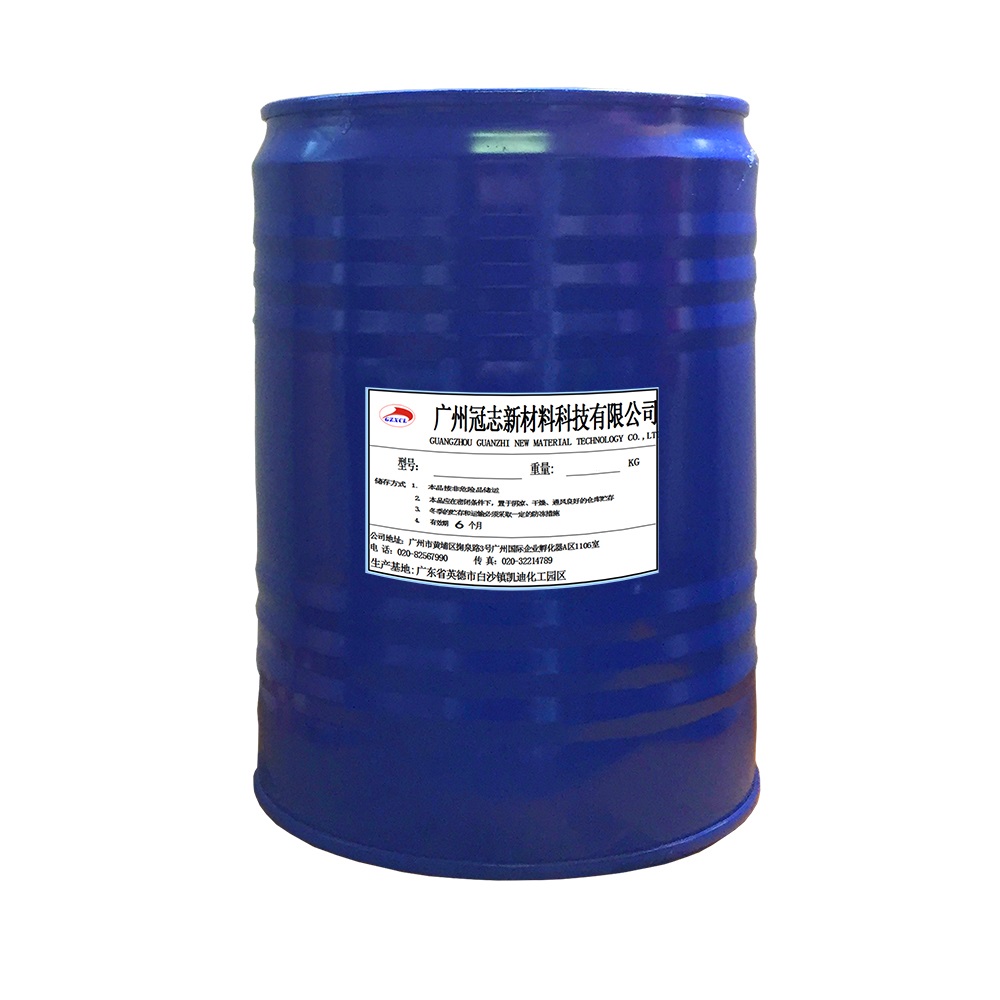
Product release procedures should be reviewed against the listed inspection items: solid content, pH value, viscosity, and particle size distribution. The audit should compare incoming-material records, in-process checks, finished-product reports, and retained-sample procedures. EP-8801 information also identifies factory quality control, a 12-month shelf life, technical support, and free reference formulas. These claims should be supported by controlled documents rather than assumed test results.
R&D, Certification, and Customer Evidence
Research and application capability is another important part of the assessment. Guanzhi reports R&D and application centers in Guangzhou and Shanghai, a specialist team containing more than 10 Ph.D. and master's-level professionals, and more than 50 invention patents. The company has also been approved to establish a Postdoctoral Research Workstation and the Guangdong Provincial Engineering Technology Research Center for High-Performance Waterborne Polyurethane Materials (Guanzhi). Auditors should verify laboratory staffing, development records, application trials, intellectual-property documentation, and scale-up controls.
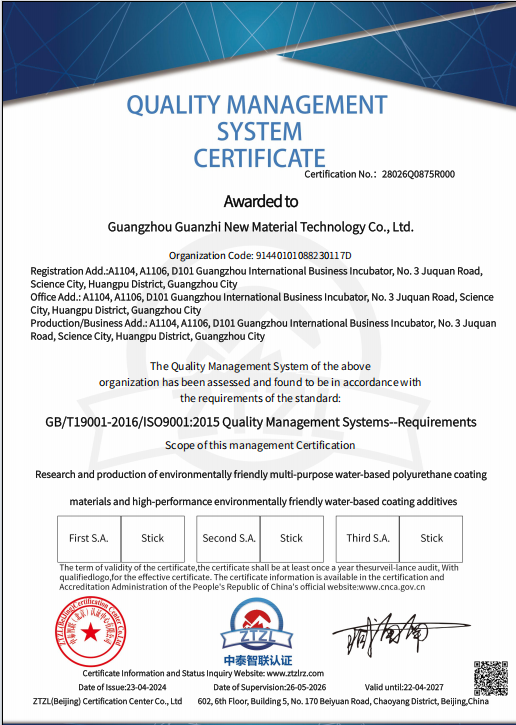
Certifications and customer references should be checked as formal evidence. The listed credentials include the QUALITY MANAGEMENTSYSTEMCERTIFICATE, certificate number 28026Q0875R000, and the Certificate of Intellectual Property ComplianceManagement System Certification, certificate number 404IPI251042ROM. PPG and Nippon Paint are identified as coating-related cooperation cases in China. These references can be reviewed for scope, relevance, and supporting customer-service records.
Audit Evidence Comparison
| Review Category | Reported Information | Recommended Verification |
|---|---|---|
| Manufacturing Capacity | 30,000 tons annually, automated water-based lines, and ABB robots | Confirm capacity calculations, equipment condition, operating records, and continuity planning |
| Quality Management | Solid content, pH, viscosity, and particle size distribution controls | Examine test methods, batch results, calibration records, and product-release approvals |
| EP-8801 Application | Approximately 2:1 with OS-8802 and a 15-40°C recommended construction range | Review formulation instructions, temperature testing, adjustment records, and application data |
| Research and Development | Guangzhou and Shanghai R&D and application centers and more than 50 invention patents | Assess laboratory equipment, technical personnel, development files, and scale-up procedures |
| Commercial Service | 900 KG MOQ, 7-10 day delivery, technical support, and free reference formulas | Check order records, delivery performance, response procedures, and customer documentation |
Frequently Asked Questions
What documents should be requested during an industrial resin factory audit?
Request production records, equipment lists, maintenance and calibration files, laboratory reports, quality-control procedures, and evidence supporting the stated 30,000-ton annual capacity. The audit should confirm that facility capability is supported by repeatable production and release controls.
Which points are most important when reviewing EP-8801?
Verify the solvent-free, silicone-modified epoxy resin description, its use with OS-8802, the approximate 2:1 mixing ratio, ultra-low VOC positioning, sealing performance, warm wood appearance, and the 15-40°C application guidance. Also review the risks of fogging and slower drying at lower temperatures.
What quality indicators are available for resin inspection?
The identified quality indicators are solid content, pH value, viscosity, and particle size distribution. The available EP-8801 information also cites factory quality control, a 12-month shelf life, technical support, and free reference formulas.
Conclusion and Practical Recommendations
A reliable industrial resin audit should combine a plant visit, equipment verification, formulation review, laboratory assessment, certification check, and commercial-service evaluation. For EP-8801, the audit file should clearly record OS-8802 compatibility, the approximate 2:1 ratio, temperature limitations, quality checkpoints, shelf life, and technical documentation. Guanzhi's reported combination of R&D, manufacturing, and direct sales makes it possible to review the complete path from product development to customer support. For detailed technical solutions or support, please contact sophia@guanzhihg.com.
About Us
Guangzhou Guanzhi New Material Technology Co., Ltd. was established in 2014 as a high-tech enterprise integrating R&D, production, sales, and technical services.
The company develops water-based resins, water-based crosslinkers, water-based additives, and bio-based special polyols. It reports an annual production capacity of 30,000 tons and maintains R&D and application centers in Guangzhou and Shanghai.
Its listed credentials include the QUALITY MANAGEMENTSYSTEMCERTIFICATE and the Certificate of Intellectual Property ComplianceManagement System Certification.
Guanzhi serves customers in multiple industries, with PPG and Nippon Paint listed as cooperation cases in coating applications.

REPORT