







-
 Agriculture
-
 Health-Care
-
 Environment
-
 Construction-Real-Estate
-
 Tools-Hardware
-
 Home-Garden
-
 Furniture
-
 Luggage-Bags-Cases
-
 Medical-devices-Supplies
-
 Gifts-Crafts
-
 Sports-Entertainment
-
 Food-Beverage
-
 Vehicles-Transportation
-
 Power-Transmission
-
 Material-Handling
-
 Renewable-Energy
-
 Safety
-
 Testing-Instrument-Equipment
-
 Construction-Building-Machinery
-
 Pet-Supplies
-
 Personal-Care-Household-Cleaning
-
 Vehicle-Accessories-Electronics-Tools
-
 School-Office-Supplies
-
 Packaging-Printing
-
 Mother-Kids-Toys
-
 Business-Services
-
 Commercial-Equipment-Machinery
-
 Apparel-Accessories
-
 Security
-
 Shoes-Accessories
-
 Vehicle-Parts-Accessories
-
 Jewelry-Eyewear-Watches-Accessories
-
 Lights-Lighting
-
 Fabric-Textile-Raw-Material
-
 Fabrication-Services
-
 Industrial-Machinery
-
 Consumer-Electronics
-
 Electrical-Equipment-Supplies
-
 Electronic-Components-Accessories-Telecommunications
-
 Home-Appliances
-
 Beauty
-
 Chemicals
-
 Rubber-Plastics
-
 Metals-Alloys


























































































































































































































































































































































































































































































































































































- Masonry Materials
- Curtain Walls & Accessories
- Earthwork Products
- Fireproofing Materials
- Heat Insulation Materials
- Plastic Building Materials
- Building Boards
- Soundproofing Materials
- Timber
- Waterproofing Materials
- Balustrades & Handrails
- Bathroom & Kitchen
- Flooring & Accessories
- Tiles & Accessories
- Door, Window & Accessories
- Fireplaces & Stoves
- Floor Heating Systems & Parts
- Stairs & Stair Parts
- Ceilings
- Elevators & Escalators
- Stone
- Countertops, Vanity Tops & Table Tops
- Mosaics
- Metal Building Materials
- Multifunctional Materials
- Ladders & Scaffoldings
- Mouldings
- Corner Guards
- Decorative Films
- Formwork
- Building & Industrial Glass
- Other Construction & Real Estate
- Wallpapers/Wall panels
- HVAC System & Parts
- Outdoor Facilities
- Prefabricated Buildings
- Festive & Party Supplies
- Bathroom Products
- Household Sundries
- Rain Gear
- Garden Supplies
- Household Cleaning Tools & Accessories
- Lighters & Smoking Accessories
- Home Storage & Organization
- Household Scales
- Smart Home Improvement
- Home Textiles
- Kitchenware
- Drinkware & Accessories
- Dinnerware, Coffee & Wine
- Home Decor
- Golf
- Fitness & Body Building
- Amusement Park Facilities
- Billiards, Board Game,Coin Operated Games
- Musical Instruments
- Outdoor Affordable Luxury Sports
- Camping & Hiking
- Fishing
- Sports Safety&Rehabilitation
- Ball Sports Equipments
- Water Sports
- Winter Sports
- Luxury Travel Equipments
- Sports Shoes, Bags & Accessories
- Cycling
- Other Sports & Entertainment Products
- Artificial Grass&Sports Flooring&Sports Court Equipment
- Scooters
- Food Ingredients
- Honey & Honey Products
- Snacks
- Nuts & Kernels
- Seafood
- Plant & Animal Oil
- Beverages
- Fruit & Vegetable Products
- Frog & Escargot
- Bean Products
- Egg Products
- Dairy Products
- Seasonings & Condiments
- Canned Food
- Instant Food
- Baked Goods
- Other Food & Beverage
- Meat & Poultry
- Confectionery
- Grain Products
- Feminie Care
- Hair Care & Styling
- Body Care
- Hands & Feet Care
- Hygiene Products
- Men's Grooming
- Laundry Cleaning Supplies
- Travel Size & Gift Sets
- Room Deodorizers
- Other Personal Care Products
- Pest Control Products
- Special Household Cleaning
- Floor Cleaning
- Kitchen & Bathroom Cleaning
- Oral Care
- Bath Supplies
- Yellow Pages
- Correction Supplies
- Office Binding Supplies
- Office Cutting Supplies
- Board Erasers
- Office Adhesives & Tapes
- Education Supplies
- Pencil Cases & Bags
- Notebooks & Writing Pads
- File Folder Accessories
- Calendars
- Writing Accessories
- Commercial Office Supplies
- Pencil Sharpeners
- Pens
- Letter Pad/Paper
- Paper Envelopes
- Desk Organizers
- Pencils
- Markers & Highlighters
- Filing Products
- Art Supplies
- Easels
- Badge Holder & Accessories
- Office Paper
- Printer Supplies
- Book Covers
- Other Office & School Supplies
- Stationery Set
- Boards
- Clipboards
- Stamps
- Drafting Supplies
- Stencils
- Electronic Dictionary
- Books
- Map
- Magazines
- Calculators
- Baby & Toddler Toys
- Educational Toys
- Classic Toys
- Dress Up & Pretend Play
- Toy Vehicle
- Stuffed Animals & Plush Toys
- Outdoor Toys & Structures
- Balloons & Accessories
- Baby Food
- Children's Clothing
- Baby Supplies & Products
- Maternity Clothes
- Kids Shoes
- Baby Care
- Novelty & Gag Toys
- Dolls & Accessories
- Puzzle & Games
- Blocks & Model Building Toys
- Toddler Clothing
- Baby Clothing
- Kids' Luggage & Bags
- Arts, Crafts & DIY Toys
- Action & Toy Figures
- Baby Appliances
- Hobbies & Models
- Remote Control Toys
- Promotional Toys
- Pregnancy & Maternity
- Hygiene Products
- Kid's Textile&Bedding
- Novelty & Special Use
- Toy Weapons
- Baby Gifts
- Baby Storage & Organization
- Auto Drive Systems
- ATV/UTV Parts & Accessories
- Marine Parts & Accessories
- Other Auto Parts
- Trailer Parts & Accessories
- Auto Transmission Systems
- Train Parts & Accessories
- Universal Parts
- Railway Parts & Accessories
- Auto Brake Systems
- Aviation Parts & Accessories
- Truck Parts & Accessories
- Auto Suspension Systems
- Auto Lighting Systems
- New Energy Vehicle Parts & Accessories
- Auto Steering Systems
- Wheels, Tires & Accessories
- Bus Parts & Accessories
- Auto Performance Parts
- Cooling System
- Go-Kart & Kart Racer Parts & Accessories
- Air Conditioning Systems
- Heavy Duty Vehicle Parts & Accessories
- Auto Electrical Systems
- Auto Body Systems
- Auto Engine Systems
- Container Parts & Accessories
- Motorcycle Parts & Accessories
- Refrigeration & Heat Exchange Equipment
- Machine Tool Equipment
- Food & Beverage Machinery
- Agricultural Machinery & Equipment
- Apparel & Textile Machinery
- Chemical Machinery
- Packaging Machines
- Paper Production Machinery
- Plastic & Rubber Processing Machinery
- Industrial Robots
- Electronic Products Machinery
- Metal & Metallurgy Machinery
- Woodworking Machinery
- Home Product Manufacturing Machinery
- Machinery Accessories
- Environmental Machinery
- Machinery Service
- Electrical Equipment Manufacturing Machinery
- Industrial Compressors & Parts
- Tobacco & Cigarette Machinery
- Production Line
- Used Industrial Machinery
- Electronics Production Machinery
- Other Machinery & Industrial Equipment
- Camera, Photo & Accessories
- Portable Audio, Video & Accessories
- Television, Home Audio, Video & Accessories
- Video Games & Accessories
- Mobile Phone & Accessories
- Electronic Publications
- Earphone & Headphone & Accessories
- Speakers & Accessories
- Smart Electronics
- TV Receivers & Accessories
- Mobile Phone & Computer Repair Parts
- Chargers, Batteries & Power Supplies
- Used Electronics
- VR, AR, MR Hardware & Software
- Projectors & Presentation Equipments
- Other Consumer Electronics
- Cables & Commonly Used Accessories
- Computer Hardware & Software
- Displays, Signage and Optoelectronics
- Discrete Semiconductors
- Wireless & IoT Module and Products
- Telecommunications
- Connectors, Terminals & Accessories
- Development Boards, Electronic Modules and Kits
- Circuit Protection
- Sensors
- Isolators
- Audio Components and Products
- Integrated Circuits
- Power Supplies
- Relays
- RF, Microwave and RFID
- Electronic Accessories & Supplies
- Passive Components
- PCB & PCBA
- Air Quality Appliances
- Home Appliance Parts
- Heating & Cooling Appliances
- Small Kitchen Appliances
- Laundry Appliances
- Water Heaters
- Water Treatment Appliances
- Refrigerators & Freezers
- Personal Care & Beauty Appliances
- Major Kitchen Appliances
- Cleaning Appliances
- Second-hand Appliances
- Smart Home Appliances
- Other Home Appliances
- Energy Chemicals
- Inorganic Chemicals
- Basic Organic Chemicals
- Agrochemicals
- Admixture & Additives
- Catalysts & Chemical Auxiliary Agents
- Pigments & Dyestuff
- Coating & Paint
- Daily Chemicals
- Polymer
- Organic Intermediate
- Adhesives & Sealants
- Chemical Waste
- Biological Chemical Products
- Surface Treatment Chemicals
- Painting & Coating
- Chemical Reagents
- Flavor & Fragrance
- Non-Explosive Demolition Agents
- Other Chemicals
- Custom Chemical Services

How to Inspect Electroplating Quality on Designer Sunglasses Samples
Assessing the electroplating quality of a designer sunglasses sample requires a systematic review of appearance, coating coverage, adhesion, and resistance to ordinary handling. Use the approved design sample as the benchmark, inspect the complete frame under stable lighting, and document every result by component and defect type. Common issues include color inconsistency, dull areas, scratches, peeling, incomplete coverage, and visible base material.
Inspection Priorities and Main Findings
- Examine the front, temples, edges, corners, hinges, temple tips, and all clip-on components under consistent lighting.
- Compare the sample’s color, gloss, smoothness, coating continuity, and decorative details with the approved designer sunglasses reference.
- Observe the finish during controlled opening, closing, fitting, and clip-on removal to identify lifting, flaking, scratches, or exposed substrate.
- Record the precise defect location and classification so corrections can be completed before OEM or ODM production approval.
Step-by-Step Electroplating Quality Assessment
1. Prepare a Consistent Visual Inspection
Inspect the sunglasses sample in a clean area with uniform lighting. View the frame from multiple angles and check both prominent and less visible surfaces. The electroplated layer should appear even and continuous, without noticeable shade changes, cloudy patches, roughness, pinholes, scratches, or exposed underlying material.
2. Check Coverage on Complex Areas
Edges, corners, hinge zones, temple ends, and transitions around the polarized clip-on component deserve special attention. These areas may show thin coating, incomplete plating, uneven color, or poor finishing more clearly than broad front surfaces. Confirm that the decorative layer follows the complete contour of every relevant component.
3. Compare with the Approved Reference
The approved physical sample or design reference should determine whether the color, gloss level, surface texture, and decorative elements are acceptable. Do not rely only on a product image to judge plating consistency. Use photographs or the image for general frame-shape and clip-on reference, while the approved sample remains the primary quality standard.
4. Observe Adhesion and Handling Resistance
During sample evaluation, repeatedly open and close the temples, handle contact points, fit the frame, and install or remove the clip-on component. Afterward, check whether the coating has lifted, cracked, flaked, or changed appearance. Pay particular attention to moving parts and frequently touched edges.
No numerical acceptance limits, test-cycle requirements, or coating-thickness specifications are provided in the available product information. Buyers and suppliers should define these criteria in the approved sample specification before mass production begins.
Yiwu Green Shine Arts & Crafts Co., Ltd. states that its product development capabilities include designers, optical engineers, 3D modeling systems, and rapid prototyping equipment. Its reported process includes concept development, structural refinement, trial sampling, and mold customization. The company also describes checks for UV protection, impact resistance, wearing comfort, and durability. These product checks should be evaluated separately from electroplating acceptance unless the project specification combines them.
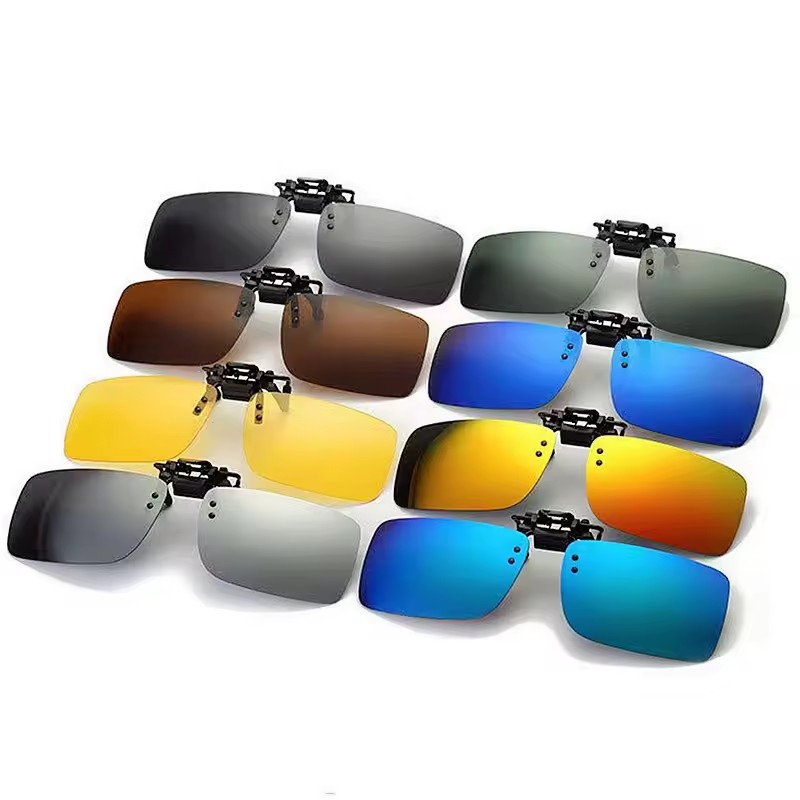
The listed product is a custom-logo wholesale unisex driving glasses design with polarized clip-on lenses and UV400 positioning. The product image below may assist with identifying the frame shape and clip-on structure during inspection.
Electroplating Inspection Checklist
| Inspection Category | Evaluation Points | Recommended Record |
|---|---|---|
| Visual finish | Check shade consistency, gloss, smoothness, scratches, dull spots, and surface marks. | Pass or fail, including the affected location |
| Coating coverage | Review edges, corners, temples, hinges, temple tips, and clip-on connection areas. | Complete, incomplete, or substrate exposed |
| Adhesion | Look for lifting, peeling, flaking, cracking, or separation during controlled handling. | Stable or defective, with defect size and position |
| Handling durability | Inspect the finish after opening, closing, fitting, and removing the clip-on repeatedly. | No visible change or visible damage |
| Reference conformity | Compare the approved sample for color, gloss, texture, and decorative accuracy. | Conforming or requiring corrective action |
Frequently Asked Questions
Which parts of a designer sunglasses sample need the most attention?
Inspect the main frame surfaces as well as edges, corners, hinges, temple tips, contact points, and the areas around the polarized clip-on unit. These locations are more likely to reveal incomplete plating or handling damage.
Is a visual inspection sufficient to approve electroplating?
Visual checks can identify uneven color, gloss variation, scratches, peeling, flaking, and exposed material. Final approval should also consider agreed adhesion, durability, handling, coating-thickness, and other project-specific requirements.
How should a failed sample be documented?
List the defect type, exact position, affected component, comparison reference, and inspection stage where the problem appeared. If the failure occurred during handling, note the operation that caused or revealed it. Numerical limits should be confirmed before production approval.
Conclusion and Practical Recommendations
A reliable electroplating review combines visual comparison, full-surface coverage inspection, adhesion observation, and controlled handling tests. Always use the approved designer sunglasses sample to judge color, gloss, texture, and decorative consistency. Record each issue clearly by location so the supplier can make targeted improvements before OEM or ODM manufacturing.
Yiwu Green Shine Arts & Crafts Co., Ltd. states that it provides OEM and ODM support for sunglasses, optical products, and related eyewear designs. For technical assistance or project inquiries, contact leoxiao@cngreenshine.com.
About Yiwu Green Shine Arts & Crafts Co., Ltd.
Yiwu Green Shine Arts & Crafts Co., Ltd. was founded in 2016 in Yiwu, Zhejiang Province. The company specializes in fashion eyewear, including sunglasses, optical frames, acetate sunglasses, children’s sunglasses, and reading glasses. It states that it operates with 10 employees in a 130-square-meter facility and supports product development through designers, optical engineers, 3D modeling, rapid prototyping, OEM services, and ODM customization.

REPORT