







-
 Agriculture
-
 Health-Care
-
 Environment
-
 Construction-Real-Estate
-
 Tools-Hardware
-
 Home-Garden
-
 Furniture
-
 Luggage-Bags-Cases
-
 Medical-devices-Supplies
-
 Gifts-Crafts
-
 Sports-Entertainment
-
 Food-Beverage
-
 Vehicles-Transportation
-
 Power-Transmission
-
 Material-Handling
-
 Renewable-Energy
-
 Safety
-
 Testing-Instrument-Equipment
-
 Construction-Building-Machinery
-
 Pet-Supplies
-
 Personal-Care-Household-Cleaning
-
 Vehicle-Accessories-Electronics-Tools
-
 School-Office-Supplies
-
 Packaging-Printing
-
 Mother-Kids-Toys
-
 Business-Services
-
 Commercial-Equipment-Machinery
-
 Apparel-Accessories
-
 Security
-
 Shoes-Accessories
-
 Vehicle-Parts-Accessories
-
 Jewelry-Eyewear-Watches-Accessories
-
 Lights-Lighting
-
 Fabric-Textile-Raw-Material
-
 Fabrication-Services
-
 Industrial-Machinery
-
 Consumer-Electronics
-
 Electrical-Equipment-Supplies
-
 Electronic-Components-Accessories-Telecommunications
-
 Home-Appliances
-
 Beauty
-
 Chemicals
-
 Rubber-Plastics
-
 Metals-Alloys


























































































































































































































































































































































































































































































































































































- Masonry Materials
- Curtain Walls & Accessories
- Earthwork Products
- Fireproofing Materials
- Heat Insulation Materials
- Plastic Building Materials
- Building Boards
- Soundproofing Materials
- Timber
- Waterproofing Materials
- Balustrades & Handrails
- Bathroom & Kitchen
- Flooring & Accessories
- Tiles & Accessories
- Door, Window & Accessories
- Fireplaces & Stoves
- Floor Heating Systems & Parts
- Stairs & Stair Parts
- Ceilings
- Elevators & Escalators
- Stone
- Countertops, Vanity Tops & Table Tops
- Mosaics
- Metal Building Materials
- Multifunctional Materials
- Ladders & Scaffoldings
- Mouldings
- Corner Guards
- Decorative Films
- Formwork
- Building & Industrial Glass
- Other Construction & Real Estate
- Wallpapers/Wall panels
- HVAC System & Parts
- Outdoor Facilities
- Prefabricated Buildings
- Festive & Party Supplies
- Bathroom Products
- Household Sundries
- Rain Gear
- Garden Supplies
- Household Cleaning Tools & Accessories
- Lighters & Smoking Accessories
- Home Storage & Organization
- Household Scales
- Smart Home Improvement
- Home Textiles
- Kitchenware
- Drinkware & Accessories
- Dinnerware, Coffee & Wine
- Home Decor
- Golf
- Fitness & Body Building
- Amusement Park Facilities
- Billiards, Board Game,Coin Operated Games
- Musical Instruments
- Outdoor Affordable Luxury Sports
- Camping & Hiking
- Fishing
- Sports Safety&Rehabilitation
- Ball Sports Equipments
- Water Sports
- Winter Sports
- Luxury Travel Equipments
- Sports Shoes, Bags & Accessories
- Cycling
- Other Sports & Entertainment Products
- Artificial Grass&Sports Flooring&Sports Court Equipment
- Scooters
- Food Ingredients
- Honey & Honey Products
- Snacks
- Nuts & Kernels
- Seafood
- Plant & Animal Oil
- Beverages
- Fruit & Vegetable Products
- Frog & Escargot
- Bean Products
- Egg Products
- Dairy Products
- Seasonings & Condiments
- Canned Food
- Instant Food
- Baked Goods
- Other Food & Beverage
- Meat & Poultry
- Confectionery
- Grain Products
- Feminie Care
- Hair Care & Styling
- Body Care
- Hands & Feet Care
- Hygiene Products
- Men's Grooming
- Laundry Cleaning Supplies
- Travel Size & Gift Sets
- Room Deodorizers
- Other Personal Care Products
- Pest Control Products
- Special Household Cleaning
- Floor Cleaning
- Kitchen & Bathroom Cleaning
- Oral Care
- Bath Supplies
- Yellow Pages
- Correction Supplies
- Office Binding Supplies
- Office Cutting Supplies
- Board Erasers
- Office Adhesives & Tapes
- Education Supplies
- Pencil Cases & Bags
- Notebooks & Writing Pads
- File Folder Accessories
- Calendars
- Writing Accessories
- Commercial Office Supplies
- Pencil Sharpeners
- Pens
- Letter Pad/Paper
- Paper Envelopes
- Desk Organizers
- Pencils
- Markers & Highlighters
- Filing Products
- Art Supplies
- Easels
- Badge Holder & Accessories
- Office Paper
- Printer Supplies
- Book Covers
- Other Office & School Supplies
- Stationery Set
- Boards
- Clipboards
- Stamps
- Drafting Supplies
- Stencils
- Electronic Dictionary
- Books
- Map
- Magazines
- Calculators
- Baby & Toddler Toys
- Educational Toys
- Classic Toys
- Dress Up & Pretend Play
- Toy Vehicle
- Stuffed Animals & Plush Toys
- Outdoor Toys & Structures
- Balloons & Accessories
- Baby Food
- Children's Clothing
- Baby Supplies & Products
- Maternity Clothes
- Kids Shoes
- Baby Care
- Novelty & Gag Toys
- Dolls & Accessories
- Puzzle & Games
- Blocks & Model Building Toys
- Toddler Clothing
- Baby Clothing
- Kids' Luggage & Bags
- Arts, Crafts & DIY Toys
- Action & Toy Figures
- Baby Appliances
- Hobbies & Models
- Remote Control Toys
- Promotional Toys
- Pregnancy & Maternity
- Hygiene Products
- Kid's Textile&Bedding
- Novelty & Special Use
- Toy Weapons
- Baby Gifts
- Baby Storage & Organization
- Auto Drive Systems
- ATV/UTV Parts & Accessories
- Marine Parts & Accessories
- Other Auto Parts
- Trailer Parts & Accessories
- Auto Transmission Systems
- Train Parts & Accessories
- Universal Parts
- Railway Parts & Accessories
- Auto Brake Systems
- Aviation Parts & Accessories
- Truck Parts & Accessories
- Auto Suspension Systems
- Auto Lighting Systems
- New Energy Vehicle Parts & Accessories
- Auto Steering Systems
- Wheels, Tires & Accessories
- Bus Parts & Accessories
- Auto Performance Parts
- Cooling System
- Go-Kart & Kart Racer Parts & Accessories
- Air Conditioning Systems
- Heavy Duty Vehicle Parts & Accessories
- Auto Electrical Systems
- Auto Body Systems
- Auto Engine Systems
- Container Parts & Accessories
- Motorcycle Parts & Accessories
- Refrigeration & Heat Exchange Equipment
- Machine Tool Equipment
- Food & Beverage Machinery
- Agricultural Machinery & Equipment
- Apparel & Textile Machinery
- Chemical Machinery
- Packaging Machines
- Paper Production Machinery
- Plastic & Rubber Processing Machinery
- Industrial Robots
- Electronic Products Machinery
- Metal & Metallurgy Machinery
- Woodworking Machinery
- Home Product Manufacturing Machinery
- Machinery Accessories
- Environmental Machinery
- Machinery Service
- Electrical Equipment Manufacturing Machinery
- Industrial Compressors & Parts
- Tobacco & Cigarette Machinery
- Production Line
- Used Industrial Machinery
- Electronics Production Machinery
- Other Machinery & Industrial Equipment
- Camera, Photo & Accessories
- Portable Audio, Video & Accessories
- Television, Home Audio, Video & Accessories
- Video Games & Accessories
- Mobile Phone & Accessories
- Electronic Publications
- Earphone & Headphone & Accessories
- Speakers & Accessories
- Smart Electronics
- TV Receivers & Accessories
- Mobile Phone & Computer Repair Parts
- Chargers, Batteries & Power Supplies
- Used Electronics
- VR, AR, MR Hardware & Software
- Projectors & Presentation Equipments
- Other Consumer Electronics
- Cables & Commonly Used Accessories
- Computer Hardware & Software
- Displays, Signage and Optoelectronics
- Discrete Semiconductors
- Wireless & IoT Module and Products
- Telecommunications
- Connectors, Terminals & Accessories
- Development Boards, Electronic Modules and Kits
- Circuit Protection
- Sensors
- Isolators
- Audio Components and Products
- Integrated Circuits
- Power Supplies
- Relays
- RF, Microwave and RFID
- Electronic Accessories & Supplies
- Passive Components
- PCB & PCBA
- Air Quality Appliances
- Home Appliance Parts
- Heating & Cooling Appliances
- Small Kitchen Appliances
- Laundry Appliances
- Water Heaters
- Water Treatment Appliances
- Refrigerators & Freezers
- Personal Care & Beauty Appliances
- Major Kitchen Appliances
- Cleaning Appliances
- Second-hand Appliances
- Smart Home Appliances
- Other Home Appliances
- Energy Chemicals
- Inorganic Chemicals
- Basic Organic Chemicals
- Agrochemicals
- Admixture & Additives
- Catalysts & Chemical Auxiliary Agents
- Pigments & Dyestuff
- Coating & Paint
- Daily Chemicals
- Polymer
- Organic Intermediate
- Adhesives & Sealants
- Chemical Waste
- Biological Chemical Products
- Surface Treatment Chemicals
- Painting & Coating
- Chemical Reagents
- Flavor & Fragrance
- Non-Explosive Demolition Agents
- Other Chemicals
- Custom Chemical Services

How to Maintain a Space Capsule House Exterior in Harsh Climates
Maintaining a space capsule house in a demanding climate requires more than occasional cleaning. The aluminum shell, protective coatings, sealants, glazing, drainage system, balcony, and structural connection points should be checked according to local weather conditions and the unit’s transport or relocation schedule. Coastal salt, desert dust, heavy rain, freezing temperatures, and strong winds can all accelerate exterior wear.
Essential Exterior Maintenance Practices
- Clean fluorocarbon-coated aluminum panels regularly to remove salt, sand, dust, bird residue, and other deposits that may affect the finish.
- Examine panel seams, window and skylight seals, balcony connections, doors, drainage routes, and waterproof interfaces after storms or major temperature changes.
- Repair scratches, peeling paint, exposed metal, damaged glass, blocked drains, and failed sealants as soon as they are discovered.
- Inspect support feet, lifting lugs, balcony assemblies, lighting fixtures, and other exposed components after lifting, transportation, installation, or relocation.
Exterior Materials and Climate Performance
The space capsule house uses a 2.0-2.5 mm aviation-grade aluminum alloy exterior with fluorocarbon baking paint, UV protection, and anti-rust treatment. This shell is supported by a 70-100 mm closed-cell polyurethane sandwich-panel system designed to provide insulation, moisture resistance, sound reduction, waterproofing, and fire-retardant performance. The listed operating range is -40 C to +50 C, although maintenance intervals should always be adjusted to the actual site environment.
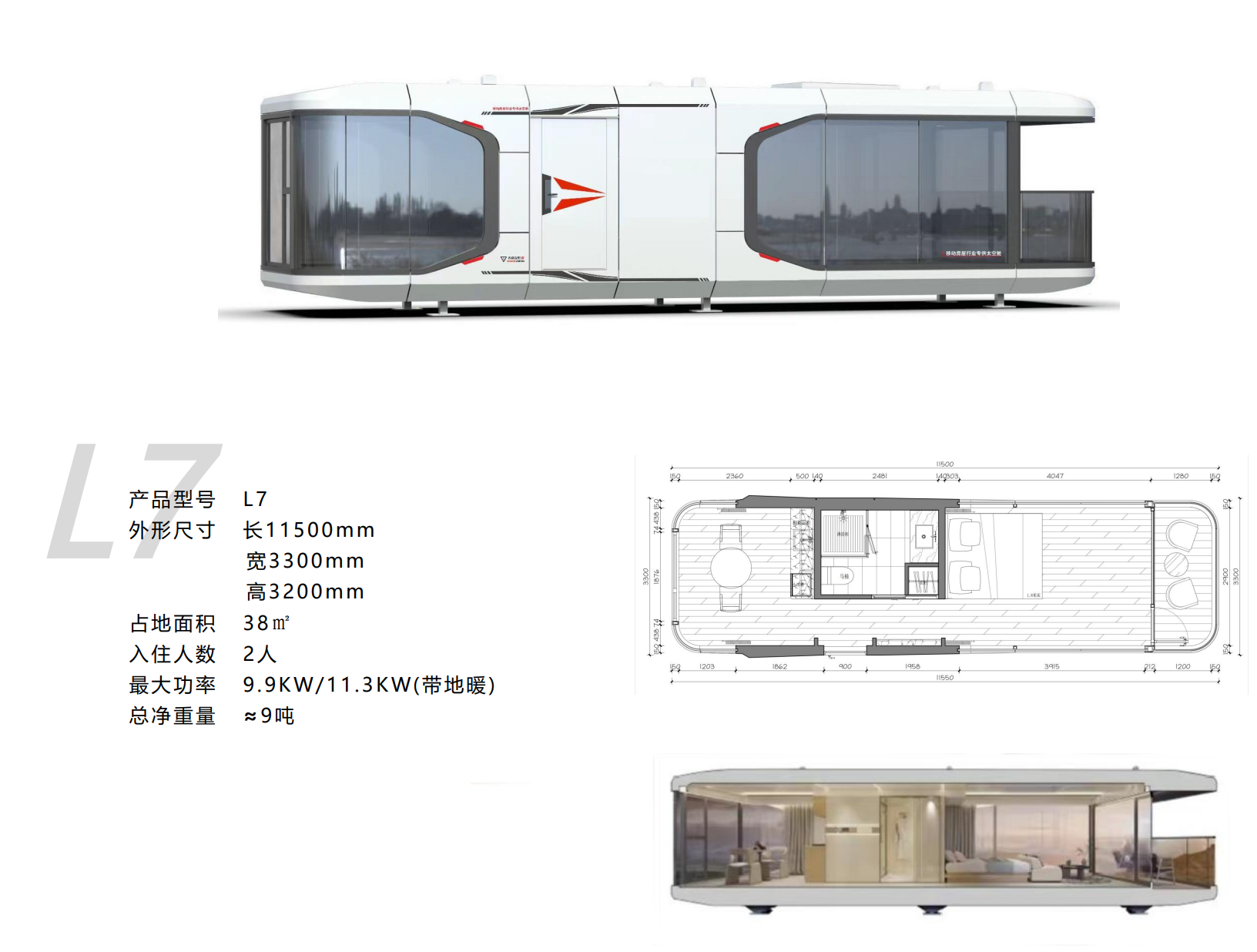
Coastal and Desert Locations
At seaside sites, remove salt deposits from aluminum panels, glass edges, fasteners, guardrails, balcony surfaces, and drainage channels. Salt can remain active on surfaces even when damage is not immediately visible. In desert, dry, or windy areas, clear sand from panel joints, door thresholds, window frames, balcony corners, and other areas where particles can accumulate or interfere with seals.
Cold, Wet, and Mountainous Areas
In regions exposed to freezing weather, snow, or persistent rainfall, pay particular attention to sealant flexibility, panel joints, drainage performance, skylights, and possible moisture entry. Standing water, frozen drainage paths, or cracked seals should be addressed promptly to help protect the insulated wall system and interior finishes.
Structural and Connection Inspections
The main frame is made from fully welded, hot-dip galvanized Q355 high-strength square steel tubes. Pickling, phosphating, and electrostatic fluorocarbon coating are specified as part of the corrosion-protection process. Although the product is listed with grade 10-12 wind resistance and grade 8 seismic fortification, visible damage should still be assessed after extreme weather or handling.

After strong winds, impact, lifting, or relocation, look for deformation, loose fittings, coating loss, unusual gaps, and movement around the shell, adjustable support feet, reserved lifting points, balcony structure, and exterior lighting. Any issue that may affect stability, waterproofing, or safe access should be evaluated before continued use.
Glass, Doors, Lighting, and Waterproof Details
The front façade uses double hollow Low-E tempered insulated glass, while the roof skylight is made from triple-layer hollow laminated tempered glass. Maintenance should include washing the glass with suitable non-abrasive materials, checking perimeter seals, looking for chips or cracks, and confirming that the skylight remains watertight.
Also verify that the balcony glass guardrail and aluminum frame are secure. The entry door, smart-lock enclosure, exterior lights, and nearby sealant lines should be examined for corrosion, water damage, loose parts, or deterioration caused by ultraviolet exposure. These checks are especially important in guesthouses, resorts, temporary accommodation, construction camps, and remote installations with continuous occupancy.
Maintenance Priorities by Exterior Area
| Exterior Component | Recommended Action | Related Specification |
|---|---|---|
| Aluminum shell and coating | Wash away deposits, inspect the finish, and touch up scratches or exposed areas. | 2.0-2.5 mm aviation-grade aluminum alloy with fluorocarbon baking paint, UV protection, and anti-rust treatment. |
| Panel joints and insulated walls | Check sealant continuity and look for moisture, staining, or gaps after rain, freezing, relocation, or temperature changes. | 70-100 mm closed-cell polyurethane sandwich panel with waterproof and moisture-resistant construction. |
| Windows, skylight, and balcony | Clean glazing, inspect edge seals, confirm frame and guardrail stability, and keep drainage areas clear. | Low-E tempered insulated glass, laminated tempered skylight glass, and glass balustrade. |
| Harsh-weather exposure | Increase inspection frequency and remove salt, sand, standing water, or storm debris after severe conditions. | IP65 waterproof grade, -40 C to +50 C operating range, and grade 10-12 wind resistance. |
Recommended Inspection Timing
A basic exterior review should be performed according to the site’s exposure level, with additional checks after typhoons, high winds, heavy rain, hail, sandstorms, freezing events, transportation, lifting, or relocation. Coastal and desert units generally need more frequent cleaning than units installed in sheltered locations. For tourism projects, inspections can be coordinated with guest turnover, seasonal maintenance, and planned transport cycles.
Frequently Asked Questions
How frequently should the exterior be checked in a harsh climate?
Inspect the unit after severe weather, handling, lifting, or relocation. Saltwater, blowing sand, strong winds, persistent moisture, and large temperature fluctuations are reasons to shorten the inspection interval.
Which exterior problems require immediate attention?
Scratched or peeling fluorocarbon coating, loose or cracked sealant, damaged panel joints, broken glass, blocked drainage, and movement or damage around doors, balconies, support feet, and lifting lugs should be addressed promptly.
Is exterior assembly required after delivery?
The space capsule house is supplied as a one-piece finished unit with decoration, water, and electrical systems pre-installed. It is transported for direct lifting and placement on level ground, but all exterior components should be checked after positioning.
Conclusion
A practical maintenance program should protect the fluorocarbon-coated aluminum shell, sealed polyurethane-insulated wall system, panoramic glazing, skylight, drainage routes, and structural connection points. Regular cleaning and post-weather inspections help preserve corrosion resistance, moisture protection, appearance, and long-term service performance. Guangdong Uni-House offers an industry-trade integration model, a minimum order quantity of one set, and a stated delivery time of 15 days. Its CE-certified modular housing products are supplied to Australia, Southeast Asia, the Middle East, North America, and other markets. For technical guidance or project support, contact guizugroup@outlook.com.
About Guangdong Uni-House
Guangdong Uni-House Technology Co., Ltd. is a foreign trade company established under the Guizu Group. Its support covers design, research and development, manufacturing, installation, and after-sales service through multiple production facilities. Founded in 2008, the company produces detachable container houses, expandable container houses, foldable container houses, prefab K houses, flat pack container houses, and space capsule houses. Its technical resources include 30 professional engineers and designers, more than 10 advanced production lines, over 200 mold sets, and 150 utility model patents. Its development work focuses on structural optimization, faster installation, and improved weather resistance. The company has supplied modular housing solutions for multiple industries and holds CE certification for applicable container-house products.

REPORT