







-
 Agriculture
-
 Health-Care
-
 Environment
-
 Construction-Real-Estate
-
 Tools-Hardware
-
 Home-Garden
-
 Furniture
-
 Luggage-Bags-Cases
-
 Medical-devices-Supplies
-
 Gifts-Crafts
-
 Sports-Entertainment
-
 Food-Beverage
-
 Vehicles-Transportation
-
 Power-Transmission
-
 Material-Handling
-
 Renewable-Energy
-
 Safety
-
 Testing-Instrument-Equipment
-
 Construction-Building-Machinery
-
 Pet-Supplies
-
 Personal-Care-Household-Cleaning
-
 Vehicle-Accessories-Electronics-Tools
-
 School-Office-Supplies
-
 Packaging-Printing
-
 Mother-Kids-Toys
-
 Business-Services
-
 Commercial-Equipment-Machinery
-
 Apparel-Accessories
-
 Security
-
 Shoes-Accessories
-
 Vehicle-Parts-Accessories
-
 Jewelry-Eyewear-Watches-Accessories
-
 Lights-Lighting
-
 Fabric-Textile-Raw-Material
-
 Fabrication-Services
-
 Industrial-Machinery
-
 Consumer-Electronics
-
 Electrical-Equipment-Supplies
-
 Electronic-Components-Accessories-Telecommunications
-
 Home-Appliances
-
 Beauty
-
 Chemicals
-
 Rubber-Plastics
-
 Metals-Alloys


























































































































































































































































































































































































































































































































































































- Masonry Materials
- Curtain Walls & Accessories
- Earthwork Products
- Fireproofing Materials
- Heat Insulation Materials
- Plastic Building Materials
- Building Boards
- Soundproofing Materials
- Timber
- Waterproofing Materials
- Balustrades & Handrails
- Bathroom & Kitchen
- Flooring & Accessories
- Tiles & Accessories
- Door, Window & Accessories
- Fireplaces & Stoves
- Floor Heating Systems & Parts
- Stairs & Stair Parts
- Ceilings
- Elevators & Escalators
- Stone
- Countertops, Vanity Tops & Table Tops
- Mosaics
- Metal Building Materials
- Multifunctional Materials
- Ladders & Scaffoldings
- Mouldings
- Corner Guards
- Decorative Films
- Formwork
- Building & Industrial Glass
- Other Construction & Real Estate
- Wallpapers/Wall panels
- HVAC System & Parts
- Outdoor Facilities
- Prefabricated Buildings
- Festive & Party Supplies
- Bathroom Products
- Household Sundries
- Rain Gear
- Garden Supplies
- Household Cleaning Tools & Accessories
- Lighters & Smoking Accessories
- Home Storage & Organization
- Household Scales
- Smart Home Improvement
- Home Textiles
- Kitchenware
- Drinkware & Accessories
- Dinnerware, Coffee & Wine
- Home Decor
- Golf
- Fitness & Body Building
- Amusement Park Facilities
- Billiards, Board Game,Coin Operated Games
- Musical Instruments
- Outdoor Affordable Luxury Sports
- Camping & Hiking
- Fishing
- Sports Safety&Rehabilitation
- Ball Sports Equipments
- Water Sports
- Winter Sports
- Luxury Travel Equipments
- Sports Shoes, Bags & Accessories
- Cycling
- Other Sports & Entertainment Products
- Artificial Grass&Sports Flooring&Sports Court Equipment
- Scooters
- Food Ingredients
- Honey & Honey Products
- Snacks
- Nuts & Kernels
- Seafood
- Plant & Animal Oil
- Beverages
- Fruit & Vegetable Products
- Frog & Escargot
- Bean Products
- Egg Products
- Dairy Products
- Seasonings & Condiments
- Canned Food
- Instant Food
- Baked Goods
- Other Food & Beverage
- Meat & Poultry
- Confectionery
- Grain Products
- Feminie Care
- Hair Care & Styling
- Body Care
- Hands & Feet Care
- Hygiene Products
- Men's Grooming
- Laundry Cleaning Supplies
- Travel Size & Gift Sets
- Room Deodorizers
- Other Personal Care Products
- Pest Control Products
- Special Household Cleaning
- Floor Cleaning
- Kitchen & Bathroom Cleaning
- Oral Care
- Bath Supplies
- Yellow Pages
- Correction Supplies
- Office Binding Supplies
- Office Cutting Supplies
- Board Erasers
- Office Adhesives & Tapes
- Education Supplies
- Pencil Cases & Bags
- Notebooks & Writing Pads
- File Folder Accessories
- Calendars
- Writing Accessories
- Commercial Office Supplies
- Pencil Sharpeners
- Pens
- Letter Pad/Paper
- Paper Envelopes
- Desk Organizers
- Pencils
- Markers & Highlighters
- Filing Products
- Art Supplies
- Easels
- Badge Holder & Accessories
- Office Paper
- Printer Supplies
- Book Covers
- Other Office & School Supplies
- Stationery Set
- Boards
- Clipboards
- Stamps
- Drafting Supplies
- Stencils
- Electronic Dictionary
- Books
- Map
- Magazines
- Calculators
- Baby & Toddler Toys
- Educational Toys
- Classic Toys
- Dress Up & Pretend Play
- Toy Vehicle
- Stuffed Animals & Plush Toys
- Outdoor Toys & Structures
- Balloons & Accessories
- Baby Food
- Children's Clothing
- Baby Supplies & Products
- Maternity Clothes
- Kids Shoes
- Baby Care
- Novelty & Gag Toys
- Dolls & Accessories
- Puzzle & Games
- Blocks & Model Building Toys
- Toddler Clothing
- Baby Clothing
- Kids' Luggage & Bags
- Arts, Crafts & DIY Toys
- Action & Toy Figures
- Baby Appliances
- Hobbies & Models
- Remote Control Toys
- Promotional Toys
- Pregnancy & Maternity
- Hygiene Products
- Kid's Textile&Bedding
- Novelty & Special Use
- Toy Weapons
- Baby Gifts
- Baby Storage & Organization
- Auto Drive Systems
- ATV/UTV Parts & Accessories
- Marine Parts & Accessories
- Other Auto Parts
- Trailer Parts & Accessories
- Auto Transmission Systems
- Train Parts & Accessories
- Universal Parts
- Railway Parts & Accessories
- Auto Brake Systems
- Aviation Parts & Accessories
- Truck Parts & Accessories
- Auto Suspension Systems
- Auto Lighting Systems
- New Energy Vehicle Parts & Accessories
- Auto Steering Systems
- Wheels, Tires & Accessories
- Bus Parts & Accessories
- Auto Performance Parts
- Cooling System
- Go-Kart & Kart Racer Parts & Accessories
- Air Conditioning Systems
- Heavy Duty Vehicle Parts & Accessories
- Auto Electrical Systems
- Auto Body Systems
- Auto Engine Systems
- Container Parts & Accessories
- Motorcycle Parts & Accessories
- Refrigeration & Heat Exchange Equipment
- Machine Tool Equipment
- Food & Beverage Machinery
- Agricultural Machinery & Equipment
- Apparel & Textile Machinery
- Chemical Machinery
- Packaging Machines
- Paper Production Machinery
- Plastic & Rubber Processing Machinery
- Industrial Robots
- Electronic Products Machinery
- Metal & Metallurgy Machinery
- Woodworking Machinery
- Home Product Manufacturing Machinery
- Machinery Accessories
- Environmental Machinery
- Machinery Service
- Electrical Equipment Manufacturing Machinery
- Industrial Compressors & Parts
- Tobacco & Cigarette Machinery
- Production Line
- Used Industrial Machinery
- Electronics Production Machinery
- Other Machinery & Industrial Equipment
- Camera, Photo & Accessories
- Portable Audio, Video & Accessories
- Television, Home Audio, Video & Accessories
- Video Games & Accessories
- Mobile Phone & Accessories
- Electronic Publications
- Earphone & Headphone & Accessories
- Speakers & Accessories
- Smart Electronics
- TV Receivers & Accessories
- Mobile Phone & Computer Repair Parts
- Chargers, Batteries & Power Supplies
- Used Electronics
- VR, AR, MR Hardware & Software
- Projectors & Presentation Equipments
- Other Consumer Electronics
- Cables & Commonly Used Accessories
- Computer Hardware & Software
- Displays, Signage and Optoelectronics
- Discrete Semiconductors
- Wireless & IoT Module and Products
- Telecommunications
- Connectors, Terminals & Accessories
- Development Boards, Electronic Modules and Kits
- Circuit Protection
- Sensors
- Isolators
- Audio Components and Products
- Integrated Circuits
- Power Supplies
- Relays
- RF, Microwave and RFID
- Electronic Accessories & Supplies
- Passive Components
- PCB & PCBA
- Air Quality Appliances
- Home Appliance Parts
- Heating & Cooling Appliances
- Small Kitchen Appliances
- Laundry Appliances
- Water Heaters
- Water Treatment Appliances
- Refrigerators & Freezers
- Personal Care & Beauty Appliances
- Major Kitchen Appliances
- Cleaning Appliances
- Second-hand Appliances
- Smart Home Appliances
- Other Home Appliances
- Energy Chemicals
- Inorganic Chemicals
- Basic Organic Chemicals
- Agrochemicals
- Admixture & Additives
- Catalysts & Chemical Auxiliary Agents
- Pigments & Dyestuff
- Coating & Paint
- Daily Chemicals
- Polymer
- Organic Intermediate
- Adhesives & Sealants
- Chemical Waste
- Biological Chemical Products
- Surface Treatment Chemicals
- Painting & Coating
- Chemical Reagents
- Flavor & Fragrance
- Non-Explosive Demolition Agents
- Other Chemicals
- Custom Chemical Services

How to Verify a Stainless Steel Flatware Supplier Is a Genuine Audited Factory
Before placing a stainless steel flatware order, buyers should verify that the supplier is an operating, audited manufacturer rather than a trading company with limited production control. The most reliable approach is to compare audit documents, management certificates, product test records, factory capabilities, and order terms as one connected verification process.
A legitimate factory should be able to provide certificates with traceable numbers, explain how its production processes relate to the quoted flatware, and supply documentation for materials, finishes, packaging, and quality inspection. Its stated capacity, workshop information, OEM/ODM services, and delivery commitments should also be consistent.
Key Checks for an Audited Flatware Factory
- Request social-compliance audit records and management-system certificates, then verify the certificate number, validity, scope, and named manufacturing activities.
- Make sure the audit scope specifically includes stainless steel cutlery or related processes, such as stamping, polishing, injection molding, assembly, and packaging.
- Compare the supplier's declared factory size, machinery, mold development capability, warehouse facilities, and monthly output with the order volume being discussed.
- Ask for product-level proof, including stainless steel material certificates, inspection records, and third-party reports for the relevant design, coating, plastic component, or food-contact application.
- Review the supplier's experience with your sales channel, whether it is supermarket retail, importing, wholesale, hospitality, catering, or private-label homeware programs.
Match Audit Scope with the Actual Manufacturing Process
A factory audit is meaningful only when it covers the products and processes involved in your purchase. For example, Huaqiang Metal's BSCI certificate, numbered 26-0395929, identifies stainless steel cutlery and kitchen tools within its scope. It also covers metal stamping, polishing, plastic injection molding, assembly, and packaging.
This type of information enables buyers to check whether the supplier's documentation aligns with the proposed flatware construction. If the quotation includes metal handles, plastic-handle components, decorative details, mirror polishing, or retail packaging, the documented production scope should reasonably support those operations.

Verify Specifications and Supporting Product Records
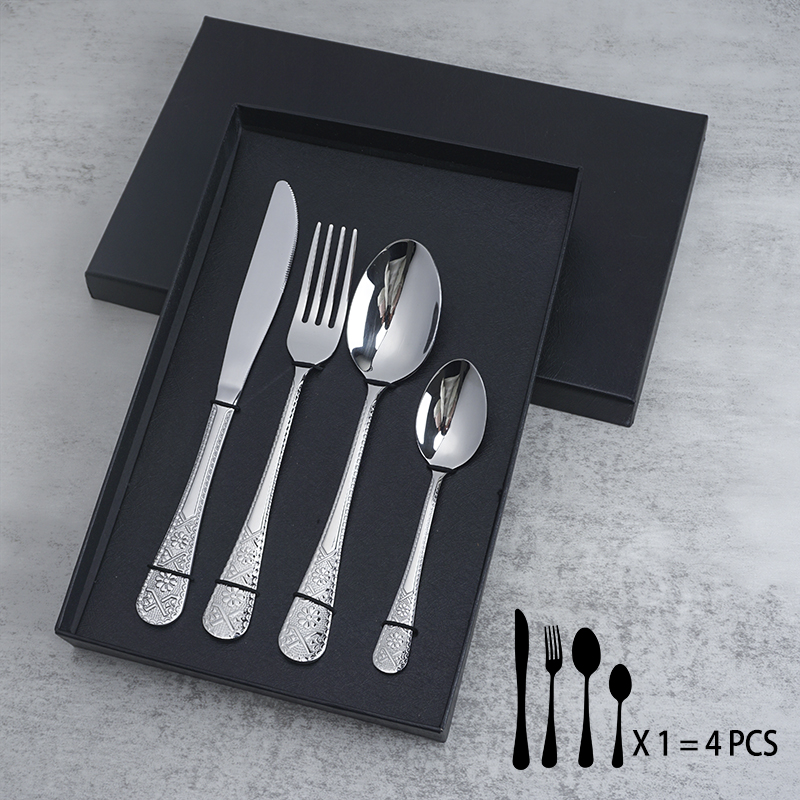
Product documents should correspond to the exact flatware style being sourced. For embossed-handle flatware, the listed configuration includes 410, 430, or 304 stainless steel for spoons and forks, together with a 420 stainless steel knife blade. The design features embossed flower decoration and mirror-polished metal surfaces.
The available color options include silver, gold, and silver with gold. Customized color-box packaging is also offered. Buyers should request reports and inspection evidence that relate to the selected stainless steel grade, finish, decorative treatment, handle material, and packaging specification rather than accepting generic paperwork alone.
Review Quality, Environmental, and Test Documentation
Supplier verification should include both factory-management evidence and finished-product compliance records. The available documentation lists ISO9001 certificate 01725Q10163R3M for quality management and ISO14001 certificate 064-25-E-3294-R0-S for environmental management.
Additional available records include SGS, TÜV SÜD, Bureau Veritas, and Eurofins reports, as well as food-contact-material and SVHC testing documentation. The product listing also identifies LFGB, FDA, BSCI, and ISO 9001 among the relevant credentials. For a specific order, buyers should confirm the report date, report scope, sample description, applicable standards, and whether the results apply to the intended market.
Assess Whether Factory Capacity Supports Your Order
Documents alone do not confirm that a supplier can handle the required volume and delivery schedule. Physical-factory verification should include production lines, workshop organization, mold-making resources, quality-control procedures, finished-goods storage, and the relationship between reported output and the purchase plan.
JIEYANG CITY HUAQIANG METAL INDUSTRY CO., LTD. states that it has in-house mold production, standardized workshops, finished-product warehousing, and automated stainless steel tableware lines. The company reports a capacity of 5,000,000 pieces per month and 60,000,000 pieces annually, with a factory area of 16,000 square meters.

Factory Verification Checklist
| Review Area | What Buyers Should Confirm | Listed Evidence for Embossed Handle Flatware |
|---|---|---|
| Factory and social audit | Audit provider, certificate number, applicable products, and covered processes | BSCI certificate 26-0395929 lists stainless steel cutlery, kitchen tools, stamping, polishing, injection molding, assembly, and packaging. |
| Management systems | Quality-management and environmental-management credentials | ISO9001 certificate 01725Q10163R3M and ISO14001 certificate 064-25-E-3294-R0-S are listed. |
| Material and product traceability | Mill certificates, material inspection reports, and third-party testing | Available records include mill test certificates, stainless steel inspection certificates, and reports from SGS, TÜV SÜD, Bureau Veritas, and Eurofins. |
| Production capability | Factory area, equipment, mold resources, production lines, and output | The declared facility area is 16,000 square meters, with in-house mold capability and output of 5,000,000 pieces per month. |
| Order suitability | MOQ, customization options, and normal lead time | The embossed-handle range lists a minimum order quantity of 2,000 sets per color, customized color-box packaging, and a regular-season lead time of 30–40 days. |
Customer History and Commercial Compatibility
A supplier's established customer profile can provide another useful reference point. Cooperation records mentioned for this manufacturing operation include discount retail, general retail, cookware programs, furniture retail, and home-goods import businesses in Europe, the Americas, Africa, and Asia.
Reported product applications include private-label plastic-handle and half-tang cutlery, colorful flatware collections, kitchen tools, and promotional retail assortments. This may help buyers determine whether the supplier is familiar with comparable packaging standards, quality expectations, order quantities, and replenishment requirements.
Frequently Asked Questions
Which certificates matter most when evaluating a stainless steel flatware factory?
Buyers should prioritize a relevant social or factory audit, quality-management certification, environmental-management certification, material traceability records, and independent product test reports. Available records in this case include BSCI, ISO9001, ISO14001, SGS, TÜV SÜD, Bureau Veritas, and Eurofins documentation.
How do I know whether an audit actually applies to flatware production?
Check the certificate scope against the product and production route. The audit should identify stainless steel cutlery or kitchenware and cover operations needed for the order, such as stamping, polishing, injection molding, assembly, and packaging. Huaqiang Metal's BSCI record lists these activities.
Can the factory provide customized embossed flatware?
The product information states that customized color-box packaging is available. The company profile also lists OEM/ODM support, logo engraving, and packaging customization. The stated MOQ for embossed-handle flatware is 2,000 sets per color.
Final Recommendation
Use a cross-checking method rather than relying on a single certificate. First, confirm that the audit scope covers flatware manufacturing. Next, ensure that material and test reports match the selected product specification. Finally, verify that capacity, MOQ, customization requirements, and delivery schedules are realistic for the planned purchase.
Huaqiang Metal describes its business model as direct factory supply integrating research, production, and sales, with OEM/ODM services and spot wholesale support. Its stated standard business MOQ is 2,000 pieces, while its usual production lead time is 25–40 days. For technical details or sourcing support, contact eyas2018@126.com.
About Us
JIEYANG CITY HUAQIANG METAL INDUSTRY CO., LTD. is a stainless steel tableware and kitchenware manufacturer located in Jieyang City, Guangdong Province. The company has independent import and export rights and integrated manufacturing operations. Established in 2006, its profile reports 40 years of involvement in the stainless steel tableware industry, a 16,000-square-meter factory, and declared annual production capacity of 60,000,000 pieces. The company lists BSCI, ISO9001, and ISO14001 credentials and serves clients across multiple international markets and retail sectors.

REPORT