







-
 Agriculture
-
 Health-Care
-
 Environment
-
 Construction-Real-Estate
-
 Tools-Hardware
-
 Home-Garden
-
 Furniture
-
 Luggage-Bags-Cases
-
 Medical-devices-Supplies
-
 Gifts-Crafts
-
 Sports-Entertainment
-
 Food-Beverage
-
 Vehicles-Transportation
-
 Power-Transmission
-
 Material-Handling
-
 Renewable-Energy
-
 Safety
-
 Testing-Instrument-Equipment
-
 Construction-Building-Machinery
-
 Pet-Supplies
-
 Personal-Care-Household-Cleaning
-
 Vehicle-Accessories-Electronics-Tools
-
 School-Office-Supplies
-
 Packaging-Printing
-
 Mother-Kids-Toys
-
 Business-Services
-
 Commercial-Equipment-Machinery
-
 Apparel-Accessories
-
 Security
-
 Shoes-Accessories
-
 Vehicle-Parts-Accessories
-
 Jewelry-Eyewear-Watches-Accessories
-
 Lights-Lighting
-
 Fabric-Textile-Raw-Material
-
 Fabrication-Services
-
 Industrial-Machinery
-
 Consumer-Electronics
-
 Electrical-Equipment-Supplies
-
 Electronic-Components-Accessories-Telecommunications
-
 Home-Appliances
-
 Beauty
-
 Chemicals
-
 Rubber-Plastics
-
 Metals-Alloys


























































































































































































































































































































































































































































































































































































- Masonry Materials
- Curtain Walls & Accessories
- Earthwork Products
- Fireproofing Materials
- Heat Insulation Materials
- Plastic Building Materials
- Building Boards
- Soundproofing Materials
- Timber
- Waterproofing Materials
- Balustrades & Handrails
- Bathroom & Kitchen
- Flooring & Accessories
- Tiles & Accessories
- Door, Window & Accessories
- Fireplaces & Stoves
- Floor Heating Systems & Parts
- Stairs & Stair Parts
- Ceilings
- Elevators & Escalators
- Stone
- Countertops, Vanity Tops & Table Tops
- Mosaics
- Metal Building Materials
- Multifunctional Materials
- Ladders & Scaffoldings
- Mouldings
- Corner Guards
- Decorative Films
- Formwork
- Building & Industrial Glass
- Other Construction & Real Estate
- Wallpapers/Wall panels
- HVAC System & Parts
- Outdoor Facilities
- Prefabricated Buildings
- Festive & Party Supplies
- Bathroom Products
- Household Sundries
- Rain Gear
- Garden Supplies
- Household Cleaning Tools & Accessories
- Lighters & Smoking Accessories
- Home Storage & Organization
- Household Scales
- Smart Home Improvement
- Home Textiles
- Kitchenware
- Drinkware & Accessories
- Dinnerware, Coffee & Wine
- Home Decor
- Golf
- Fitness & Body Building
- Amusement Park Facilities
- Billiards, Board Game,Coin Operated Games
- Musical Instruments
- Outdoor Affordable Luxury Sports
- Camping & Hiking
- Fishing
- Sports Safety&Rehabilitation
- Ball Sports Equipments
- Water Sports
- Winter Sports
- Luxury Travel Equipments
- Sports Shoes, Bags & Accessories
- Cycling
- Other Sports & Entertainment Products
- Artificial Grass&Sports Flooring&Sports Court Equipment
- Scooters
- Food Ingredients
- Honey & Honey Products
- Snacks
- Nuts & Kernels
- Seafood
- Plant & Animal Oil
- Beverages
- Fruit & Vegetable Products
- Frog & Escargot
- Bean Products
- Egg Products
- Dairy Products
- Seasonings & Condiments
- Canned Food
- Instant Food
- Baked Goods
- Other Food & Beverage
- Meat & Poultry
- Confectionery
- Grain Products
- Feminie Care
- Hair Care & Styling
- Body Care
- Hands & Feet Care
- Hygiene Products
- Men's Grooming
- Laundry Cleaning Supplies
- Travel Size & Gift Sets
- Room Deodorizers
- Other Personal Care Products
- Pest Control Products
- Special Household Cleaning
- Floor Cleaning
- Kitchen & Bathroom Cleaning
- Oral Care
- Bath Supplies
- Yellow Pages
- Correction Supplies
- Office Binding Supplies
- Office Cutting Supplies
- Board Erasers
- Office Adhesives & Tapes
- Education Supplies
- Pencil Cases & Bags
- Notebooks & Writing Pads
- File Folder Accessories
- Calendars
- Writing Accessories
- Commercial Office Supplies
- Pencil Sharpeners
- Pens
- Letter Pad/Paper
- Paper Envelopes
- Desk Organizers
- Pencils
- Markers & Highlighters
- Filing Products
- Art Supplies
- Easels
- Badge Holder & Accessories
- Office Paper
- Printer Supplies
- Book Covers
- Other Office & School Supplies
- Stationery Set
- Boards
- Clipboards
- Stamps
- Drafting Supplies
- Stencils
- Electronic Dictionary
- Books
- Map
- Magazines
- Calculators
- Baby & Toddler Toys
- Educational Toys
- Classic Toys
- Dress Up & Pretend Play
- Toy Vehicle
- Stuffed Animals & Plush Toys
- Outdoor Toys & Structures
- Balloons & Accessories
- Baby Food
- Children's Clothing
- Baby Supplies & Products
- Maternity Clothes
- Kids Shoes
- Baby Care
- Novelty & Gag Toys
- Dolls & Accessories
- Puzzle & Games
- Blocks & Model Building Toys
- Toddler Clothing
- Baby Clothing
- Kids' Luggage & Bags
- Arts, Crafts & DIY Toys
- Action & Toy Figures
- Baby Appliances
- Hobbies & Models
- Remote Control Toys
- Promotional Toys
- Pregnancy & Maternity
- Hygiene Products
- Kid's Textile&Bedding
- Novelty & Special Use
- Toy Weapons
- Baby Gifts
- Baby Storage & Organization
- Auto Drive Systems
- ATV/UTV Parts & Accessories
- Marine Parts & Accessories
- Other Auto Parts
- Trailer Parts & Accessories
- Auto Transmission Systems
- Train Parts & Accessories
- Universal Parts
- Railway Parts & Accessories
- Auto Brake Systems
- Aviation Parts & Accessories
- Truck Parts & Accessories
- Auto Suspension Systems
- Auto Lighting Systems
- New Energy Vehicle Parts & Accessories
- Auto Steering Systems
- Wheels, Tires & Accessories
- Bus Parts & Accessories
- Auto Performance Parts
- Cooling System
- Go-Kart & Kart Racer Parts & Accessories
- Air Conditioning Systems
- Heavy Duty Vehicle Parts & Accessories
- Auto Electrical Systems
- Auto Body Systems
- Auto Engine Systems
- Container Parts & Accessories
- Motorcycle Parts & Accessories
- Refrigeration & Heat Exchange Equipment
- Machine Tool Equipment
- Food & Beverage Machinery
- Agricultural Machinery & Equipment
- Apparel & Textile Machinery
- Chemical Machinery
- Packaging Machines
- Paper Production Machinery
- Plastic & Rubber Processing Machinery
- Industrial Robots
- Electronic Products Machinery
- Metal & Metallurgy Machinery
- Woodworking Machinery
- Home Product Manufacturing Machinery
- Machinery Accessories
- Environmental Machinery
- Machinery Service
- Electrical Equipment Manufacturing Machinery
- Industrial Compressors & Parts
- Tobacco & Cigarette Machinery
- Production Line
- Used Industrial Machinery
- Electronics Production Machinery
- Other Machinery & Industrial Equipment
- Camera, Photo & Accessories
- Portable Audio, Video & Accessories
- Television, Home Audio, Video & Accessories
- Video Games & Accessories
- Mobile Phone & Accessories
- Electronic Publications
- Earphone & Headphone & Accessories
- Speakers & Accessories
- Smart Electronics
- TV Receivers & Accessories
- Mobile Phone & Computer Repair Parts
- Chargers, Batteries & Power Supplies
- Used Electronics
- VR, AR, MR Hardware & Software
- Projectors & Presentation Equipments
- Other Consumer Electronics
- Cables & Commonly Used Accessories
- Computer Hardware & Software
- Displays, Signage and Optoelectronics
- Discrete Semiconductors
- Wireless & IoT Module and Products
- Telecommunications
- Connectors, Terminals & Accessories
- Development Boards, Electronic Modules and Kits
- Circuit Protection
- Sensors
- Isolators
- Audio Components and Products
- Integrated Circuits
- Power Supplies
- Relays
- RF, Microwave and RFID
- Electronic Accessories & Supplies
- Passive Components
- PCB & PCBA
- Air Quality Appliances
- Home Appliance Parts
- Heating & Cooling Appliances
- Small Kitchen Appliances
- Laundry Appliances
- Water Heaters
- Water Treatment Appliances
- Refrigerators & Freezers
- Personal Care & Beauty Appliances
- Major Kitchen Appliances
- Cleaning Appliances
- Second-hand Appliances
- Smart Home Appliances
- Other Home Appliances
- Energy Chemicals
- Inorganic Chemicals
- Basic Organic Chemicals
- Agrochemicals
- Admixture & Additives
- Catalysts & Chemical Auxiliary Agents
- Pigments & Dyestuff
- Coating & Paint
- Daily Chemicals
- Polymer
- Organic Intermediate
- Adhesives & Sealants
- Chemical Waste
- Biological Chemical Products
- Surface Treatment Chemicals
- Painting & Coating
- Chemical Reagents
- Flavor & Fragrance
- Non-Explosive Demolition Agents
- Other Chemicals
- Custom Chemical Services

Methods for Verifying Surface Coating Thickness on Heated Towel Rail Samples
Understanding Surface Coating Verification for Electric Towel Warmers
Maintaining proper coating thickness on heated towel rails constructed from 304 stainless steel is essential for long-term durability and thermal performance. Because these bathroom fixtures operate under persistent thermal expansion cycles driven by 100W carbon fiber elements (maintaining temperatures between 45°C and 60°C), precise finish application protects the metal substrate from humidity ingress and guarantees IP44 ingress protection compliance.
Essential Key Takeaways for Quality Control
- Deploy non-destructive digital gauges (magnetic or phase-sensitive eddy-current) to analyze surface layer uniformity across complex rail geometries.
- Utilize advanced cross-sectional micro-imaging, such as scanning electron microscopy (SEM) or optical metallurgical tools, to measure ultra-thin Physical Vapor Deposition (PVD) finishes.
- Evaluate coating resistance under operational heat stress to confirm that continuous 45–60°C cycles do not induce micro-cracking or finish flaking.
- Ensure all thickness measurements fulfill international standards for high-moisture spaces, including luxury hotels, wellness centers, and residential bathrooms.
Detailed Measurement Methodologies by Finish Type
Different surface treatments on electric towel warmers—such as the ODO-R3B-1AP model—demand customized evaluation techniques depending on whether the finish is an organic polymer, ultra-thin PVD plating, or electroplated layer.
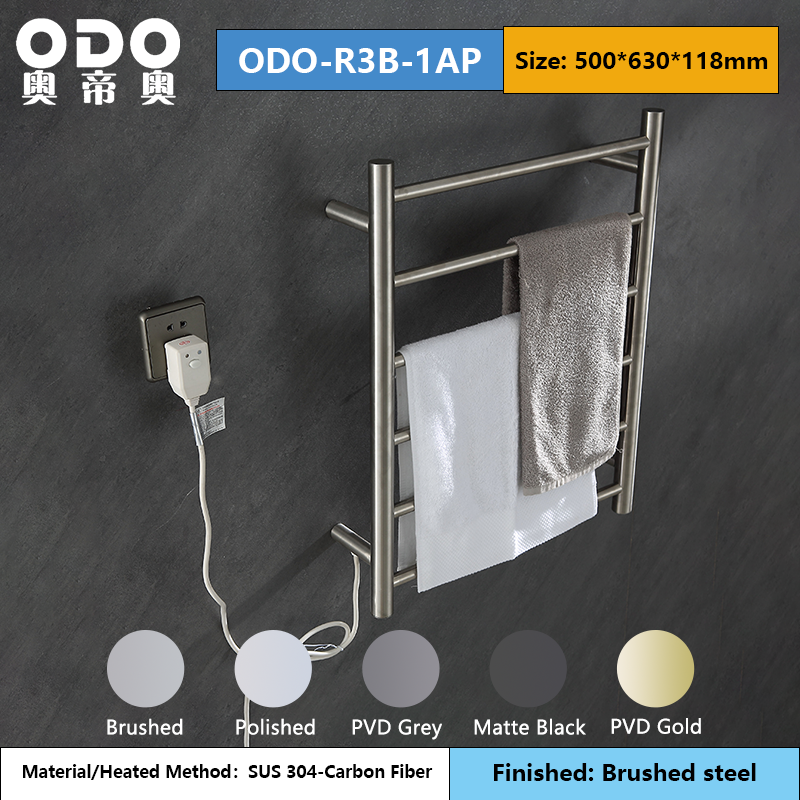
1. Baked Lacquer Finishes (Matte Black & Color Coatings)
For baked lacquer coatings, quality inspectors rely on phase-sensitive eddy-current gauges calibrated against non-magnetic stainless steel substrates. Measurements must cover multiple reference points along rungs, frame tubes, and welded junctions. Sub-standard thickness risks premature oxidation, whereas over-application insulates the frame and diminishes heat transfer efficiency.
2. Ultra-Thin PVD Plating & Electroplated Layers
Finishes like brushed grey or brushed gold PVD plating feature sub-micron layer thicknesses that exceed the resolution capabilities of conventional magnetic thickness meters. Here, destructive micro-sectioning, scanning electron microscopy (SEM), or coulometric titration methods are required. For electroplated chrome finishes, X-ray Fluorescence (XRF) analyzers offer reliable precision.
Furthermore, robust quality assurance workflows—such as the 14-step inspection protocol for CE-certified towel warmers (e.g., CE-LVD report FTS22LC-8881S)—pair layer thickness validation with accelerated neutral salt spray testing to verify resistance against pinhole corrosion.
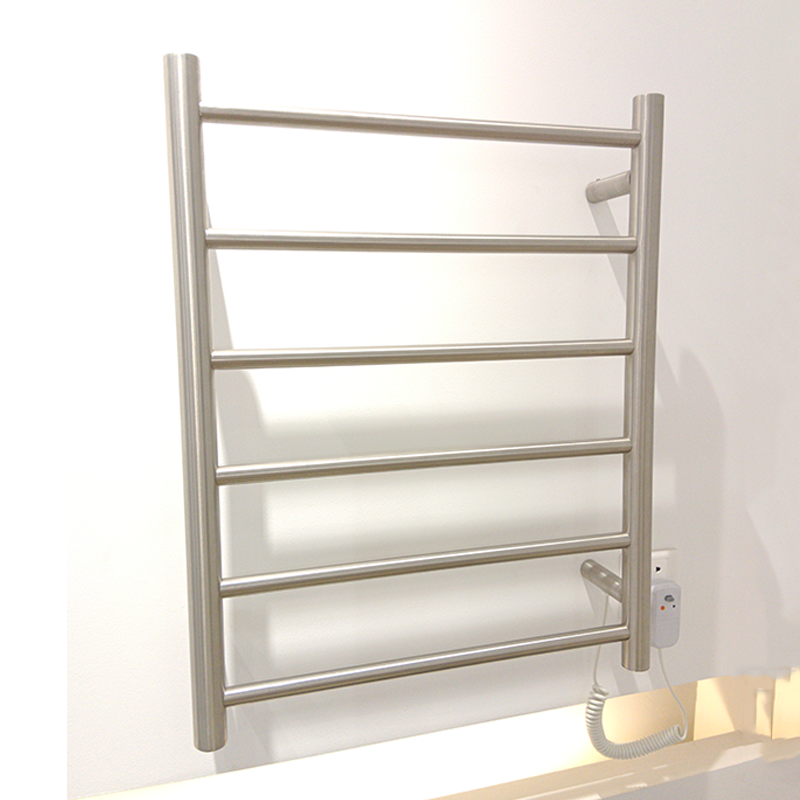
Coating Inspection & Performance Comparison Matrix
| Finish & Surface Treatment | Recommended Inspection Technique | Target Thickness Spec | Thermal & Moisture Resistance |
|---|---|---|---|
| Baked Lacquer (Matte Black / Colors) | Eddy-Current Thickness Measurement | 40 – 80 µm | Stable up to 80°C; excellent atmospheric moisture barrier |
| PVD Plating (Brushed Gold / Grey) | SEM Microscopy / Coulometric Method | 0.3 – 1.0 µm | Exceptional wear resistance; copes with thermal expansion |
| Polished / Brushed Stainless Steel | Optical Profilometry (Surface Roughness Ra) | Base Metal Surface | No risk of layer peel-off; direct heat dissipation |
| Electroplated Chrome Layer | X-ray Fluorescence (XRF) Analyzer | 10 – 25 µm | High salt-spray endurance; retains reflective gloss |
Frequently Asked Questions
Why is coating thickness critical for towel warmers powered by carbon fiber elements?
Carbon fiber heaters deliver constant warmth throughout the 304 stainless steel frame. Improper coating thickness causes differential thermal expansion between the metal and surface layer, risking cracks, compromised IP44 sealings, and humidity-induced corrosion.
How can inspectors measure non-planar or curved towel rail tubing accurately?
Using specialized micro-probes equipped with V-groove attachments allows non-destructive eddy-current and magnetic gauges to conform to curved tube profiles, providing accurate readings around joints and typical 500*630*118mm frame dimensions.
Which global standards regulate surface finish quality on towel warmers?
Surface treatments are validated alongside electrical standards like CE-LVD. Coatings undergo strict testing for adhesion strength, corrosion resistance, and thermal endurance to withstand daily continuous operation.
Conclusion & Technical Support
Accurate verification of surface coating thickness on a heated towel rail sample depends on selecting the proper analytical method—eddy-current testing for polymer coatings and XRF or microscopic analysis for PVD and chrome layers. Maintaining exact thickness specs maximizes thermal distribution from 100W carbon fiber heating systems while protecting 304 stainless steel structures. For full technical data, OEM/ODM inquiries, or quality compliance documents, contact technical engineers via charlene@seosodo.com.
About Our Company
Founded in 2014, Foshan Pinshi Sanitary Ware Co., Ltd. operates a modern 20,000-square-meter facility with 245 skilled workers across 20 specialized production lines. Utilizing more than 200 advanced manufacturing and R&D machines, the company achieves a monthly production capacity of 100,000 units. Guided by ISO9001 and 6S management systems, the 20-person R&D team holds over 50 patents and numerous international quality certifications, catering to premium clients across Europe, North America, the Middle East, and Southeast Asia.

REPORT