







-
 Agriculture
-
 Health-Care
-
 Environment
-
 Construction-Real-Estate
-
 Tools-Hardware
-
 Home-Garden
-
 Furniture
-
 Luggage-Bags-Cases
-
 Medical-devices-Supplies
-
 Gifts-Crafts
-
 Sports-Entertainment
-
 Food-Beverage
-
 Vehicles-Transportation
-
 Power-Transmission
-
 Material-Handling
-
 Renewable-Energy
-
 Safety
-
 Testing-Instrument-Equipment
-
 Construction-Building-Machinery
-
 Pet-Supplies
-
 Personal-Care-Household-Cleaning
-
 Vehicle-Accessories-Electronics-Tools
-
 School-Office-Supplies
-
 Packaging-Printing
-
 Mother-Kids-Toys
-
 Business-Services
-
 Commercial-Equipment-Machinery
-
 Apparel-Accessories
-
 Security
-
 Shoes-Accessories
-
 Vehicle-Parts-Accessories
-
 Jewelry-Eyewear-Watches-Accessories
-
 Lights-Lighting
-
 Fabric-Textile-Raw-Material
-
 Fabrication-Services
-
 Industrial-Machinery
-
 Consumer-Electronics
-
 Electrical-Equipment-Supplies
-
 Electronic-Components-Accessories-Telecommunications
-
 Home-Appliances
-
 Beauty
-
 Chemicals
-
 Rubber-Plastics
-
 Metals-Alloys


























































































































































































































































































































































































































































































































































































- Masonry Materials
- Curtain Walls & Accessories
- Earthwork Products
- Fireproofing Materials
- Heat Insulation Materials
- Plastic Building Materials
- Building Boards
- Soundproofing Materials
- Timber
- Waterproofing Materials
- Balustrades & Handrails
- Bathroom & Kitchen
- Flooring & Accessories
- Tiles & Accessories
- Door, Window & Accessories
- Fireplaces & Stoves
- Floor Heating Systems & Parts
- Stairs & Stair Parts
- Ceilings
- Elevators & Escalators
- Stone
- Countertops, Vanity Tops & Table Tops
- Mosaics
- Metal Building Materials
- Multifunctional Materials
- Ladders & Scaffoldings
- Mouldings
- Corner Guards
- Decorative Films
- Formwork
- Building & Industrial Glass
- Other Construction & Real Estate
- Wallpapers/Wall panels
- HVAC System & Parts
- Outdoor Facilities
- Prefabricated Buildings
- Festive & Party Supplies
- Bathroom Products
- Household Sundries
- Rain Gear
- Garden Supplies
- Household Cleaning Tools & Accessories
- Lighters & Smoking Accessories
- Home Storage & Organization
- Household Scales
- Smart Home Improvement
- Home Textiles
- Kitchenware
- Drinkware & Accessories
- Dinnerware, Coffee & Wine
- Home Decor
- Golf
- Fitness & Body Building
- Amusement Park Facilities
- Billiards, Board Game,Coin Operated Games
- Musical Instruments
- Outdoor Affordable Luxury Sports
- Camping & Hiking
- Fishing
- Sports Safety&Rehabilitation
- Ball Sports Equipments
- Water Sports
- Winter Sports
- Luxury Travel Equipments
- Sports Shoes, Bags & Accessories
- Cycling
- Other Sports & Entertainment Products
- Artificial Grass&Sports Flooring&Sports Court Equipment
- Scooters
- Food Ingredients
- Honey & Honey Products
- Snacks
- Nuts & Kernels
- Seafood
- Plant & Animal Oil
- Beverages
- Fruit & Vegetable Products
- Frog & Escargot
- Bean Products
- Egg Products
- Dairy Products
- Seasonings & Condiments
- Canned Food
- Instant Food
- Baked Goods
- Other Food & Beverage
- Meat & Poultry
- Confectionery
- Grain Products
- Feminie Care
- Hair Care & Styling
- Body Care
- Hands & Feet Care
- Hygiene Products
- Men's Grooming
- Laundry Cleaning Supplies
- Travel Size & Gift Sets
- Room Deodorizers
- Other Personal Care Products
- Pest Control Products
- Special Household Cleaning
- Floor Cleaning
- Kitchen & Bathroom Cleaning
- Oral Care
- Bath Supplies
- Yellow Pages
- Correction Supplies
- Office Binding Supplies
- Office Cutting Supplies
- Board Erasers
- Office Adhesives & Tapes
- Education Supplies
- Pencil Cases & Bags
- Notebooks & Writing Pads
- File Folder Accessories
- Calendars
- Writing Accessories
- Commercial Office Supplies
- Pencil Sharpeners
- Pens
- Letter Pad/Paper
- Paper Envelopes
- Desk Organizers
- Pencils
- Markers & Highlighters
- Filing Products
- Art Supplies
- Easels
- Badge Holder & Accessories
- Office Paper
- Printer Supplies
- Book Covers
- Other Office & School Supplies
- Stationery Set
- Boards
- Clipboards
- Stamps
- Drafting Supplies
- Stencils
- Electronic Dictionary
- Books
- Map
- Magazines
- Calculators
- Baby & Toddler Toys
- Educational Toys
- Classic Toys
- Dress Up & Pretend Play
- Toy Vehicle
- Stuffed Animals & Plush Toys
- Outdoor Toys & Structures
- Balloons & Accessories
- Baby Food
- Children's Clothing
- Baby Supplies & Products
- Maternity Clothes
- Kids Shoes
- Baby Care
- Novelty & Gag Toys
- Dolls & Accessories
- Puzzle & Games
- Blocks & Model Building Toys
- Toddler Clothing
- Baby Clothing
- Kids' Luggage & Bags
- Arts, Crafts & DIY Toys
- Action & Toy Figures
- Baby Appliances
- Hobbies & Models
- Remote Control Toys
- Promotional Toys
- Pregnancy & Maternity
- Hygiene Products
- Kid's Textile&Bedding
- Novelty & Special Use
- Toy Weapons
- Baby Gifts
- Baby Storage & Organization
- Auto Drive Systems
- ATV/UTV Parts & Accessories
- Marine Parts & Accessories
- Other Auto Parts
- Trailer Parts & Accessories
- Auto Transmission Systems
- Train Parts & Accessories
- Universal Parts
- Railway Parts & Accessories
- Auto Brake Systems
- Aviation Parts & Accessories
- Truck Parts & Accessories
- Auto Suspension Systems
- Auto Lighting Systems
- New Energy Vehicle Parts & Accessories
- Auto Steering Systems
- Wheels, Tires & Accessories
- Bus Parts & Accessories
- Auto Performance Parts
- Cooling System
- Go-Kart & Kart Racer Parts & Accessories
- Air Conditioning Systems
- Heavy Duty Vehicle Parts & Accessories
- Auto Electrical Systems
- Auto Body Systems
- Auto Engine Systems
- Container Parts & Accessories
- Motorcycle Parts & Accessories
- Refrigeration & Heat Exchange Equipment
- Machine Tool Equipment
- Food & Beverage Machinery
- Agricultural Machinery & Equipment
- Apparel & Textile Machinery
- Chemical Machinery
- Packaging Machines
- Paper Production Machinery
- Plastic & Rubber Processing Machinery
- Industrial Robots
- Electronic Products Machinery
- Metal & Metallurgy Machinery
- Woodworking Machinery
- Home Product Manufacturing Machinery
- Machinery Accessories
- Environmental Machinery
- Machinery Service
- Electrical Equipment Manufacturing Machinery
- Industrial Compressors & Parts
- Tobacco & Cigarette Machinery
- Production Line
- Used Industrial Machinery
- Electronics Production Machinery
- Other Machinery & Industrial Equipment
- Camera, Photo & Accessories
- Portable Audio, Video & Accessories
- Television, Home Audio, Video & Accessories
- Video Games & Accessories
- Mobile Phone & Accessories
- Electronic Publications
- Earphone & Headphone & Accessories
- Speakers & Accessories
- Smart Electronics
- TV Receivers & Accessories
- Mobile Phone & Computer Repair Parts
- Chargers, Batteries & Power Supplies
- Used Electronics
- VR, AR, MR Hardware & Software
- Projectors & Presentation Equipments
- Other Consumer Electronics
- Cables & Commonly Used Accessories
- Computer Hardware & Software
- Displays, Signage and Optoelectronics
- Discrete Semiconductors
- Wireless & IoT Module and Products
- Telecommunications
- Connectors, Terminals & Accessories
- Development Boards, Electronic Modules and Kits
- Circuit Protection
- Sensors
- Isolators
- Audio Components and Products
- Integrated Circuits
- Power Supplies
- Relays
- RF, Microwave and RFID
- Electronic Accessories & Supplies
- Passive Components
- PCB & PCBA
- Air Quality Appliances
- Home Appliance Parts
- Heating & Cooling Appliances
- Small Kitchen Appliances
- Laundry Appliances
- Water Heaters
- Water Treatment Appliances
- Refrigerators & Freezers
- Personal Care & Beauty Appliances
- Major Kitchen Appliances
- Cleaning Appliances
- Second-hand Appliances
- Smart Home Appliances
- Other Home Appliances
- Energy Chemicals
- Inorganic Chemicals
- Basic Organic Chemicals
- Agrochemicals
- Admixture & Additives
- Catalysts & Chemical Auxiliary Agents
- Pigments & Dyestuff
- Coating & Paint
- Daily Chemicals
- Polymer
- Organic Intermediate
- Adhesives & Sealants
- Chemical Waste
- Biological Chemical Products
- Surface Treatment Chemicals
- Painting & Coating
- Chemical Reagents
- Flavor & Fragrance
- Non-Explosive Demolition Agents
- Other Chemicals
- Custom Chemical Services

Should You Request a Factory Audit Before Buying an Expandable Container House?
Quick Answer
Yes. Request a factory audit report before ordering an expandable container house, but use it as one part of a broader supplier-verification process. The available supplier information confirms factory self-inspection, CE certification, a one-year warranty, and stated production capabilities. However, it does not include a separate independent audit report.
Before placing an order, ask for the report and review its audit scope, issue date, auditor, findings, and corrective actions. Then compare the information with the purchase contract, inspection plan, quotation, and specifications for the exact expandable model.
What the Audit Report Should Confirm
A useful audit report should provide evidence about the manufacturing site and the supplier's operating controls. At minimum, it should address the following areas:
- Factory location, ownership, and production facilities.
- Quality-control procedures, inspection records, and acceptance standards.
- Production capacity, equipment, staffing, and delivery capability.
- Audit date, auditor identity, audit standard, identified nonconformities, and corrective-action status.
- Whether the audited factory produces the same expandable container house configuration being purchased.
Do not assume that a supplier's self-inspection statement is equivalent to an independent factory audit. Self-inspection can be useful, but it should be supported by inspection records and a clear pre-shipment quality process.
Review the Supplier's Manufacturing Evidence
Guangdong Uni-House Technology Co., Ltd. states that its production system includes automated laser cutting, robotic welding, automated spraying, sandwich-panel manufacturing, door and window production, and accessory production lines. The company also reports more than 30 research and development engineers, over 10 advanced production lines, and more than 200 sets of molds.
These details indicate a stated manufacturing base, but an audit report can help verify whether the facilities, equipment, personnel, and quality systems are currently in place. Ask the supplier to confirm that the report relates to the factory and production line responsible for your order.
Match the Technical Documents to the Ordered Model
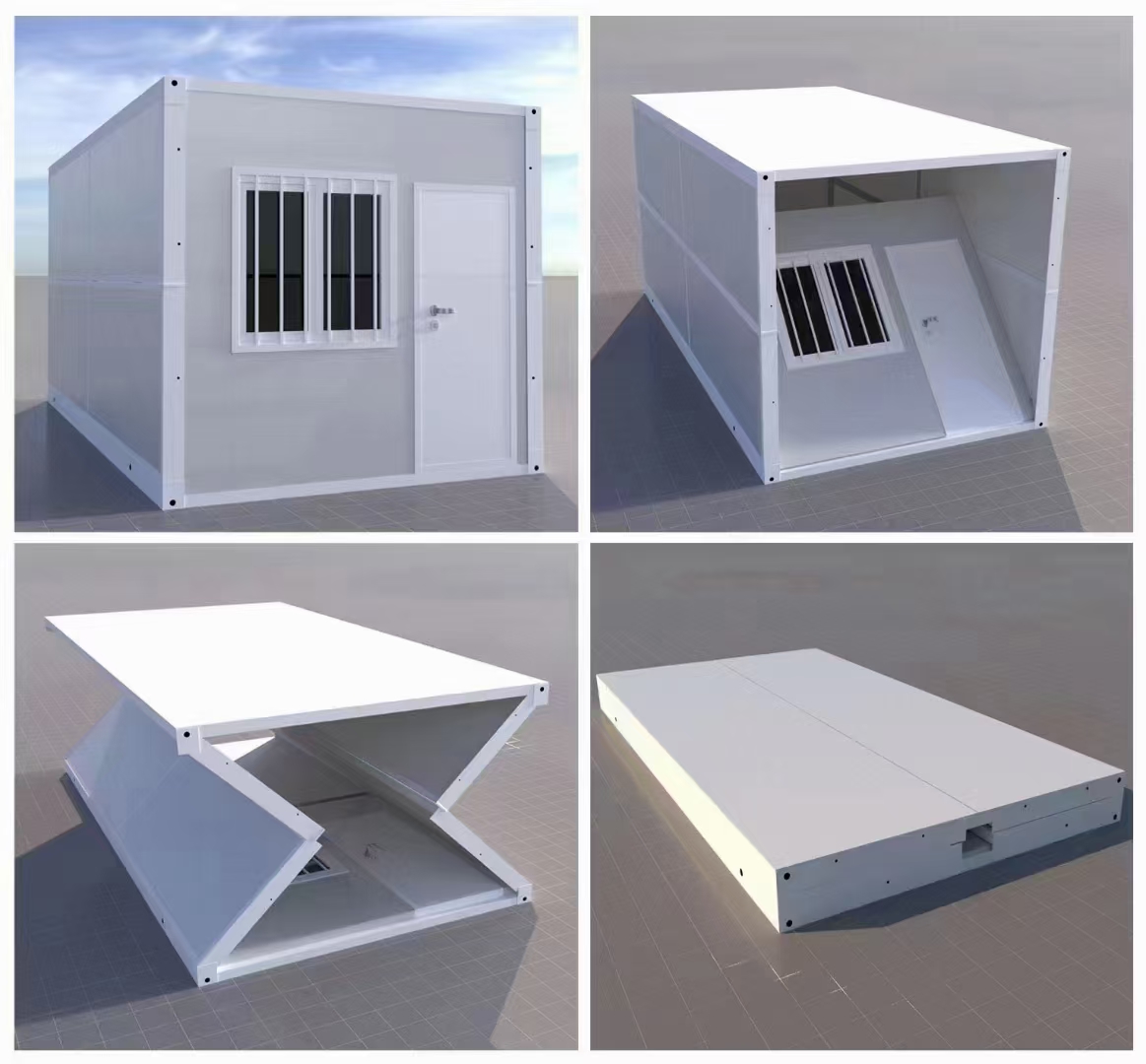
The product information provided describes a folding container house, while the purchasing question concerns an expandable container house. This difference should be resolved before approving the order. Request the drawings and technical specifications for the exact expandable model, including dimensions, structural materials, wall and roof cores, electrical configuration, drainage design, packing method, and installation requirements.
For reference, the supplied folding model has standard external dimensions of 6055mm by 2435mm by 2800mm, a clear indoor height of 2500mm, and an approximate net weight of 1300 to 1500kg. Its structure uses hot-dip galvanized steel, bolt assembly, cast steel hinges, corner castings, and an integrated roof drainage system. Available wall-core options include EPS, rock wool, and PU.
An audit report should be evaluated against the final production configuration rather than accepted as general evidence for every product in the supplier's catalog.
Check Certification Separately
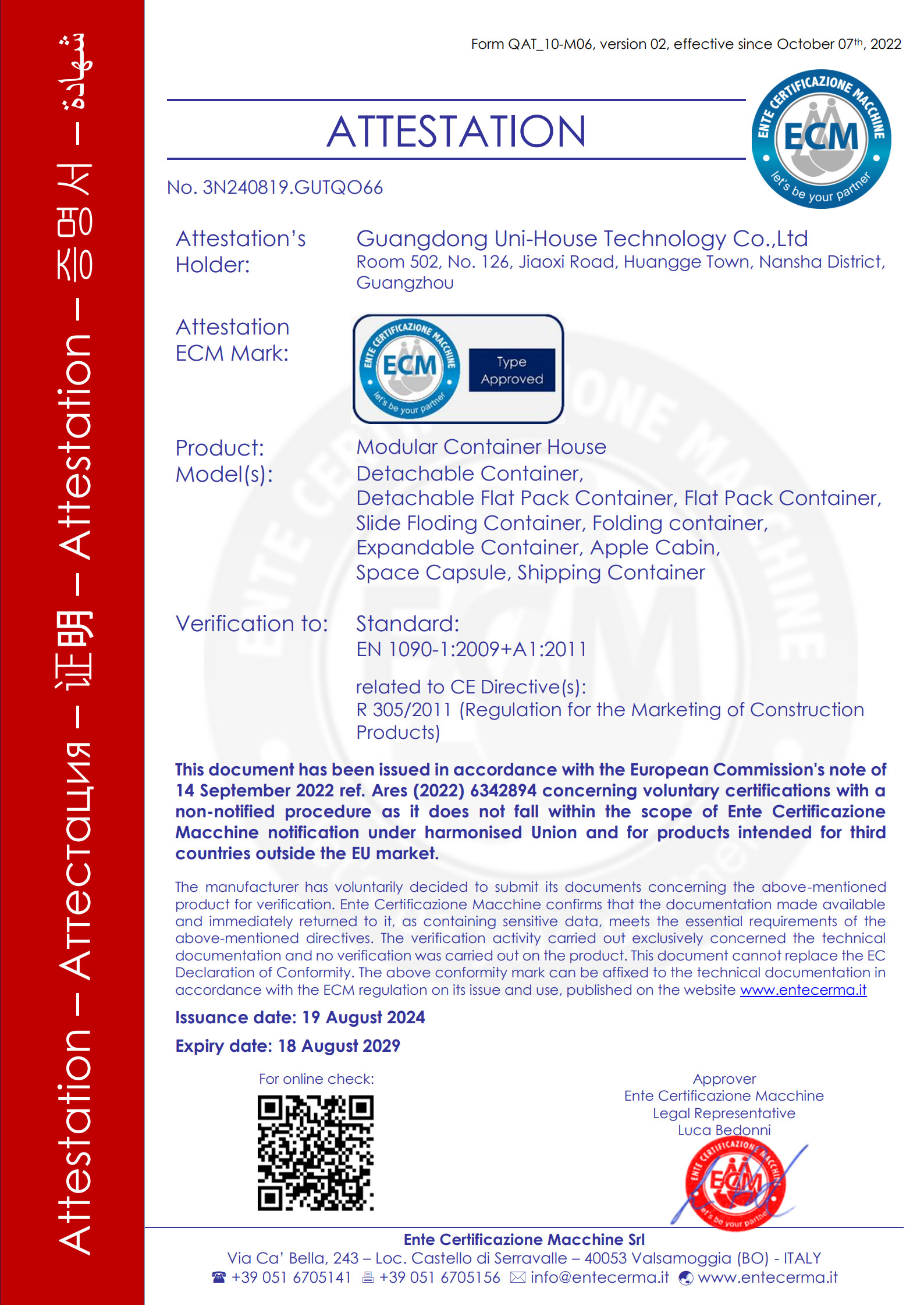
The listed CE certificate is No. 3N240819.GUTQO66. It is described as covering the EU, Australia, North America, South America, Southeast Asia, and the Middle East. The applicable product list includes detachable, flat pack, slide folding, folding, and expandable containers, along with other modular housing products.
However, a CE certificate is product-compliance documentation and does not prove that a factory has passed an independent audit. Confirm that the certificate applies to the final design, structural materials, electrical system, and destination market. The certificate details should also match the model name and configuration stated in the quotation and contract.
Compare Commercial and Quality Terms
| Verification area | Information currently available | Buyer action before ordering |
|---|---|---|
| Factory audit | No separate audit report has been provided. | Request the full report, audit scope, date, auditor, findings, and corrective actions. |
| Quality inspection | Factory self-inspection is listed as the inspection method. | Obtain inspection records, acceptance criteria, and the pre-shipment inspection procedure. |
| Certification | CE certificate No. 3N240819.GUTQO66. | Verify product coverage, destination-market relevance, and consistency with the ordered model. |
| Product configuration | Folding-house specifications are supplied, while expandable options are listed separately. | Approve drawings and specifications for the exact expandable container house. |
| Warranty | One year, excluding man-made damage. | Define covered components, claim evidence, response times, and exclusions in writing. |
| Minimum order and lead time | Minimum order quantity of one set and a stated delivery time of seven days. | Confirm that the timing applies to the selected configuration, quantity, and shipping schedule. |
| Payment and shipping | 50% deposit and 50% balance before shipment; ocean freight in 40HQ and 20FT containers. | Link the balance payment to agreed inspection results and shipment documents. |
Supplier Experience and Reference Checks
The supplier reports experience with construction sites, field construction camps, temporary housing after natural disasters, cultural and tourism commercial projects, and new rural villas. One cooperation case describes a mining workers' accommodation project in Indonesia involving 2,000 sets for a local energy company.
These project records may support a reference check, but they should not replace an audit of the current production site. Ask for recent project references, delivery records, product photographs, and evidence that the same factory can manufacture the model and quantity required for your order.
Frequently Asked Questions
Is a factory audit report required by law before ordering?
The available information does not state that an audit report is legally mandatory. Nevertheless, requesting one is a sensible commercial safeguard because the supplier lists factory self-inspection and no separate audit report has been supplied.
Does the CE certificate show that the factory passed an audit?
No. The CE certificate relates to product compliance and lists applicable regions and products. It should be reviewed together with the factory audit, product drawings, inspection records, and contract documents.
What should buyers do when folding-house information is provided for an expandable-house inquiry?
Ask for the exact expandable-house drawings, dimensions, structural materials, wall and roof cores, electrical system, drainage details, packing method, warranty terms, and inspection criteria. Confirm that the quotation, purchase order, and contract all identify the same model.
Final Recommendation
Request a factory audit report before ordering an expandable container house, but do not rely on that document alone. The strongest verification package should combine the audit report with product-specific drawings, CE documentation, factory inspection records, warranty terms, payment conditions, shipping details, and recent project references.
The current supplier information includes factory self-inspection, CE certification, stated research and development resources, a one-year warranty, a one-set minimum order, and documented payment and shipping terms. Guangdong Uni-House operates an industry-trade integration model. For technical solutions or further support, contact guizugroup@outlook.com.
About Us
Guangdong Uni-House Technology Co., Ltd. is a foreign trade company established under the Guizu Group. It provides design, research and development, manufacturing, installation, and after-sales support through multiple factories. Established in 2008, the company reports approximately 200 employees and a factory area of fifteen thousand square meters.
Its product range includes detachable, flat pack, prefab K, folding, expandable, and space capsule houses for offices, dormitories, residences, shops, hospitals, hotels, and other applications. The company holds CE certification and reports serving customers across multiple industries and regions.

REPORT