







-
 Agriculture
-
 Health-Care
-
 Environment
-
 Construction-Real-Estate
-
 Tools-Hardware
-
 Home-Garden
-
 Furniture
-
 Luggage-Bags-Cases
-
 Medical-devices-Supplies
-
 Gifts-Crafts
-
 Sports-Entertainment
-
 Food-Beverage
-
 Vehicles-Transportation
-
 Power-Transmission
-
 Material-Handling
-
 Renewable-Energy
-
 Safety
-
 Testing-Instrument-Equipment
-
 Construction-Building-Machinery
-
 Pet-Supplies
-
 Personal-Care-Household-Cleaning
-
 Vehicle-Accessories-Electronics-Tools
-
 School-Office-Supplies
-
 Packaging-Printing
-
 Mother-Kids-Toys
-
 Business-Services
-
 Commercial-Equipment-Machinery
-
 Apparel-Accessories
-
 Security
-
 Shoes-Accessories
-
 Vehicle-Parts-Accessories
-
 Jewelry-Eyewear-Watches-Accessories
-
 Lights-Lighting
-
 Fabric-Textile-Raw-Material
-
 Fabrication-Services
-
 Industrial-Machinery
-
 Consumer-Electronics
-
 Electrical-Equipment-Supplies
-
 Electronic-Components-Accessories-Telecommunications
-
 Home-Appliances
-
 Beauty
-
 Chemicals
-
 Rubber-Plastics
-
 Metals-Alloys


























































































































































































































































































































































































































































































































































































- Masonry Materials
- Curtain Walls & Accessories
- Earthwork Products
- Fireproofing Materials
- Heat Insulation Materials
- Plastic Building Materials
- Building Boards
- Soundproofing Materials
- Timber
- Waterproofing Materials
- Balustrades & Handrails
- Bathroom & Kitchen
- Flooring & Accessories
- Tiles & Accessories
- Door, Window & Accessories
- Fireplaces & Stoves
- Floor Heating Systems & Parts
- Stairs & Stair Parts
- Ceilings
- Elevators & Escalators
- Stone
- Countertops, Vanity Tops & Table Tops
- Mosaics
- Metal Building Materials
- Multifunctional Materials
- Ladders & Scaffoldings
- Mouldings
- Corner Guards
- Decorative Films
- Formwork
- Building & Industrial Glass
- Other Construction & Real Estate
- Wallpapers/Wall panels
- HVAC System & Parts
- Outdoor Facilities
- Prefabricated Buildings
- Festive & Party Supplies
- Bathroom Products
- Household Sundries
- Rain Gear
- Garden Supplies
- Household Cleaning Tools & Accessories
- Lighters & Smoking Accessories
- Home Storage & Organization
- Household Scales
- Smart Home Improvement
- Home Textiles
- Kitchenware
- Drinkware & Accessories
- Dinnerware, Coffee & Wine
- Home Decor
- Golf
- Fitness & Body Building
- Amusement Park Facilities
- Billiards, Board Game,Coin Operated Games
- Musical Instruments
- Outdoor Affordable Luxury Sports
- Camping & Hiking
- Fishing
- Sports Safety&Rehabilitation
- Ball Sports Equipments
- Water Sports
- Winter Sports
- Luxury Travel Equipments
- Sports Shoes, Bags & Accessories
- Cycling
- Other Sports & Entertainment Products
- Artificial Grass&Sports Flooring&Sports Court Equipment
- Scooters
- Food Ingredients
- Honey & Honey Products
- Snacks
- Nuts & Kernels
- Seafood
- Plant & Animal Oil
- Beverages
- Fruit & Vegetable Products
- Frog & Escargot
- Bean Products
- Egg Products
- Dairy Products
- Seasonings & Condiments
- Canned Food
- Instant Food
- Baked Goods
- Other Food & Beverage
- Meat & Poultry
- Confectionery
- Grain Products
- Feminie Care
- Hair Care & Styling
- Body Care
- Hands & Feet Care
- Hygiene Products
- Men's Grooming
- Laundry Cleaning Supplies
- Travel Size & Gift Sets
- Room Deodorizers
- Other Personal Care Products
- Pest Control Products
- Special Household Cleaning
- Floor Cleaning
- Kitchen & Bathroom Cleaning
- Oral Care
- Bath Supplies
- Yellow Pages
- Correction Supplies
- Office Binding Supplies
- Office Cutting Supplies
- Board Erasers
- Office Adhesives & Tapes
- Education Supplies
- Pencil Cases & Bags
- Notebooks & Writing Pads
- File Folder Accessories
- Calendars
- Writing Accessories
- Commercial Office Supplies
- Pencil Sharpeners
- Pens
- Letter Pad/Paper
- Paper Envelopes
- Desk Organizers
- Pencils
- Markers & Highlighters
- Filing Products
- Art Supplies
- Easels
- Badge Holder & Accessories
- Office Paper
- Printer Supplies
- Book Covers
- Other Office & School Supplies
- Stationery Set
- Boards
- Clipboards
- Stamps
- Drafting Supplies
- Stencils
- Electronic Dictionary
- Books
- Map
- Magazines
- Calculators
- Baby & Toddler Toys
- Educational Toys
- Classic Toys
- Dress Up & Pretend Play
- Toy Vehicle
- Stuffed Animals & Plush Toys
- Outdoor Toys & Structures
- Balloons & Accessories
- Baby Food
- Children's Clothing
- Baby Supplies & Products
- Maternity Clothes
- Kids Shoes
- Baby Care
- Novelty & Gag Toys
- Dolls & Accessories
- Puzzle & Games
- Blocks & Model Building Toys
- Toddler Clothing
- Baby Clothing
- Kids' Luggage & Bags
- Arts, Crafts & DIY Toys
- Action & Toy Figures
- Baby Appliances
- Hobbies & Models
- Remote Control Toys
- Promotional Toys
- Pregnancy & Maternity
- Hygiene Products
- Kid's Textile&Bedding
- Novelty & Special Use
- Toy Weapons
- Baby Gifts
- Baby Storage & Organization
- Auto Drive Systems
- ATV/UTV Parts & Accessories
- Marine Parts & Accessories
- Other Auto Parts
- Trailer Parts & Accessories
- Auto Transmission Systems
- Train Parts & Accessories
- Universal Parts
- Railway Parts & Accessories
- Auto Brake Systems
- Aviation Parts & Accessories
- Truck Parts & Accessories
- Auto Suspension Systems
- Auto Lighting Systems
- New Energy Vehicle Parts & Accessories
- Auto Steering Systems
- Wheels, Tires & Accessories
- Bus Parts & Accessories
- Auto Performance Parts
- Cooling System
- Go-Kart & Kart Racer Parts & Accessories
- Air Conditioning Systems
- Heavy Duty Vehicle Parts & Accessories
- Auto Electrical Systems
- Auto Body Systems
- Auto Engine Systems
- Container Parts & Accessories
- Motorcycle Parts & Accessories
- Refrigeration & Heat Exchange Equipment
- Machine Tool Equipment
- Food & Beverage Machinery
- Agricultural Machinery & Equipment
- Apparel & Textile Machinery
- Chemical Machinery
- Packaging Machines
- Paper Production Machinery
- Plastic & Rubber Processing Machinery
- Industrial Robots
- Electronic Products Machinery
- Metal & Metallurgy Machinery
- Woodworking Machinery
- Home Product Manufacturing Machinery
- Machinery Accessories
- Environmental Machinery
- Machinery Service
- Electrical Equipment Manufacturing Machinery
- Industrial Compressors & Parts
- Tobacco & Cigarette Machinery
- Production Line
- Used Industrial Machinery
- Electronics Production Machinery
- Other Machinery & Industrial Equipment
- Camera, Photo & Accessories
- Portable Audio, Video & Accessories
- Television, Home Audio, Video & Accessories
- Video Games & Accessories
- Mobile Phone & Accessories
- Electronic Publications
- Earphone & Headphone & Accessories
- Speakers & Accessories
- Smart Electronics
- TV Receivers & Accessories
- Mobile Phone & Computer Repair Parts
- Chargers, Batteries & Power Supplies
- Used Electronics
- VR, AR, MR Hardware & Software
- Projectors & Presentation Equipments
- Other Consumer Electronics
- Cables & Commonly Used Accessories
- Computer Hardware & Software
- Displays, Signage and Optoelectronics
- Discrete Semiconductors
- Wireless & IoT Module and Products
- Telecommunications
- Connectors, Terminals & Accessories
- Development Boards, Electronic Modules and Kits
- Circuit Protection
- Sensors
- Isolators
- Audio Components and Products
- Integrated Circuits
- Power Supplies
- Relays
- RF, Microwave and RFID
- Electronic Accessories & Supplies
- Passive Components
- PCB & PCBA
- Air Quality Appliances
- Home Appliance Parts
- Heating & Cooling Appliances
- Small Kitchen Appliances
- Laundry Appliances
- Water Heaters
- Water Treatment Appliances
- Refrigerators & Freezers
- Personal Care & Beauty Appliances
- Major Kitchen Appliances
- Cleaning Appliances
- Second-hand Appliances
- Smart Home Appliances
- Other Home Appliances
- Energy Chemicals
- Inorganic Chemicals
- Basic Organic Chemicals
- Agrochemicals
- Admixture & Additives
- Catalysts & Chemical Auxiliary Agents
- Pigments & Dyestuff
- Coating & Paint
- Daily Chemicals
- Polymer
- Organic Intermediate
- Adhesives & Sealants
- Chemical Waste
- Biological Chemical Products
- Surface Treatment Chemicals
- Painting & Coating
- Chemical Reagents
- Flavor & Fragrance
- Non-Explosive Demolition Agents
- Other Chemicals
- Custom Chemical Services

Tortilla Packaging Line Trial Checklist Before You Order
A factory trial is one of the most important steps before purchasing a tortilla packaging line. Use your own tortillas, selected packaging film, and intended production conditions to evaluate the full process, from infeed and alignment to wrapping, sealing, coding, rejection, and discharge. The trial should confirm stable output, acceptable package quality, the final equipment configuration, utility needs, integration requirements, and available technical support.
What the Trial Should Confirm
- Run representative tortilla samples through the complete line to check feeding, spacing, orientation, stacking, and transfer stability.
- Examine package appearance and seal integrity, including film centering, seal continuity, product protection, and the selected package format.
- Verify practical production speed, recipe management, PLC and HMI operation, date coding, inspection devices, and automatic rejection where specified.
- Document the approved configuration, test conditions, commercial terms, delivery requirements, and service arrangements before releasing the order. The supplier supports manufacturing and OEM projects, with a minimum order quantity of one.
How to Structure a Tortilla Packaging Machine Test
Begin with tortillas that match the planned production range. Record their diameter, thickness, moisture condition, stacking pattern, and any variations that may affect handling. The selected paper, plastic, or composite film should also be used during the trial. Testing the complete route from product loading to finished-package discharge provides more useful evidence than evaluating the wrapping unit alone.
During the infeed test, observe whether tortillas enter the machine consistently and remain correctly oriented. The line should maintain suitable spacing without causing tearing, folding, slipping, or unstable stacks. Transfer points should be checked for product damage and accumulation, especially during start-up, temporary stops, and changes in production speed.
Wrapping, Film Tracking, and Sealing
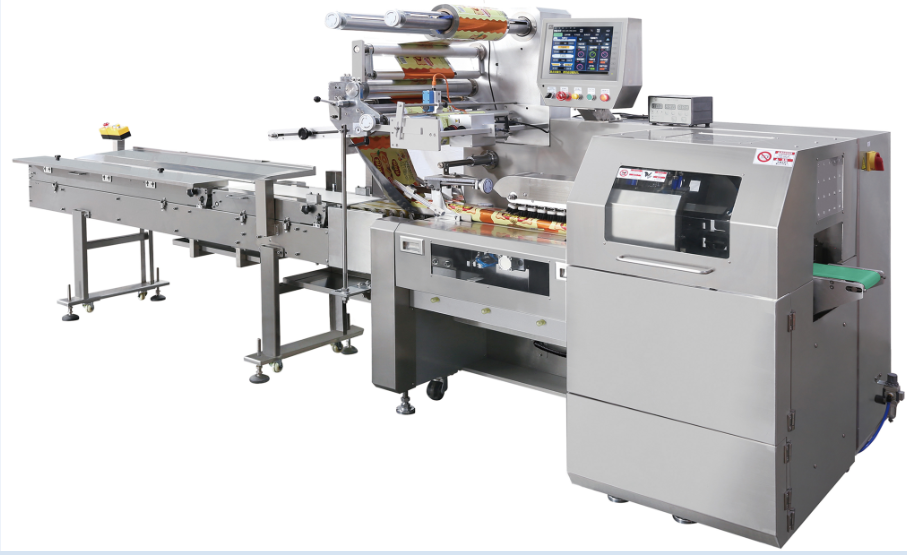
The available product information describes a fully automatic horizontal flow-wrapper with servo-driven controls and a reference output range of 20 to 120 bags per minute. This range should be treated as a module specification rather than a guaranteed tortilla rate. Ask the supplier to establish the attainable speed using your tortillas, package dimensions, and selected film.
Inspect the film path throughout continuous operation. The film should remain centered and form the specified package without wrinkles, drift, or inconsistent tension. Check both the longitudinal seal and the end seals for continuity and strength. No tortilla fragments should be caught in the sealing zones, and the finished pack should protect the product while maintaining a consistent appearance.
Include roll replacement, product changes, planned stops, and restart cycles in the test. These situations often reveal problems that are not visible during a short uninterrupted run. The trial report should list the film material, package size, sealing temperature or pressure settings, machine speed, and adjustments made by the operators.
Controls, Optional Equipment, and Line Usability
Test the PLC and HMI touch screen under normal operating conditions. Confirm that operators can adjust speed, select or save recipes, respond to alarms, and restart the line correctly after a stop. Recipe changes should be assessed for both accuracy and the time required to return to acceptable production.
Any optional devices must be included in the quotation and factory test scope when they are required for the project. These may include a metal detector, checkweigher, thermal printer, label applicator, and automatic reject mechanism. Verify that each device communicates correctly with the main line and that rejected products are removed reliably without interrupting good-product flow.
A sustained sample run should also cover operator access, cleaning access, crumb removal, and changeover time. Integrated systems are described as using food-grade stainless steel, removable crumb trays, and IP-rated motors as typical features. Confirm the actual materials, hygiene design, and protection ratings of the proposed tortilla line rather than relying only on general product descriptions.
Reference Specifications and Acceptance Evidence
| Test Category | Acceptance Points | Reference Information |
|---|---|---|
| Product handling | Consistent feeding, spacing, alignment, stacking, and transfer using the buyer's tortillas | Must be established through customer-sample testing |
| Film and package formation | Correct film tracking, package dimensions, product position, and continuous wrapping | Horizontal flow wrapping supports paper, plastic, and composite films |
| Output and continuity | Measured sustained speed, stoppage frequency, restart performance, and package consistency | Reference flow-wrapper range: 20–120 bags per minute; tortilla output requires validation |
| Seal performance | Complete longitudinal and end seals with no product contamination in the seal area | Evaluate with the selected tortilla, film, and sealing parameters |
| Control and changeover | PLC, HMI, recipes, speed controls, alarms, restart behavior, and product or film changes | PLC and HMI touch-screen control are listed for integrated systems |
| Inspection and rejection | Correct operation of detection, weighing, printing, labeling, and rejection functions when required | These functions are available as optional integrations |
| Factory acceptance | Written results identifying samples, settings, issues, corrective actions, and open points | The supplier states 48-hour testing or testing with customer samples |
Documents to Request Before Purchase
Ask for a formal trial report that identifies the tortilla samples, film specification, package format, line speed, operating settings, observed defects, and agreed corrective actions. The final technical agreement should also define the approved machine layout, utility consumption, electrical requirements, line interfaces, installation conditions, and performance criteria.
Commercial documents should state the delivery schedule, warranty, training, spare-parts scope, after-sales response, and payment terms. The stated payment arrangement is a 30% deposit, with the remaining 70% due on or before shipment. Ruipuhua also reports engineer support after delivery, which should be described clearly in the purchase agreement.
Frequently Asked Questions
Is it necessary to test with our own tortillas?
Yes. Customer samples provide the most relevant evidence for feeding behavior, alignment, package appearance, sealing quality, and achievable throughput. General machine specifications cannot replace validation with the actual tortilla range and packaging materials.
How long should the factory trial run?
The duration should be sufficient to demonstrate stable production rather than only a few acceptable packs. Include start-up, continuous running, stops, restart, film replacement, product changes, and any optional inspection or rejection equipment. The supplier states that testing may last 48 hours or be performed with customer samples; agree on the specific acceptance method in writing.
What should determine the purchase decision?
Place the order only after the line demonstrates reliable feeding, consistent packages, acceptable seals, verified controls, practical changeover, and the required coding, inspection, or rejection functions. Any unresolved issue should have an owner, corrective action, and completion deadline recorded in the technical agreement.
Conclusion
A tortilla packaging line trial should be treated as a production validation exercise, not simply a machine demonstration. Use representative tortillas and the intended film to verify the complete flow, measure sustained performance, and document every setting that affects package quality. Confirm the final configuration, utilities, integration points, delivery terms, and service responsibilities before signing the order.
Ruipuhua supports manufacturing and OEM cooperation and lists a minimum order quantity of one. Its reported CE certification covers flow packaging machines, automatic packaging systems, cartoning machines, and palletizing robots. A documented project for an international bakery customer involved chocolate pie cake wrapping and robotic palletizing, demonstrating experience with integrated packaging workflows. Tortilla-specific performance should nevertheless be accepted only after the customer-sample trial. For technical solutions or support, contact lotuspack@ruipuhua.com.
About the Manufacturer
Foshan Ruipuhua Machinery Equipment Co. Ltd was founded in 2005 and manufactures automatic packaging equipment and integrated packaging lines in Foshan, Guangdong, China. Its stated application areas include bakery products, biscuits, snacks, noodles, chocolate, soap, hardware, pharmaceuticals, and daily chemicals. The company reports exports to more than 100 countries, annual production exceeding 500 sets, and an annual output value of approximately 300 million RMB.
The company states that its CE certification covers flow-pack machines, automatic packaging systems, cartoning equipment, and palletizing robots, with experience serving customers across several industries.

REPORT