







-
 Agriculture
-
 Health-Care
-
 Environment
-
 Construction-Real-Estate
-
 Tools-Hardware
-
 Home-Garden
-
 Furniture
-
 Luggage-Bags-Cases
-
 Medical-devices-Supplies
-
 Gifts-Crafts
-
 Sports-Entertainment
-
 Food-Beverage
-
 Vehicles-Transportation
-
 Power-Transmission
-
 Material-Handling
-
 Renewable-Energy
-
 Safety
-
 Testing-Instrument-Equipment
-
 Construction-Building-Machinery
-
 Pet-Supplies
-
 Personal-Care-Household-Cleaning
-
 Vehicle-Accessories-Electronics-Tools
-
 School-Office-Supplies
-
 Packaging-Printing
-
 Mother-Kids-Toys
-
 Business-Services
-
 Commercial-Equipment-Machinery
-
 Apparel-Accessories
-
 Security
-
 Shoes-Accessories
-
 Vehicle-Parts-Accessories
-
 Jewelry-Eyewear-Watches-Accessories
-
 Lights-Lighting
-
 Fabric-Textile-Raw-Material
-
 Fabrication-Services
-
 Industrial-Machinery
-
 Consumer-Electronics
-
 Electrical-Equipment-Supplies
-
 Electronic-Components-Accessories-Telecommunications
-
 Home-Appliances
-
 Beauty
-
 Chemicals
-
 Rubber-Plastics
-
 Metals-Alloys


























































































































































































































































































































































































































































































































































































- Masonry Materials
- Curtain Walls & Accessories
- Earthwork Products
- Fireproofing Materials
- Heat Insulation Materials
- Plastic Building Materials
- Building Boards
- Soundproofing Materials
- Timber
- Waterproofing Materials
- Balustrades & Handrails
- Bathroom & Kitchen
- Flooring & Accessories
- Tiles & Accessories
- Door, Window & Accessories
- Fireplaces & Stoves
- Floor Heating Systems & Parts
- Stairs & Stair Parts
- Ceilings
- Elevators & Escalators
- Stone
- Countertops, Vanity Tops & Table Tops
- Mosaics
- Metal Building Materials
- Multifunctional Materials
- Ladders & Scaffoldings
- Mouldings
- Corner Guards
- Decorative Films
- Formwork
- Building & Industrial Glass
- Other Construction & Real Estate
- Wallpapers/Wall panels
- HVAC System & Parts
- Outdoor Facilities
- Prefabricated Buildings
- Festive & Party Supplies
- Bathroom Products
- Household Sundries
- Rain Gear
- Garden Supplies
- Household Cleaning Tools & Accessories
- Lighters & Smoking Accessories
- Home Storage & Organization
- Household Scales
- Smart Home Improvement
- Home Textiles
- Kitchenware
- Drinkware & Accessories
- Dinnerware, Coffee & Wine
- Home Decor
- Golf
- Fitness & Body Building
- Amusement Park Facilities
- Billiards, Board Game,Coin Operated Games
- Musical Instruments
- Outdoor Affordable Luxury Sports
- Camping & Hiking
- Fishing
- Sports Safety&Rehabilitation
- Ball Sports Equipments
- Water Sports
- Winter Sports
- Luxury Travel Equipments
- Sports Shoes, Bags & Accessories
- Cycling
- Other Sports & Entertainment Products
- Artificial Grass&Sports Flooring&Sports Court Equipment
- Scooters
- Food Ingredients
- Honey & Honey Products
- Snacks
- Nuts & Kernels
- Seafood
- Plant & Animal Oil
- Beverages
- Fruit & Vegetable Products
- Frog & Escargot
- Bean Products
- Egg Products
- Dairy Products
- Seasonings & Condiments
- Canned Food
- Instant Food
- Baked Goods
- Other Food & Beverage
- Meat & Poultry
- Confectionery
- Grain Products
- Feminie Care
- Hair Care & Styling
- Body Care
- Hands & Feet Care
- Hygiene Products
- Men's Grooming
- Laundry Cleaning Supplies
- Travel Size & Gift Sets
- Room Deodorizers
- Other Personal Care Products
- Pest Control Products
- Special Household Cleaning
- Floor Cleaning
- Kitchen & Bathroom Cleaning
- Oral Care
- Bath Supplies
- Yellow Pages
- Correction Supplies
- Office Binding Supplies
- Office Cutting Supplies
- Board Erasers
- Office Adhesives & Tapes
- Education Supplies
- Pencil Cases & Bags
- Notebooks & Writing Pads
- File Folder Accessories
- Calendars
- Writing Accessories
- Commercial Office Supplies
- Pencil Sharpeners
- Pens
- Letter Pad/Paper
- Paper Envelopes
- Desk Organizers
- Pencils
- Markers & Highlighters
- Filing Products
- Art Supplies
- Easels
- Badge Holder & Accessories
- Office Paper
- Printer Supplies
- Book Covers
- Other Office & School Supplies
- Stationery Set
- Boards
- Clipboards
- Stamps
- Drafting Supplies
- Stencils
- Electronic Dictionary
- Books
- Map
- Magazines
- Calculators
- Baby & Toddler Toys
- Educational Toys
- Classic Toys
- Dress Up & Pretend Play
- Toy Vehicle
- Stuffed Animals & Plush Toys
- Outdoor Toys & Structures
- Balloons & Accessories
- Baby Food
- Children's Clothing
- Baby Supplies & Products
- Maternity Clothes
- Kids Shoes
- Baby Care
- Novelty & Gag Toys
- Dolls & Accessories
- Puzzle & Games
- Blocks & Model Building Toys
- Toddler Clothing
- Baby Clothing
- Kids' Luggage & Bags
- Arts, Crafts & DIY Toys
- Action & Toy Figures
- Baby Appliances
- Hobbies & Models
- Remote Control Toys
- Promotional Toys
- Pregnancy & Maternity
- Hygiene Products
- Kid's Textile&Bedding
- Novelty & Special Use
- Toy Weapons
- Baby Gifts
- Baby Storage & Organization
- Auto Drive Systems
- ATV/UTV Parts & Accessories
- Marine Parts & Accessories
- Other Auto Parts
- Trailer Parts & Accessories
- Auto Transmission Systems
- Train Parts & Accessories
- Universal Parts
- Railway Parts & Accessories
- Auto Brake Systems
- Aviation Parts & Accessories
- Truck Parts & Accessories
- Auto Suspension Systems
- Auto Lighting Systems
- New Energy Vehicle Parts & Accessories
- Auto Steering Systems
- Wheels, Tires & Accessories
- Bus Parts & Accessories
- Auto Performance Parts
- Cooling System
- Go-Kart & Kart Racer Parts & Accessories
- Air Conditioning Systems
- Heavy Duty Vehicle Parts & Accessories
- Auto Electrical Systems
- Auto Body Systems
- Auto Engine Systems
- Container Parts & Accessories
- Motorcycle Parts & Accessories
- Refrigeration & Heat Exchange Equipment
- Machine Tool Equipment
- Food & Beverage Machinery
- Agricultural Machinery & Equipment
- Apparel & Textile Machinery
- Chemical Machinery
- Packaging Machines
- Paper Production Machinery
- Plastic & Rubber Processing Machinery
- Industrial Robots
- Electronic Products Machinery
- Metal & Metallurgy Machinery
- Woodworking Machinery
- Home Product Manufacturing Machinery
- Machinery Accessories
- Environmental Machinery
- Machinery Service
- Electrical Equipment Manufacturing Machinery
- Industrial Compressors & Parts
- Tobacco & Cigarette Machinery
- Production Line
- Used Industrial Machinery
- Electronics Production Machinery
- Other Machinery & Industrial Equipment
- Camera, Photo & Accessories
- Portable Audio, Video & Accessories
- Television, Home Audio, Video & Accessories
- Video Games & Accessories
- Mobile Phone & Accessories
- Electronic Publications
- Earphone & Headphone & Accessories
- Speakers & Accessories
- Smart Electronics
- TV Receivers & Accessories
- Mobile Phone & Computer Repair Parts
- Chargers, Batteries & Power Supplies
- Used Electronics
- VR, AR, MR Hardware & Software
- Projectors & Presentation Equipments
- Other Consumer Electronics
- Cables & Commonly Used Accessories
- Computer Hardware & Software
- Displays, Signage and Optoelectronics
- Discrete Semiconductors
- Wireless & IoT Module and Products
- Telecommunications
- Connectors, Terminals & Accessories
- Development Boards, Electronic Modules and Kits
- Circuit Protection
- Sensors
- Isolators
- Audio Components and Products
- Integrated Circuits
- Power Supplies
- Relays
- RF, Microwave and RFID
- Electronic Accessories & Supplies
- Passive Components
- PCB & PCBA
- Air Quality Appliances
- Home Appliance Parts
- Heating & Cooling Appliances
- Small Kitchen Appliances
- Laundry Appliances
- Water Heaters
- Water Treatment Appliances
- Refrigerators & Freezers
- Personal Care & Beauty Appliances
- Major Kitchen Appliances
- Cleaning Appliances
- Second-hand Appliances
- Smart Home Appliances
- Other Home Appliances
- Energy Chemicals
- Inorganic Chemicals
- Basic Organic Chemicals
- Agrochemicals
- Admixture & Additives
- Catalysts & Chemical Auxiliary Agents
- Pigments & Dyestuff
- Coating & Paint
- Daily Chemicals
- Polymer
- Organic Intermediate
- Adhesives & Sealants
- Chemical Waste
- Biological Chemical Products
- Surface Treatment Chemicals
- Painting & Coating
- Chemical Reagents
- Flavor & Fragrance
- Non-Explosive Demolition Agents
- Other Chemicals
- Custom Chemical Services

What Should You Photograph When Approving an LCD Separator Prototype?
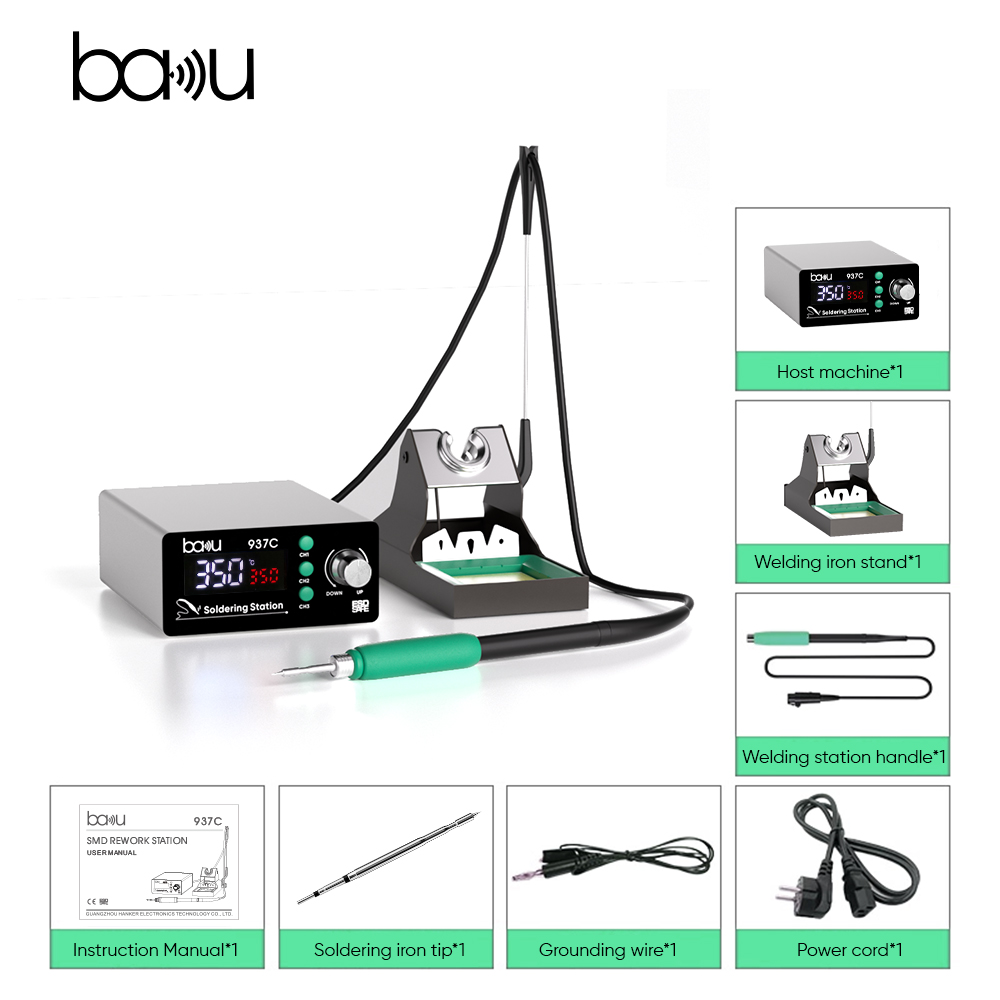
A complete prototype approval record should make the product easy to identify and compare with its technical documentation. Photograph the entire unit from several angles, the model and rating labels, control panel, digital display, connectors, dimensions, net weight, and all visible operating or safety markings. In the supplied BAKU product information, the listed item is the BA-937C 2s Rapid Temp Soldering Station rather than an LCD Separator. The photo set should therefore confirm its 120W rating, 200°C-500°C temperature range, 225x194x105mm dimensions, 1kg net weight, and noise level below 45dB.
Prototype Photography Checklist
Prototype approval photographs should provide visual evidence of product identity, construction quality, operating interfaces, and compliance information. A well-organized set normally includes the following:
- Full front, side, rear, and top views showing the complete housing and overall condition.
- Close-ups of the brand, product name, model number, serial information, and any safety or compliance markings.
- Readable images of the control panel, LED display, temperature settings, power label, connectors, and supplied accessories.
- Separate evidence for measurements, weight, noise performance, certificates, and other specifications that may not appear on the product itself.
For the supplied BAKU record, the images should be matched to the BA-937C product information, including the LED microcomputer digital display, 120W power, 200°C-500°C iron temperature range, 225x194x105mm size, 1kg net weight, and noise below 45dB.
Recommended Photo Sequence
1. Record the complete unit
Begin with a clean, well-lit photograph of the assembled prototype. Use additional front, rear, left, right, and top views when a single image cannot show the housing, ventilation areas, controls, cable routing, and external connections clearly. These photographs help reviewers assess finish quality, visible damage, assembly consistency, and whether the supplied prototype matches the approved form.
2. Photograph identity and rating information
Take close-up images of the nameplate, product label, model number, brand logo, power rating, and any serial or compliance markings. The text must be sharp enough to read without relying on transcription. For this product record, the image evidence should identify the item as the BA-937C 2s Rapid Temp Soldering Station and show information related to its 120W power specification.
3. Capture the operating interface
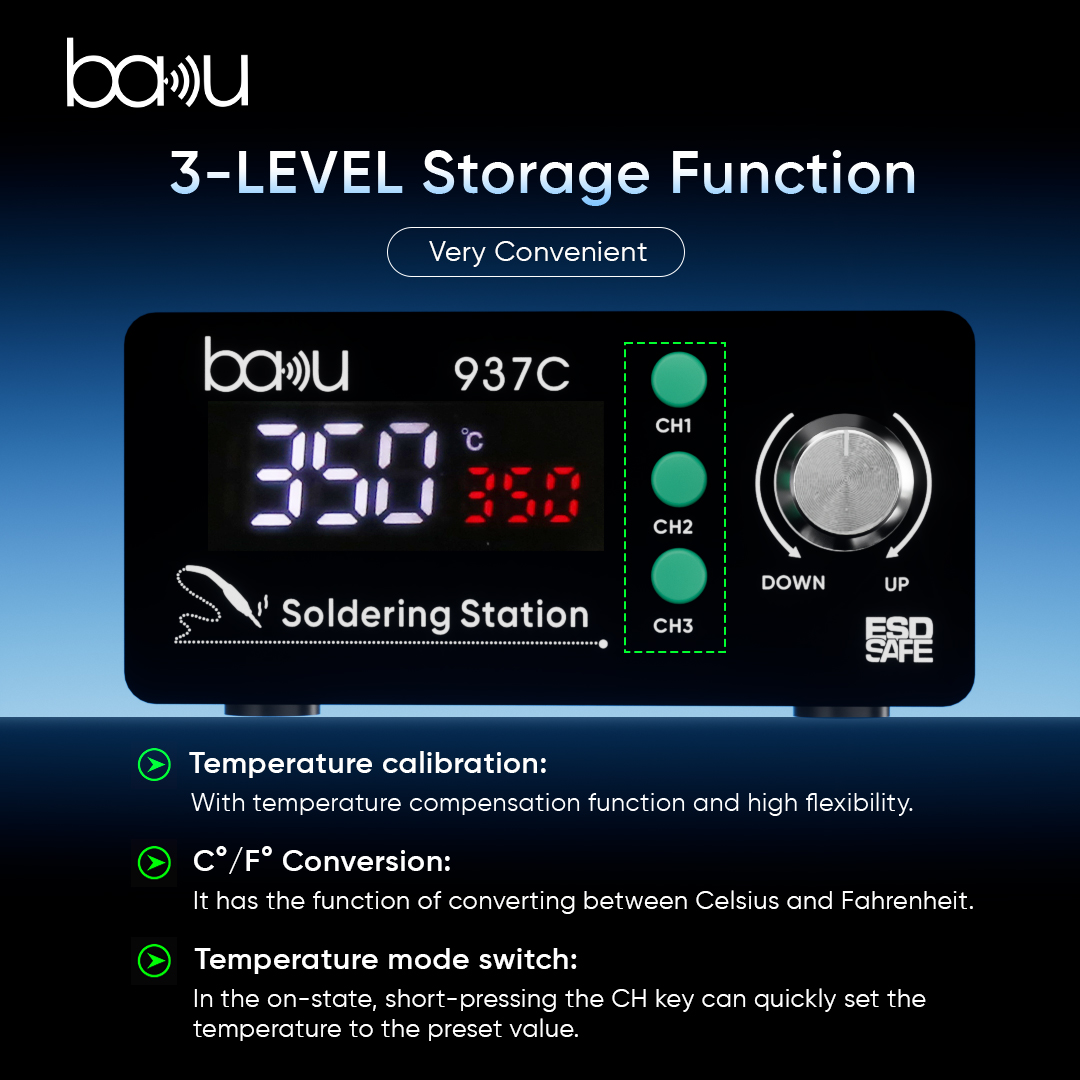
Photograph the LED microcomputer digital display while it is visible and, where appropriate, include the temperature control and soldering handle connection. The control panel should be shown both as part of the complete unit and in a close-up that allows reviewers to inspect buttons, switches, indicators, labels, and surface quality.
4. Document physical and performance specifications
Dimensions can be supported with photographs of the measuring process or a technical drawing linked to the prototype record. The BA-937C reference size is 225x194x105mm and its stated net weight is 1kg. If noise performance is part of the approval criteria, retain a separate measurement record showing the level below 45dB. The iron temperature range should also be checked against the 200°C-500°C specification and connected to a photograph of the display or temperature control where possible.
Product Context and Intended Use
The supplied information describes a rapid-temperature soldering station, not an LCD Separator. This distinction should be recorded during approval so that the photographs are evaluated against the correct product specification. No LCD Separator-specific power, dimensions, temperature range, or operating data appears in the supplied BAKU record.
BAKU lists the product for mobile phone and tablet repair, laptop and computer circuit board repair, and electronic laboratory or vocational training. These applications make it useful to photograph the soldering handle interface, temperature adjustment controls, display response, power connection, and external protection features. Such evidence helps confirm that the prototype supports the workflow expected in repair shops, computer workshops, and teaching environments.
Certification and Supporting Documents
Prototype images should be stored together with relevant technical and compliance documents. BAKU states that its soldering stations have CE certificates for the European Union and FCC certificates for the United States. The listed CE certificate numbers are 2022SZ0629222 and 2022SZ0629223. The FCC certificate numbers are LCS1410130250E, LCS1410130248E, and LCS1410130249E.
Certificates do not need to be photographed in the same frame as the product. Instead, capture clear document images or retain the original files and link them to the matching BA-937C product record. The model reference, certificate number, issuing information, and applicable product category should remain readable so the documents can be traced during approval.
Photo Evidence Compared with BA-937C Requirements
| Evidence group | What the reviewer should inspect | BA-937C reference information |
|---|---|---|
| Identity and condition | Complete unit, brand, product name, model label, serial information, housing, and visible finish quality | 2s Rapid Temp Soldering Station, model BA-937C |
| Electrical and thermal data | Power label, temperature controls or display, measuring records, dimensions, weight, and noise documentation | 120W; 200°C-500°C; 225x194x105mm; 1kg; below 45dB |
| Controls and connections | LED display, operating buttons, soldering handle socket, power input, cables, and external protection | LED microcomputer digital display |
| Compliance documentation | Certificate images or files with product references and readable certificate numbers | CE for the European Union; FCC for the United States |
Related Supply and Cooperation Experience
The company reports cooperation with a Philippine electronic repair store that ordered a mixed tool kit, a Malaysian vocational training institution that purchased welding and testing equipment, a Saudi Arabian repair-tool distributor, and a Mexican computer repair workshop that sourced soldering and BGA rework equipment. These examples cover repair businesses, education providers, wholesalers, and computer service workshops, which are relevant environments for evaluating the BA-937C prototype.
Frequently Asked Questions
What should appear in the opening photograph?
The first image should show the fully assembled unit, including its housing, front panel, main controls, and general condition. Use additional views to document areas hidden or unreadable in that overview.
Which BA-937C specifications require close-up or supporting evidence?
Record the model name, LED microcomputer digital display, 120W power rating, 200°C-500°C iron temperature range, 225x194x105mm dimensions, 1kg net weight, and noise below 45dB. Labels, displays, measurement photographs, and test documents can be combined to provide complete evidence.
Does the supplied record describe an LCD Separator?
No. The record identifies the product as a BA-937C 2s Rapid Temp Soldering Station. It does not provide LCD Separator-specific operating or dimensional information, so approval should use the soldering-station specifications supplied by BAKU.
Should certification documents be included in the product photographs?
They should be included in the approval file, but they can be stored as separate document images linked to the product record. Make sure the product reference and certificate numbers are readable and traceable.
Approval Recommendation
Approve the photo record only when it demonstrates product identity, complete physical condition, control layout, display details, connections, measurements, rating information, and available compliance evidence. For the supplied BAKU product, the final record should clearly correspond to the BA-937C 2s Rapid Temp Soldering Station and its stated 120W, 200°C-500°C, 225x194x105mm, 1kg, and below-45dB specifications.
BAKU supports own-brand wholesale supply as well as OEM and ODM customization. The company states a typical delivery period of 7-15 days and full-function testing before shipment. For technical solutions or product support, contact Joyce Ma at hanker002@bakutool.com.
About BAKU
Guangdong BAKU Technology Development Co., Ltd. was established in 2003 and supplies professional electronic repair tools in more than thirty categories. Its range includes precision screwdrivers, flux, multimeters, soldering equipment, and ultrasonic cleaners. The company operates an independent R&D laboratory with structural, hardware, and testing engineers who support industrial design, structural development, PCB debugging, and reliability testing. BAKU also owns 25 design patents.
Its product portfolio includes soldering stations, solder flux, solder paste, screwdrivers, and ultrasonic cleaners. Certification records include CE certifications for solder stations intended for the European Union and FCC certifications for solder stations intended for the United States. Its customers include repair stores, training institutions, wholesalers, and computer repair workshops.

REPORT