







-
 Agriculture
-
 Health-Care
-
 Environment
-
 Construction-Real-Estate
-
 Tools-Hardware
-
 Home-Garden
-
 Furniture
-
 Luggage-Bags-Cases
-
 Medical-devices-Supplies
-
 Gifts-Crafts
-
 Sports-Entertainment
-
 Food-Beverage
-
 Vehicles-Transportation
-
 Power-Transmission
-
 Material-Handling
-
 Renewable-Energy
-
 Safety
-
 Testing-Instrument-Equipment
-
 Construction-Building-Machinery
-
 Pet-Supplies
-
 Personal-Care-Household-Cleaning
-
 Vehicle-Accessories-Electronics-Tools
-
 School-Office-Supplies
-
 Packaging-Printing
-
 Mother-Kids-Toys
-
 Business-Services
-
 Commercial-Equipment-Machinery
-
 Apparel-Accessories
-
 Security
-
 Shoes-Accessories
-
 Vehicle-Parts-Accessories
-
 Jewelry-Eyewear-Watches-Accessories
-
 Lights-Lighting
-
 Fabric-Textile-Raw-Material
-
 Fabrication-Services
-
 Industrial-Machinery
-
 Consumer-Electronics
-
 Electrical-Equipment-Supplies
-
 Electronic-Components-Accessories-Telecommunications
-
 Home-Appliances
-
 Beauty
-
 Chemicals
-
 Rubber-Plastics
-
 Metals-Alloys


























































































































































































































































































































































































































































































































































































- Masonry Materials
- Curtain Walls & Accessories
- Earthwork Products
- Fireproofing Materials
- Heat Insulation Materials
- Plastic Building Materials
- Building Boards
- Soundproofing Materials
- Timber
- Waterproofing Materials
- Balustrades & Handrails
- Bathroom & Kitchen
- Flooring & Accessories
- Tiles & Accessories
- Door, Window & Accessories
- Fireplaces & Stoves
- Floor Heating Systems & Parts
- Stairs & Stair Parts
- Ceilings
- Elevators & Escalators
- Stone
- Countertops, Vanity Tops & Table Tops
- Mosaics
- Metal Building Materials
- Multifunctional Materials
- Ladders & Scaffoldings
- Mouldings
- Corner Guards
- Decorative Films
- Formwork
- Building & Industrial Glass
- Other Construction & Real Estate
- Wallpapers/Wall panels
- HVAC System & Parts
- Outdoor Facilities
- Prefabricated Buildings
- Festive & Party Supplies
- Bathroom Products
- Household Sundries
- Rain Gear
- Garden Supplies
- Household Cleaning Tools & Accessories
- Lighters & Smoking Accessories
- Home Storage & Organization
- Household Scales
- Smart Home Improvement
- Home Textiles
- Kitchenware
- Drinkware & Accessories
- Dinnerware, Coffee & Wine
- Home Decor
- Golf
- Fitness & Body Building
- Amusement Park Facilities
- Billiards, Board Game,Coin Operated Games
- Musical Instruments
- Outdoor Affordable Luxury Sports
- Camping & Hiking
- Fishing
- Sports Safety&Rehabilitation
- Ball Sports Equipments
- Water Sports
- Winter Sports
- Luxury Travel Equipments
- Sports Shoes, Bags & Accessories
- Cycling
- Other Sports & Entertainment Products
- Artificial Grass&Sports Flooring&Sports Court Equipment
- Scooters
- Food Ingredients
- Honey & Honey Products
- Snacks
- Nuts & Kernels
- Seafood
- Plant & Animal Oil
- Beverages
- Fruit & Vegetable Products
- Frog & Escargot
- Bean Products
- Egg Products
- Dairy Products
- Seasonings & Condiments
- Canned Food
- Instant Food
- Baked Goods
- Other Food & Beverage
- Meat & Poultry
- Confectionery
- Grain Products
- Feminie Care
- Hair Care & Styling
- Body Care
- Hands & Feet Care
- Hygiene Products
- Men's Grooming
- Laundry Cleaning Supplies
- Travel Size & Gift Sets
- Room Deodorizers
- Other Personal Care Products
- Pest Control Products
- Special Household Cleaning
- Floor Cleaning
- Kitchen & Bathroom Cleaning
- Oral Care
- Bath Supplies
- Yellow Pages
- Correction Supplies
- Office Binding Supplies
- Office Cutting Supplies
- Board Erasers
- Office Adhesives & Tapes
- Education Supplies
- Pencil Cases & Bags
- Notebooks & Writing Pads
- File Folder Accessories
- Calendars
- Writing Accessories
- Commercial Office Supplies
- Pencil Sharpeners
- Pens
- Letter Pad/Paper
- Paper Envelopes
- Desk Organizers
- Pencils
- Markers & Highlighters
- Filing Products
- Art Supplies
- Easels
- Badge Holder & Accessories
- Office Paper
- Printer Supplies
- Book Covers
- Other Office & School Supplies
- Stationery Set
- Boards
- Clipboards
- Stamps
- Drafting Supplies
- Stencils
- Electronic Dictionary
- Books
- Map
- Magazines
- Calculators
- Baby & Toddler Toys
- Educational Toys
- Classic Toys
- Dress Up & Pretend Play
- Toy Vehicle
- Stuffed Animals & Plush Toys
- Outdoor Toys & Structures
- Balloons & Accessories
- Baby Food
- Children's Clothing
- Baby Supplies & Products
- Maternity Clothes
- Kids Shoes
- Baby Care
- Novelty & Gag Toys
- Dolls & Accessories
- Puzzle & Games
- Blocks & Model Building Toys
- Toddler Clothing
- Baby Clothing
- Kids' Luggage & Bags
- Arts, Crafts & DIY Toys
- Action & Toy Figures
- Baby Appliances
- Hobbies & Models
- Remote Control Toys
- Promotional Toys
- Pregnancy & Maternity
- Hygiene Products
- Kid's Textile&Bedding
- Novelty & Special Use
- Toy Weapons
- Baby Gifts
- Baby Storage & Organization
- Auto Drive Systems
- ATV/UTV Parts & Accessories
- Marine Parts & Accessories
- Other Auto Parts
- Trailer Parts & Accessories
- Auto Transmission Systems
- Train Parts & Accessories
- Universal Parts
- Railway Parts & Accessories
- Auto Brake Systems
- Aviation Parts & Accessories
- Truck Parts & Accessories
- Auto Suspension Systems
- Auto Lighting Systems
- New Energy Vehicle Parts & Accessories
- Auto Steering Systems
- Wheels, Tires & Accessories
- Bus Parts & Accessories
- Auto Performance Parts
- Cooling System
- Go-Kart & Kart Racer Parts & Accessories
- Air Conditioning Systems
- Heavy Duty Vehicle Parts & Accessories
- Auto Electrical Systems
- Auto Body Systems
- Auto Engine Systems
- Container Parts & Accessories
- Motorcycle Parts & Accessories
- Refrigeration & Heat Exchange Equipment
- Machine Tool Equipment
- Food & Beverage Machinery
- Agricultural Machinery & Equipment
- Apparel & Textile Machinery
- Chemical Machinery
- Packaging Machines
- Paper Production Machinery
- Plastic & Rubber Processing Machinery
- Industrial Robots
- Electronic Products Machinery
- Metal & Metallurgy Machinery
- Woodworking Machinery
- Home Product Manufacturing Machinery
- Machinery Accessories
- Environmental Machinery
- Machinery Service
- Electrical Equipment Manufacturing Machinery
- Industrial Compressors & Parts
- Tobacco & Cigarette Machinery
- Production Line
- Used Industrial Machinery
- Electronics Production Machinery
- Other Machinery & Industrial Equipment
- Camera, Photo & Accessories
- Portable Audio, Video & Accessories
- Television, Home Audio, Video & Accessories
- Video Games & Accessories
- Mobile Phone & Accessories
- Electronic Publications
- Earphone & Headphone & Accessories
- Speakers & Accessories
- Smart Electronics
- TV Receivers & Accessories
- Mobile Phone & Computer Repair Parts
- Chargers, Batteries & Power Supplies
- Used Electronics
- VR, AR, MR Hardware & Software
- Projectors & Presentation Equipments
- Other Consumer Electronics
- Cables & Commonly Used Accessories
- Computer Hardware & Software
- Displays, Signage and Optoelectronics
- Discrete Semiconductors
- Wireless & IoT Module and Products
- Telecommunications
- Connectors, Terminals & Accessories
- Development Boards, Electronic Modules and Kits
- Circuit Protection
- Sensors
- Isolators
- Audio Components and Products
- Integrated Circuits
- Power Supplies
- Relays
- RF, Microwave and RFID
- Electronic Accessories & Supplies
- Passive Components
- PCB & PCBA
- Air Quality Appliances
- Home Appliance Parts
- Heating & Cooling Appliances
- Small Kitchen Appliances
- Laundry Appliances
- Water Heaters
- Water Treatment Appliances
- Refrigerators & Freezers
- Personal Care & Beauty Appliances
- Major Kitchen Appliances
- Cleaning Appliances
- Second-hand Appliances
- Smart Home Appliances
- Other Home Appliances
- Energy Chemicals
- Inorganic Chemicals
- Basic Organic Chemicals
- Agrochemicals
- Admixture & Additives
- Catalysts & Chemical Auxiliary Agents
- Pigments & Dyestuff
- Coating & Paint
- Daily Chemicals
- Polymer
- Organic Intermediate
- Adhesives & Sealants
- Chemical Waste
- Biological Chemical Products
- Surface Treatment Chemicals
- Painting & Coating
- Chemical Reagents
- Flavor & Fragrance
- Non-Explosive Demolition Agents
- Other Chemicals
- Custom Chemical Services

Which Film Materials Are Suitable for Automatic Wafer Packaging Systems?
Choosing an alternative to conventional plastic film for wafer packaging requires more than selecting a different substrate. The packaging material must work with the machine's forming and sealing system, match the wafer format, and maintain reliable package integrity at production speed. Based on the available specifications, the wafer automatic packaging system is designed for heat-sealable laminate films, including OPP, CPP, PET/Alu/PE, and metallized films. Paper, compostable substrates, and other non-plastic materials are not confirmed options and require formal testing before adoption.
Material Options and Main Conclusions
- OPP, CPP, PET/Alu/PE, and metallized films are the heat-sealable film categories identified in the equipment specifications.
- The supplied data does not list paper-based or compostable films as approved materials for the wafer flow wrapper.
- Any new film structure should be evaluated for forming, fin sealing, end sealing, cutting, registration, and final pack strength.
- The packaging line can be configured with wafer stacking, gas flushing, checkweighing, metal detection, cartoning, and robotic palletizing.
How the Wafer Packaging Process Works
The equipment uses a horizontal form-fill-seal configuration. Wafers are fed into the machine, aligned or stacked according to the required pack count, wrapped in film, sealed along the longitudinal seam, sealed at both ends, cut, and discharged as finished pillow packs. This sequence means that a replacement film must perform consistently at every stage rather than only at the sealing jaws.
The specified film options are all heat-sealable laminate structures. OPP and CPP may be selected for suitable sealing and barrier requirements, while PET/Alu/PE and metallized films can provide additional barrier performance where the application requires it. The longitudinal seal uses a preheating assembly or hot-wheel arrangement, and heated jaws create the cross seals. The available technical information does not demonstrate that uncoated paper or compostable materials will operate correctly in these sealing areas.
Parameters to Confirm During a Film Trial
A different film structure can change the machine settings and operating window. Before production approval, verify the film width, bag-making length, wafer dimensions, film tension, sealing temperature, sealing pressure, and line speed. Depending on the model, the stated film width range is approximately 90 to 900 mm, and the adjustable bag length is listed as 60 to 400 mm. These ranges do not replace a material trial because actual results depend on the film construction, product size, and selected package format.
Testing should also include color-mark tracking when printed film is used. The PLC-based control system, distributed servo drives, recipe storage, multilingual HMI, fault records, and optional remote access help operators control and repeat settings for a new material. The trial should confirm accurate registration, stable film feeding, clean cuts, uniform seals, and resistance to leakage or opening during handling.
Line Integration and Additional Functions
For products that require longer shelf life or protection from oxidation, an optional gas-flushing function can be added to support modified-atmosphere packaging. Automatic collating or stacking equipment can arrange two to six wafers in each pack, depending on the required product configuration.
The line can also be extended with inspection and secondary packaging equipment, including a checkweigher, metal detector, labeler, cartoning machine, and robotic palletizer. These modules allow the selected film to be evaluated as part of a complete wafer production and packaging workflow rather than as an isolated machine component.
Foshan Ruipuhua Machinery Equipment Co. Ltd has supplied packaging machinery for bakery, biscuit, wafer, snack, noodle, chocolate, soap, hardware, pharmaceutical, and daily chemical applications. Its stated product range includes wafer production and packaging lines, horizontal flow wrapping machines, multi-lane packaging machines, feeding systems, cartoning equipment, and palletizing robots.
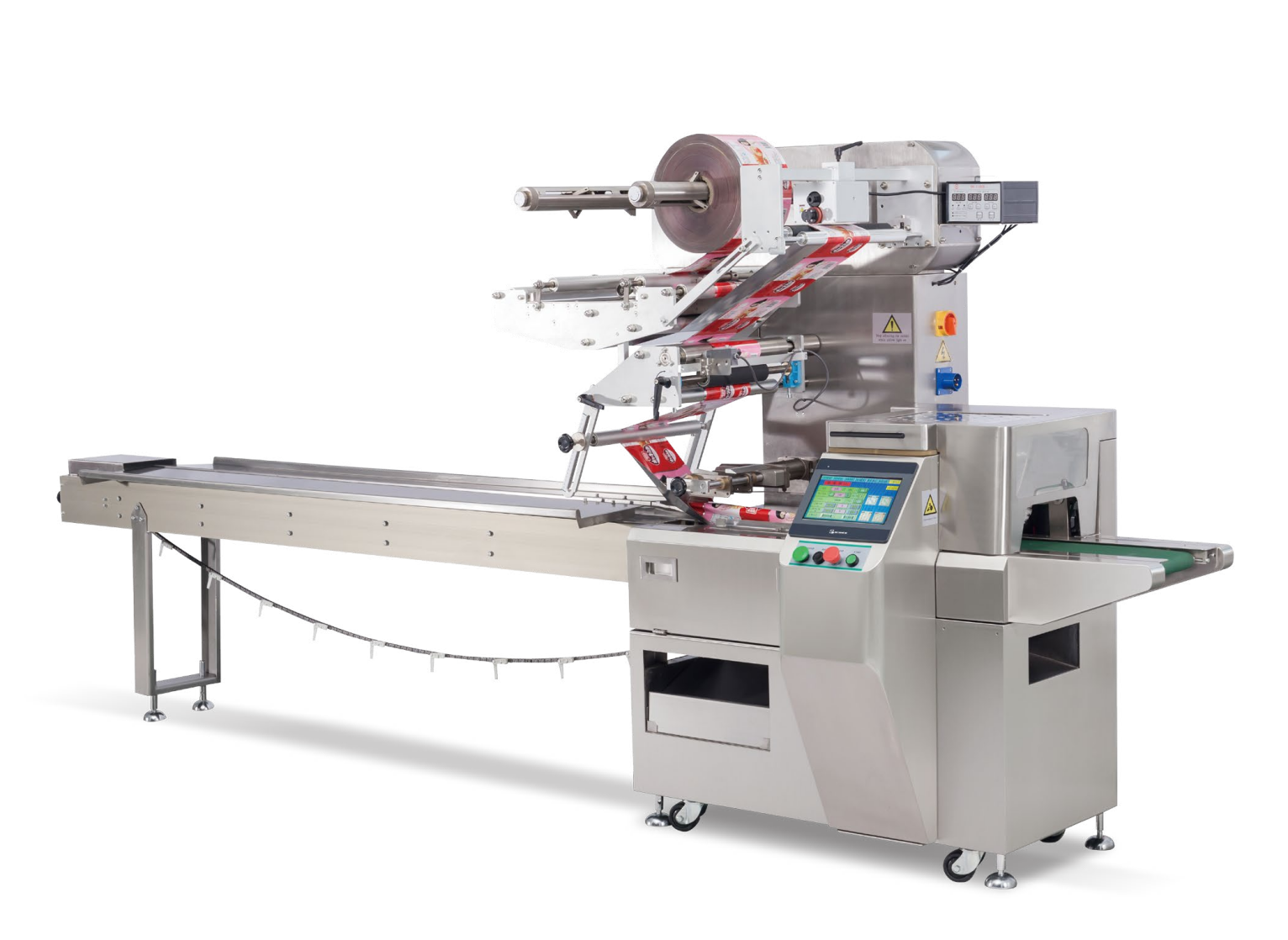
The company reports CE certification for flow packaging machines, automatic packaging systems, cartoning machines, and palletizing robots. One documented project describes the supply of 27 sets for Orion production facilities in Vietnam, Korea, and China, combining wrapping equipment with robotic palletizing for chocolate pie cake production lines.
Comparison of Potential Film Materials
| Film category | Position in the available specifications | What should be verified |
|---|---|---|
| OPP or CPP heat-sealable laminate | Listed as a supported film category | Confirm sealing temperature, film tension, feeding stability, and the selected product format |
| PET/Alu/PE laminate | Listed as a supported film category | Check performance with the longitudinal preheating or hot-wheel sealing system |
| Metallized film | Listed as a supported film category | Evaluate seal strength, printed-film registration, and the barrier structure selected |
| Paper-based material | Not confirmed by the supplied product data | Complete manufacturer review and sample testing before equipment use |
| Compostable or other non-plastic film | Not confirmed by the supplied product data | Validate forming, sealing, cutting, speed capability, and finished-pack performance |
Frequently Asked Questions
Can paper be used instead of plastic film for wafer packaging?
Paper compatibility is not confirmed in the available specifications. A paper-based structure would need sample testing to assess film forming, longitudinal and cross sealing, cutting behavior, registration, and finished-pack integrity.
Which films are explicitly identified for the wafer flow wrapper?
The listed options are OPP, CPP, PET/Alu/PE, and metallized heat-sealable films. Their availability may vary by machine model and should be confirmed against the required wafer dimensions and package design.
What must be checked before introducing a new film?
Confirm the film width, bag length, product size, tension, sealing temperature, sealing pressure, color-mark position, machine speed, and pillow-pack strength. Sample trials should also check seal consistency, clean cutting, product protection, and line stability.
Conclusion and Selection Advice
The current technical information supports heat-sealable laminate films, specifically OPP, CPP, PET/Alu/PE, and metallized structures. It does not establish compatibility with paper, compostable film, or other non-plastic materials. The practical way to select an alternative is to submit samples for testing, review the resulting machine settings, and confirm the finished package with the manufacturer before placing the material into regular production.
Ruipuhua provides manufacturing and OEM cooperation, sample-based product testing, engineer support, worldwide export service, and a stated minimum order quantity of one unit. For technical guidance on wafer packaging materials or complete line configuration, contact lotuspack@ruipuhua.com.
About Ruipuhua
Foshan Ruipuhua Machinery Equipment Co. Ltd is a Chinese manufacturer of intelligent packaging equipment covering research and development, manufacturing, installation, and technical after-sales support. Established in 2005, the company operates from a 50,000-square-meter facility in Foshan, Guangdong, and serves food, bakery, biscuit, snack, noodle, chocolate, soap, hardware, pharmaceutical, and daily chemical industries. Its machinery is exported to more than 100 countries, with solutions covering wafer packaging, feeding, cartoning, case packing, and palletizing. The company holds CE certification for flow packaging machines, automatic packaging systems, cartoning machines, and palletizing robots.

REPORT