







-
 Agriculture
-
 Health-Care
-
 Environment
-
 Construction-Real-Estate
-
 Tools-Hardware
-
 Home-Garden
-
 Furniture
-
 Luggage-Bags-Cases
-
 Medical-devices-Supplies
-
 Gifts-Crafts
-
 Sports-Entertainment
-
 Food-Beverage
-
 Vehicles-Transportation
-
 Power-Transmission
-
 Material-Handling
-
 Renewable-Energy
-
 Safety
-
 Testing-Instrument-Equipment
-
 Construction-Building-Machinery
-
 Pet-Supplies
-
 Personal-Care-Household-Cleaning
-
 Vehicle-Accessories-Electronics-Tools
-
 School-Office-Supplies
-
 Packaging-Printing
-
 Mother-Kids-Toys
-
 Business-Services
-
 Commercial-Equipment-Machinery
-
 Apparel-Accessories
-
 Security
-
 Shoes-Accessories
-
 Vehicle-Parts-Accessories
-
 Jewelry-Eyewear-Watches-Accessories
-
 Lights-Lighting
-
 Fabric-Textile-Raw-Material
-
 Fabrication-Services
-
 Industrial-Machinery
-
 Consumer-Electronics
-
 Electrical-Equipment-Supplies
-
 Electronic-Components-Accessories-Telecommunications
-
 Home-Appliances
-
 Beauty
-
 Chemicals
-
 Rubber-Plastics
-
 Metals-Alloys


























































































































































































































































































































































































































































































































































































- Masonry Materials
- Curtain Walls & Accessories
- Earthwork Products
- Fireproofing Materials
- Heat Insulation Materials
- Plastic Building Materials
- Building Boards
- Soundproofing Materials
- Timber
- Waterproofing Materials
- Balustrades & Handrails
- Bathroom & Kitchen
- Flooring & Accessories
- Tiles & Accessories
- Door, Window & Accessories
- Fireplaces & Stoves
- Floor Heating Systems & Parts
- Stairs & Stair Parts
- Ceilings
- Elevators & Escalators
- Stone
- Countertops, Vanity Tops & Table Tops
- Mosaics
- Metal Building Materials
- Multifunctional Materials
- Ladders & Scaffoldings
- Mouldings
- Corner Guards
- Decorative Films
- Formwork
- Building & Industrial Glass
- Other Construction & Real Estate
- Wallpapers/Wall panels
- HVAC System & Parts
- Outdoor Facilities
- Prefabricated Buildings
- Festive & Party Supplies
- Bathroom Products
- Household Sundries
- Rain Gear
- Garden Supplies
- Household Cleaning Tools & Accessories
- Lighters & Smoking Accessories
- Home Storage & Organization
- Household Scales
- Smart Home Improvement
- Home Textiles
- Kitchenware
- Drinkware & Accessories
- Dinnerware, Coffee & Wine
- Home Decor
- Golf
- Fitness & Body Building
- Amusement Park Facilities
- Billiards, Board Game,Coin Operated Games
- Musical Instruments
- Outdoor Affordable Luxury Sports
- Camping & Hiking
- Fishing
- Sports Safety&Rehabilitation
- Ball Sports Equipments
- Water Sports
- Winter Sports
- Luxury Travel Equipments
- Sports Shoes, Bags & Accessories
- Cycling
- Other Sports & Entertainment Products
- Artificial Grass&Sports Flooring&Sports Court Equipment
- Scooters
- Food Ingredients
- Honey & Honey Products
- Snacks
- Nuts & Kernels
- Seafood
- Plant & Animal Oil
- Beverages
- Fruit & Vegetable Products
- Frog & Escargot
- Bean Products
- Egg Products
- Dairy Products
- Seasonings & Condiments
- Canned Food
- Instant Food
- Baked Goods
- Other Food & Beverage
- Meat & Poultry
- Confectionery
- Grain Products
- Feminie Care
- Hair Care & Styling
- Body Care
- Hands & Feet Care
- Hygiene Products
- Men's Grooming
- Laundry Cleaning Supplies
- Travel Size & Gift Sets
- Room Deodorizers
- Other Personal Care Products
- Pest Control Products
- Special Household Cleaning
- Floor Cleaning
- Kitchen & Bathroom Cleaning
- Oral Care
- Bath Supplies
- Yellow Pages
- Correction Supplies
- Office Binding Supplies
- Office Cutting Supplies
- Board Erasers
- Office Adhesives & Tapes
- Education Supplies
- Pencil Cases & Bags
- Notebooks & Writing Pads
- File Folder Accessories
- Calendars
- Writing Accessories
- Commercial Office Supplies
- Pencil Sharpeners
- Pens
- Letter Pad/Paper
- Paper Envelopes
- Desk Organizers
- Pencils
- Markers & Highlighters
- Filing Products
- Art Supplies
- Easels
- Badge Holder & Accessories
- Office Paper
- Printer Supplies
- Book Covers
- Other Office & School Supplies
- Stationery Set
- Boards
- Clipboards
- Stamps
- Drafting Supplies
- Stencils
- Electronic Dictionary
- Books
- Map
- Magazines
- Calculators
- Baby & Toddler Toys
- Educational Toys
- Classic Toys
- Dress Up & Pretend Play
- Toy Vehicle
- Stuffed Animals & Plush Toys
- Outdoor Toys & Structures
- Balloons & Accessories
- Baby Food
- Children's Clothing
- Baby Supplies & Products
- Maternity Clothes
- Kids Shoes
- Baby Care
- Novelty & Gag Toys
- Dolls & Accessories
- Puzzle & Games
- Blocks & Model Building Toys
- Toddler Clothing
- Baby Clothing
- Kids' Luggage & Bags
- Arts, Crafts & DIY Toys
- Action & Toy Figures
- Baby Appliances
- Hobbies & Models
- Remote Control Toys
- Promotional Toys
- Pregnancy & Maternity
- Hygiene Products
- Kid's Textile&Bedding
- Novelty & Special Use
- Toy Weapons
- Baby Gifts
- Baby Storage & Organization
- Auto Drive Systems
- ATV/UTV Parts & Accessories
- Marine Parts & Accessories
- Other Auto Parts
- Trailer Parts & Accessories
- Auto Transmission Systems
- Train Parts & Accessories
- Universal Parts
- Railway Parts & Accessories
- Auto Brake Systems
- Aviation Parts & Accessories
- Truck Parts & Accessories
- Auto Suspension Systems
- Auto Lighting Systems
- New Energy Vehicle Parts & Accessories
- Auto Steering Systems
- Wheels, Tires & Accessories
- Bus Parts & Accessories
- Auto Performance Parts
- Cooling System
- Go-Kart & Kart Racer Parts & Accessories
- Air Conditioning Systems
- Heavy Duty Vehicle Parts & Accessories
- Auto Electrical Systems
- Auto Body Systems
- Auto Engine Systems
- Container Parts & Accessories
- Motorcycle Parts & Accessories
- Refrigeration & Heat Exchange Equipment
- Machine Tool Equipment
- Food & Beverage Machinery
- Agricultural Machinery & Equipment
- Apparel & Textile Machinery
- Chemical Machinery
- Packaging Machines
- Paper Production Machinery
- Plastic & Rubber Processing Machinery
- Industrial Robots
- Electronic Products Machinery
- Metal & Metallurgy Machinery
- Woodworking Machinery
- Home Product Manufacturing Machinery
- Machinery Accessories
- Environmental Machinery
- Machinery Service
- Electrical Equipment Manufacturing Machinery
- Industrial Compressors & Parts
- Tobacco & Cigarette Machinery
- Production Line
- Used Industrial Machinery
- Electronics Production Machinery
- Other Machinery & Industrial Equipment
- Camera, Photo & Accessories
- Portable Audio, Video & Accessories
- Television, Home Audio, Video & Accessories
- Video Games & Accessories
- Mobile Phone & Accessories
- Electronic Publications
- Earphone & Headphone & Accessories
- Speakers & Accessories
- Smart Electronics
- TV Receivers & Accessories
- Mobile Phone & Computer Repair Parts
- Chargers, Batteries & Power Supplies
- Used Electronics
- VR, AR, MR Hardware & Software
- Projectors & Presentation Equipments
- Other Consumer Electronics
- Cables & Commonly Used Accessories
- Computer Hardware & Software
- Displays, Signage and Optoelectronics
- Discrete Semiconductors
- Wireless & IoT Module and Products
- Telecommunications
- Connectors, Terminals & Accessories
- Development Boards, Electronic Modules and Kits
- Circuit Protection
- Sensors
- Isolators
- Audio Components and Products
- Integrated Circuits
- Power Supplies
- Relays
- RF, Microwave and RFID
- Electronic Accessories & Supplies
- Passive Components
- PCB & PCBA
- Air Quality Appliances
- Home Appliance Parts
- Heating & Cooling Appliances
- Small Kitchen Appliances
- Laundry Appliances
- Water Heaters
- Water Treatment Appliances
- Refrigerators & Freezers
- Personal Care & Beauty Appliances
- Major Kitchen Appliances
- Cleaning Appliances
- Second-hand Appliances
- Smart Home Appliances
- Other Home Appliances
- Energy Chemicals
- Inorganic Chemicals
- Basic Organic Chemicals
- Agrochemicals
- Admixture & Additives
- Catalysts & Chemical Auxiliary Agents
- Pigments & Dyestuff
- Coating & Paint
- Daily Chemicals
- Polymer
- Organic Intermediate
- Adhesives & Sealants
- Chemical Waste
- Biological Chemical Products
- Surface Treatment Chemicals
- Painting & Coating
- Chemical Reagents
- Flavor & Fragrance
- Non-Explosive Demolition Agents
- Other Chemicals
- Custom Chemical Services

Why Detachable Container Houses Outperform Welded Modules in Reusability and Logistics
Understanding the Superior Reusability of Detachable Container Houses
When selecting modular prefabricated housing, mechanical reusability is a key factor for temporary site installations. Detachable container houses surpass traditional welded container modules in flexibility because they utilize standard full bolt fasteners rather than permanent welds. This engineering design allows components to undergo 5 to 8 cycle relocations without causing structural degradation or producing on-site construction waste.
Why Bolted Connections Outperform Permanent Structural Welding
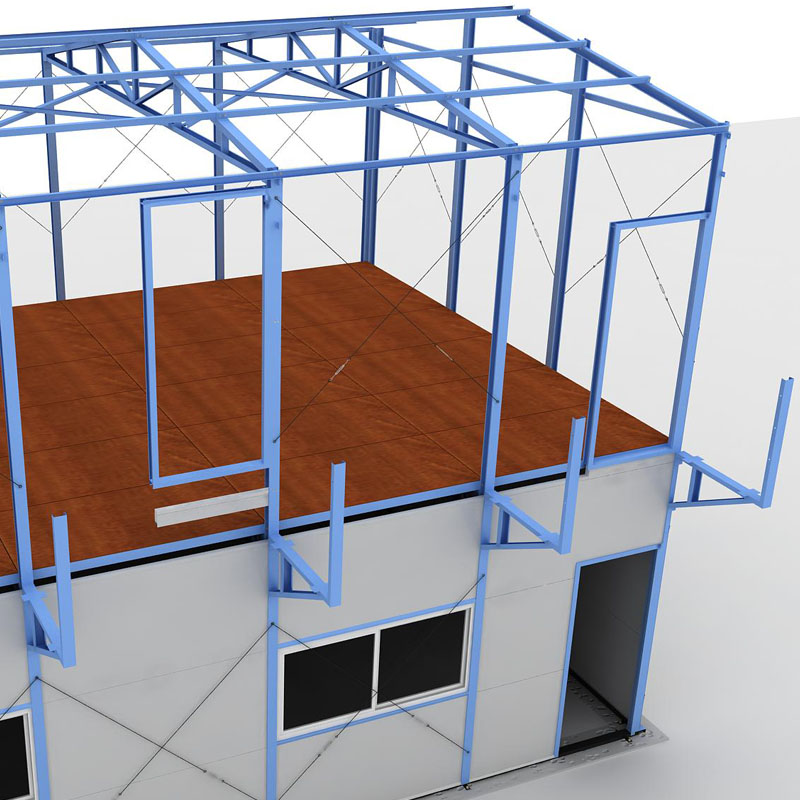
The operational success of modular units depends heavily on frame engineering. Fabricated by Guangdong Uni-House Technology Co., Ltd., these detachable systems use 80×160mm C-channel galvanized steel (1.8mm–2.0mm thickness) for vertical pillars, connected to 100×50mm base frame square tubes. Chemical surface treatments—including pickling, phosphating, and electrostatic powder spraying—guarantee a rust-resistant lifespan exceeding 10 years, alongside Grade 8 wind resistance and Grade 7 seismic endurance.
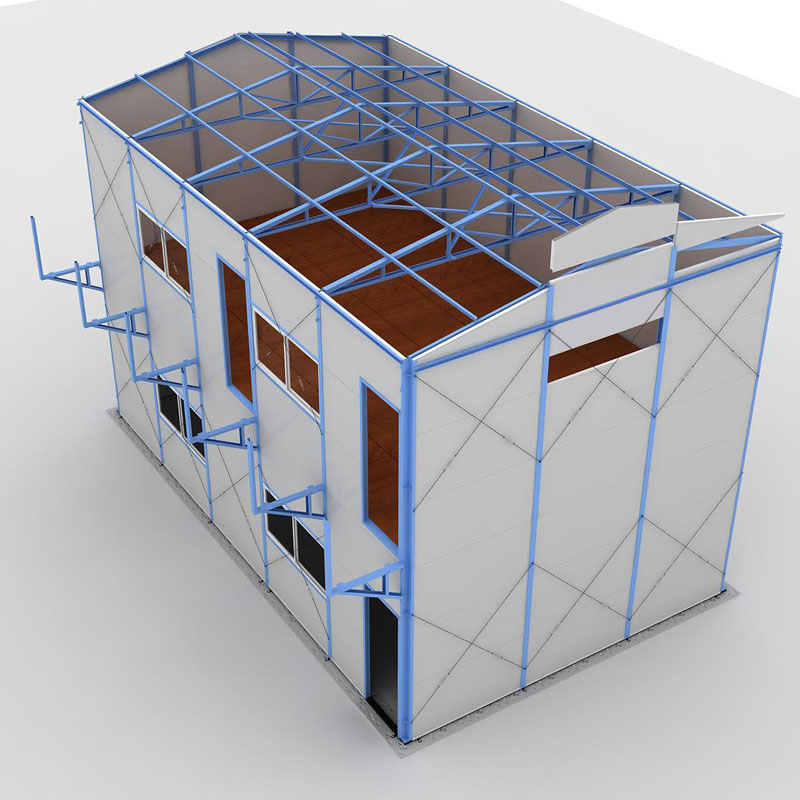
Adhering to the standard K and P dimensional grid system (1K = 1820 mm, 1P = 950 mm), single-floor units achieve a 3P eave height (~2690 mm), whereas two-story and three-story structures reach 6P (~5380 mm) and 9P (~8070 mm) respectively. Thermal insulation and wall protection are provided by 50mm to 100mm sandwich panels with choices of EPS, fireproof A1-grade rock wool, or moisture-resistant PU cores, protected by 0.326–0.4mm color-coated anti-fingerprint galvanized steel layers.
Key Logistics and Operational Advantages
- Eco-Friendly Disassembly: Standard bolt hardware eliminates on-site cutting or welding during teardown, enabling 5 to 8 assembly cycles with zero waste.
- Reduced Ocean Freight: Knock-down flat-pack shipping optimizes space inside 40HQ standard sea containers compared to pre-built volumetric boxes.
- Rapid On-Site Setup: Minimal crew sizes (2 to 3 workers) can assemble a standard unit within two hours.
- Versatile Site Applications: Ideal for remote mining camps, emergency disaster relief, workforce housing, and temporary retail outlets.
Side-by-Side Performance Comparison
To evaluate how knock-down structures differ from permanently welded boxes, review the structural matrix below:
| Feature & Metric | Detachable Modular System | Welded Steel Module |
|---|---|---|
| Joining Technique | 100% bolt assembly (no welding required) | Permanent continuous welding |
| Relocation Lifetime | 5 to 8 full reuse cycles | Restricted due to frame deformation during transport |
| Installation Effort | 2–3 personnel assemble in 2 hours | Requires heavy lifting cranes for rigid block placement |
| Freight Configuration | Flat-packed knock-down package (fits 40HQ / 20FT container) | Shipped fully assembled as high-volume cargo |
| Structural Safety Standard | Grade 8 Wind / Grade 7 Seismic protection | Grade 8 Wind / Grade 7 Seismic protection |
| Surface Corrosion Treatment | Pickling, phosphating, electrostatic powder coating | Standard industrial liquid paint coat |
Global Project Deployments & Industry Certifications
The practical value of knock-down modular units is demonstrated in large-scale operations, such as the Indonesian Coal Mine Accommodation Project involving 2,000 living modules. When project phases shift, unbolting the modular housing allows swift transportation to new sites. Backed by CE certification (No. 3N240819.GUTQO66), these units comply with international standards for deployment across North America, Southeast Asia, Australia, and the Middle East.
Frequently Asked Questions
How many times can a detachable container house be dismantled and reassembled?
Thanks to full bolt joining systems, these structures can be disassembled and rebuilt 5 to 8 times without structural weakening or site waste generation.
What panel cores are available for thermal insulation?
Wall panels come in 50mm, 75mm, and 100mm options, featuring EPS foam for insulation, A1 non-combustible rock wool for fire safety, or PU polyurethane for superior moisture insulation.
Are electrical conduits integrated during assembly?
Yes, electrical piping is pre-installed within the sandwich wall panels during factory fabrication, enabling direct connection of lighting fixtures, sockets, and distribution panels during module setup.
Summary & Ordering Details
Compared with welded container modules, detachable container houses deliver superior mobility, reduced shipping expenses, and rapid field deployment. Standard production cycles take 15 days, with flat-pack shipments delivered via 40HQ or 20FT containers under a 50% deposit and 50% balance before dispatch terms. For customized project inquiries, contact guizugroup@outlook.com.
Company Overview
Established in 2008 as a core division of Guizu Group, Guangdong Uni-House Technology Co., Ltd. operates a 15,000 square meter manufacturing plant equipped with automated robotic welding and spray-coating lines. Backed by 200 skilled staff members and a 30-engineer R&D department, the company holds 150 utility model patents and CE certification, supplying modular building solutions across Australia, Southeast Asia, the Middle East, and North America.

REPORT