







-
 Agriculture
-
 Health-Care
-
 Environment
-
 Construction-Real-Estate
-
 Tools-Hardware
-
 Home-Garden
-
 Furniture
-
 Luggage-Bags-Cases
-
 Medical-devices-Supplies
-
 Gifts-Crafts
-
 Sports-Entertainment
-
 Food-Beverage
-
 Vehicles-Transportation
-
 Power-Transmission
-
 Material-Handling
-
 Renewable-Energy
-
 Safety
-
 Testing-Instrument-Equipment
-
 Construction-Building-Machinery
-
 Pet-Supplies
-
 Personal-Care-Household-Cleaning
-
 Vehicle-Accessories-Electronics-Tools
-
 School-Office-Supplies
-
 Packaging-Printing
-
 Mother-Kids-Toys
-
 Business-Services
-
 Commercial-Equipment-Machinery
-
 Apparel-Accessories
-
 Security
-
 Shoes-Accessories
-
 Vehicle-Parts-Accessories
-
 Jewelry-Eyewear-Watches-Accessories
-
 Lights-Lighting
-
 Fabric-Textile-Raw-Material
-
 Fabrication-Services
-
 Industrial-Machinery
-
 Consumer-Electronics
-
 Electrical-Equipment-Supplies
-
 Electronic-Components-Accessories-Telecommunications
-
 Home-Appliances
-
 Beauty
-
 Chemicals
-
 Rubber-Plastics
-
 Metals-Alloys


























































































































































































































































































































































































































































































































































































- Masonry Materials
- Curtain Walls & Accessories
- Earthwork Products
- Fireproofing Materials
- Heat Insulation Materials
- Plastic Building Materials
- Building Boards
- Soundproofing Materials
- Timber
- Waterproofing Materials
- Balustrades & Handrails
- Bathroom & Kitchen
- Flooring & Accessories
- Tiles & Accessories
- Door, Window & Accessories
- Fireplaces & Stoves
- Floor Heating Systems & Parts
- Stairs & Stair Parts
- Ceilings
- Elevators & Escalators
- Stone
- Countertops, Vanity Tops & Table Tops
- Mosaics
- Metal Building Materials
- Multifunctional Materials
- Ladders & Scaffoldings
- Mouldings
- Corner Guards
- Decorative Films
- Formwork
- Building & Industrial Glass
- Other Construction & Real Estate
- Wallpapers/Wall panels
- HVAC System & Parts
- Outdoor Facilities
- Prefabricated Buildings
- Festive & Party Supplies
- Bathroom Products
- Household Sundries
- Rain Gear
- Garden Supplies
- Household Cleaning Tools & Accessories
- Lighters & Smoking Accessories
- Home Storage & Organization
- Household Scales
- Smart Home Improvement
- Home Textiles
- Kitchenware
- Drinkware & Accessories
- Dinnerware, Coffee & Wine
- Home Decor
- Golf
- Fitness & Body Building
- Amusement Park Facilities
- Billiards, Board Game,Coin Operated Games
- Musical Instruments
- Outdoor Affordable Luxury Sports
- Camping & Hiking
- Fishing
- Sports Safety&Rehabilitation
- Ball Sports Equipments
- Water Sports
- Winter Sports
- Luxury Travel Equipments
- Sports Shoes, Bags & Accessories
- Cycling
- Other Sports & Entertainment Products
- Artificial Grass&Sports Flooring&Sports Court Equipment
- Scooters
- Food Ingredients
- Honey & Honey Products
- Snacks
- Nuts & Kernels
- Seafood
- Plant & Animal Oil
- Beverages
- Fruit & Vegetable Products
- Frog & Escargot
- Bean Products
- Egg Products
- Dairy Products
- Seasonings & Condiments
- Canned Food
- Instant Food
- Baked Goods
- Other Food & Beverage
- Meat & Poultry
- Confectionery
- Grain Products
- Feminie Care
- Hair Care & Styling
- Body Care
- Hands & Feet Care
- Hygiene Products
- Men's Grooming
- Laundry Cleaning Supplies
- Travel Size & Gift Sets
- Room Deodorizers
- Other Personal Care Products
- Pest Control Products
- Special Household Cleaning
- Floor Cleaning
- Kitchen & Bathroom Cleaning
- Oral Care
- Bath Supplies
- Yellow Pages
- Correction Supplies
- Office Binding Supplies
- Office Cutting Supplies
- Board Erasers
- Office Adhesives & Tapes
- Education Supplies
- Pencil Cases & Bags
- Notebooks & Writing Pads
- File Folder Accessories
- Calendars
- Writing Accessories
- Commercial Office Supplies
- Pencil Sharpeners
- Pens
- Letter Pad/Paper
- Paper Envelopes
- Desk Organizers
- Pencils
- Markers & Highlighters
- Filing Products
- Art Supplies
- Easels
- Badge Holder & Accessories
- Office Paper
- Printer Supplies
- Book Covers
- Other Office & School Supplies
- Stationery Set
- Boards
- Clipboards
- Stamps
- Drafting Supplies
- Stencils
- Electronic Dictionary
- Books
- Map
- Magazines
- Calculators
- Baby & Toddler Toys
- Educational Toys
- Classic Toys
- Dress Up & Pretend Play
- Toy Vehicle
- Stuffed Animals & Plush Toys
- Outdoor Toys & Structures
- Balloons & Accessories
- Baby Food
- Children's Clothing
- Baby Supplies & Products
- Maternity Clothes
- Kids Shoes
- Baby Care
- Novelty & Gag Toys
- Dolls & Accessories
- Puzzle & Games
- Blocks & Model Building Toys
- Toddler Clothing
- Baby Clothing
- Kids' Luggage & Bags
- Arts, Crafts & DIY Toys
- Action & Toy Figures
- Baby Appliances
- Hobbies & Models
- Remote Control Toys
- Promotional Toys
- Pregnancy & Maternity
- Hygiene Products
- Kid's Textile&Bedding
- Novelty & Special Use
- Toy Weapons
- Baby Gifts
- Baby Storage & Organization
- Auto Drive Systems
- ATV/UTV Parts & Accessories
- Marine Parts & Accessories
- Other Auto Parts
- Trailer Parts & Accessories
- Auto Transmission Systems
- Train Parts & Accessories
- Universal Parts
- Railway Parts & Accessories
- Auto Brake Systems
- Aviation Parts & Accessories
- Truck Parts & Accessories
- Auto Suspension Systems
- Auto Lighting Systems
- New Energy Vehicle Parts & Accessories
- Auto Steering Systems
- Wheels, Tires & Accessories
- Bus Parts & Accessories
- Auto Performance Parts
- Cooling System
- Go-Kart & Kart Racer Parts & Accessories
- Air Conditioning Systems
- Heavy Duty Vehicle Parts & Accessories
- Auto Electrical Systems
- Auto Body Systems
- Auto Engine Systems
- Container Parts & Accessories
- Motorcycle Parts & Accessories
- Refrigeration & Heat Exchange Equipment
- Machine Tool Equipment
- Food & Beverage Machinery
- Agricultural Machinery & Equipment
- Apparel & Textile Machinery
- Chemical Machinery
- Packaging Machines
- Paper Production Machinery
- Plastic & Rubber Processing Machinery
- Industrial Robots
- Electronic Products Machinery
- Metal & Metallurgy Machinery
- Woodworking Machinery
- Home Product Manufacturing Machinery
- Machinery Accessories
- Environmental Machinery
- Machinery Service
- Electrical Equipment Manufacturing Machinery
- Industrial Compressors & Parts
- Tobacco & Cigarette Machinery
- Production Line
- Used Industrial Machinery
- Electronics Production Machinery
- Other Machinery & Industrial Equipment
- Camera, Photo & Accessories
- Portable Audio, Video & Accessories
- Television, Home Audio, Video & Accessories
- Video Games & Accessories
- Mobile Phone & Accessories
- Electronic Publications
- Earphone & Headphone & Accessories
- Speakers & Accessories
- Smart Electronics
- TV Receivers & Accessories
- Mobile Phone & Computer Repair Parts
- Chargers, Batteries & Power Supplies
- Used Electronics
- VR, AR, MR Hardware & Software
- Projectors & Presentation Equipments
- Other Consumer Electronics
- Cables & Commonly Used Accessories
- Computer Hardware & Software
- Displays, Signage and Optoelectronics
- Discrete Semiconductors
- Wireless & IoT Module and Products
- Telecommunications
- Connectors, Terminals & Accessories
- Development Boards, Electronic Modules and Kits
- Circuit Protection
- Sensors
- Isolators
- Audio Components and Products
- Integrated Circuits
- Power Supplies
- Relays
- RF, Microwave and RFID
- Electronic Accessories & Supplies
- Passive Components
- PCB & PCBA
- Air Quality Appliances
- Home Appliance Parts
- Heating & Cooling Appliances
- Small Kitchen Appliances
- Laundry Appliances
- Water Heaters
- Water Treatment Appliances
- Refrigerators & Freezers
- Personal Care & Beauty Appliances
- Major Kitchen Appliances
- Cleaning Appliances
- Second-hand Appliances
- Smart Home Appliances
- Other Home Appliances
- Energy Chemicals
- Inorganic Chemicals
- Basic Organic Chemicals
- Agrochemicals
- Admixture & Additives
- Catalysts & Chemical Auxiliary Agents
- Pigments & Dyestuff
- Coating & Paint
- Daily Chemicals
- Polymer
- Organic Intermediate
- Adhesives & Sealants
- Chemical Waste
- Biological Chemical Products
- Surface Treatment Chemicals
- Painting & Coating
- Chemical Reagents
- Flavor & Fragrance
- Non-Explosive Demolition Agents
- Other Chemicals
- Custom Chemical Services

How to Assess an Ethical and Capable Custom Sports Socks Factory
A Practical Framework for Choosing a Custom Sports Socks Manufacturer
Finding a reliable custom sports socks factory requires more than reviewing a supplier’s website or product photos. Buyers should verify labor and material credentials, confirm that the factory has the right machinery for the requested sock construction, test its customization ability through samples, and obtain a realistic production schedule in writing. This process is particularly important for custom grip socks, where knitting quality and anti-slip application directly affect product performance.
A qualified supplier should be able to provide clear, traceable evidence for every major claim: certifications, production equipment, sample procedures, inspection standards, and delivery commitments. Rather than relying on general assurances, use product-specific questions and physical samples to evaluate the factory’s actual capability.
Start with Ethical, Material, and Compliance Documentation
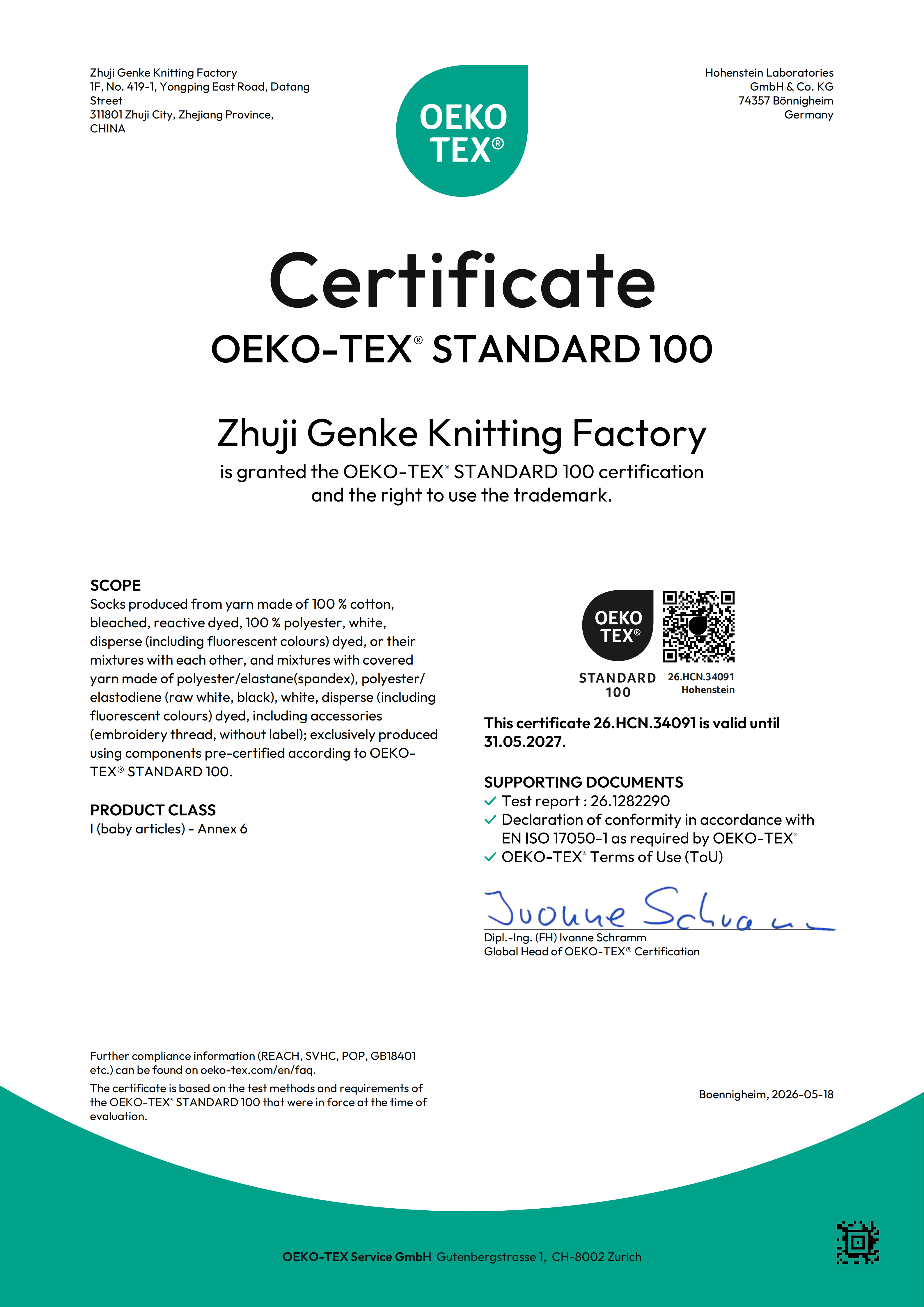
Ethical sourcing should be supported by verifiable records rather than broad statements about responsibility. For custom sock orders, buyers may request documentation related to BSCI, Oeko-Tex 100, and GRS when these standards are relevant to the factory, materials, or products being purchased.
BSCI is associated with supply-chain social auditing, while Oeko-Tex 100 concerns textile materials and products intended for skin contact. GRS may be relevant when recycled materials are included in a sock program. Ask for the certificate name, certificate number, validity period, audited facility information, and product or material scope. A certificate alone does not automatically apply to every order, so its connection to the actual production location and ordered materials should be confirmed.
Confirm the Factory Can Produce Your Specific Sock Design
Manufacturing capability should be evaluated according to the sock type you intend to buy. A regular promotional sock, a team athletic sock, a Pilates grip sock, and a technical soccer grip sock may require different yarns, knitting programs, finishing steps, and quality standards.
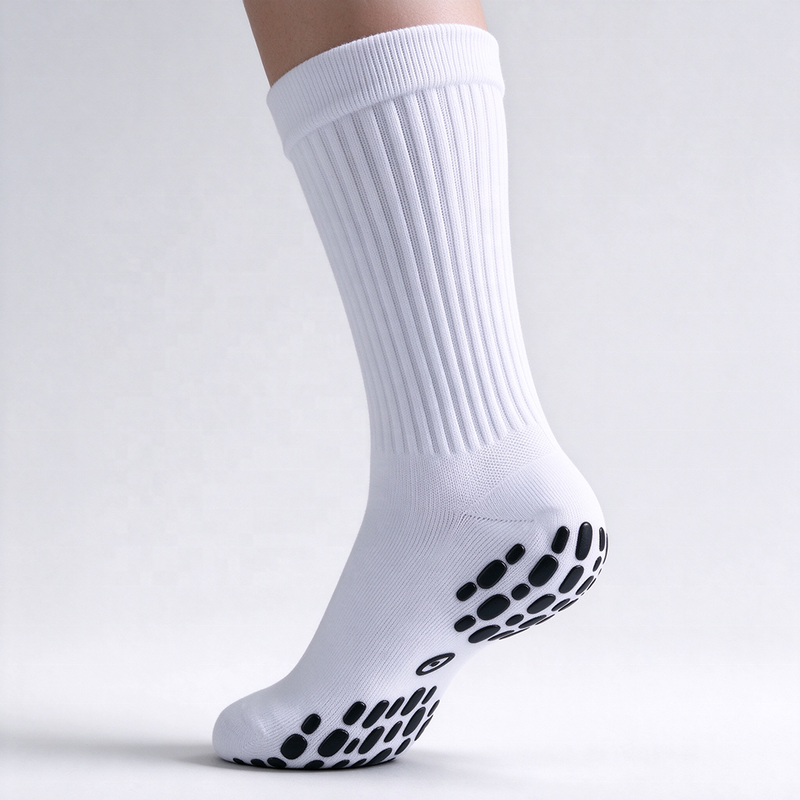
For custom soccer grip socks, the factory should be able to explain how it forms the ribbed leg, supportive cuff, breathable knit zones, and sole structure. It should also describe the process used to apply silicone or PVC grip elements to the sole and heel. Buyers can request evidence of the machinery and workflow used for computerized jacquard knitting, toe closing, sewing, and anti-slip dispensing.
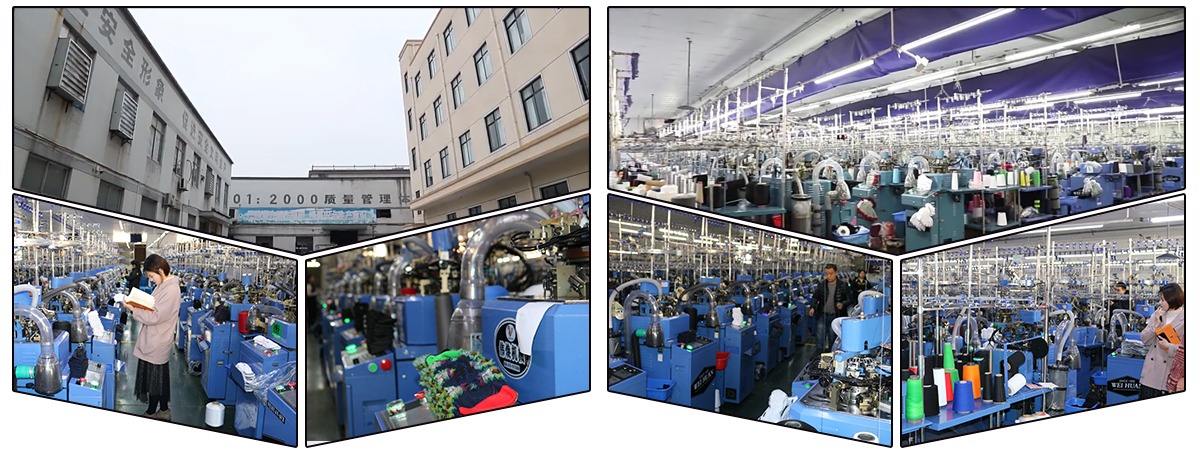
Reported equipment for this type of production includes more than 200 computerized high-speed jacquard machines, automatic toe-closing and sewing machines, and dedicated silicone or PVC dispensing equipment. Ask the supplier to clarify which machines and process steps will be used for your order, especially when the grip pattern, logo placement, or material combination is unusual.
Use Sampling to Test Customization Claims
A pre-production sample is one of the most useful tools for reducing risk before bulk manufacturing begins. It allows buyers to see whether the factory can accurately reproduce the intended logo, colors, knit pattern, size range, grip layout, packaging, and private-label details.
For the described custom grip sock program, sample development is stated to take approximately 7 to 10 business days. During sample review, inspect the cuff recovery, ribbed construction, yarn feel, breathability, knit density, sizing, logo clarity, color consistency, and overall finishing. On grip socks, also examine the shape, placement, coverage, and adhesion of the anti-slip dots or patterns on the heel and sole.
Do not approve bulk production based only on digital artwork or photos. The final approved physical sample should be retained as the production reference so that the factory’s inspection team has a clear standard for the full order.
Ask How Quality Control Is Performed
Quality assurance should be described as an operational process, not simply as a promise of good quality. The product information states that 100% manual inspection is performed, while the factory profile refers to multi-stage quality control and full manual checking. Buyers should ask how this inspection process works in practice.
Useful questions include: Which defects are checked at each stage? Are knitting flaws, loose threads, incorrect sizing, logo errors, grip defects, stains, and packaging mistakes recorded? How are rejected pairs separated and corrected? Is there a final inspection record available before shipment? Clear answers to these questions help determine whether quality control is systematic and accountable.
Align Factory Experience with Your End Use
A factory’s past project experience can indicate whether it understands the requirements of your market. Athletic teams may prioritize durability, compression, and grip performance. Yoga and Pilates studios often need reliable anti-slip coverage, comfortable materials, and consistent branding. Corporate gift programs may focus on logo reproduction, packaging, and delivery timing, while fashion retailers may place greater emphasis on color, texture, seasonal design, and presentation.
The company reports experience serving North American boutique fitness chains, athletic teams, corporate marketing agencies, independent fashion retailers, and gift distributors. Its referenced projects include professional athletic socks, studio grip socks, branded promotional merchandise, and retail sock collections. Buyers should compare these types of references with their own usage scenario and requested specifications.
Review Lead Times Against Your Actual Order Plan
Production timing should be evaluated after the sock design, quantities, materials, and customization details are known. The stated bulk production window is 15 to 25 business days after sample approval and deposit, while repeat orders are stated to require around 10 to 20 business days. These timeframes should be treated as planning references and confirmed in writing for each purchase order.
Request a schedule that covers sample approval, material preparation, knitting, grip application where applicable, inspection, packaging, and shipment. Seasonal demand, order volume, special yarn sourcing, custom packaging, and complex grip artwork can all influence the final delivery date.
Factory Verification Checklist
| Evaluation Area | Available Evidence | Recommended Buyer Action |
|---|---|---|
| Ethical and textile compliance | BSCI, Oeko-Tex 100, and GRS credentials are listed. | Check certificate numbers, validity dates, facility details, and relevance to the ordered product. |
| Grip sock production | Computerized jacquard knitting, toe-closing and sewing machines, plus silicone or PVC dispensing equipment are stated. | Request an explanation of the knitting, grip application, and finishing process for your design. |
| Customization and sample development | Custom yarn combinations, colors, logos, grip patterns, packaging, and private-label options are supported; samples are stated at 7 to 10 business days. | Approve a physical sample against written artwork and technical specifications. |
| Inspection procedures | 100% manual inspection is stated. | Confirm inspection criteria, rejection handling, and final quality records. |
| Production scheduling | Bulk lead time is stated as 15 to 25 business days after approval and deposit; repeat orders are stated as 10 to 20 business days. | Obtain an order-specific production and shipment schedule before payment. |
Frequently Asked Questions
Does BSCI certification guarantee that every sock order is ethically produced?
No. BSCI can be a relevant indicator of supply-chain auditing, but buyers should still verify that the certificate is valid and applies to the correct factory location and production process. Documentation should be reviewed together with order-specific supplier communication and quality controls.
What machinery is important for custom grip socks?
The manufacturer should have capabilities for patterned knitting, toe closing, sewing, and applying anti-slip material. For grip socks, computerized jacquard knitting machines and specialized silicone or PVC dispensing equipment are particularly relevant.
What should be checked on a soccer grip sock sample?
Review the cuff fit, rib structure, knit consistency, breathability, size accuracy, color match, logo placement, and finishing. Check that the sole and heel grip coverage matches the approved design and that the grip material is securely applied. Confirm that this approved sample will serve as the reference standard during bulk inspection.
Final Recommendation
A dependable custom sports socks factory should be selected only after credentials, equipment, sampling, inspection procedures, and delivery planning have been reviewed together. Yiwu Genke Apparel Co., Ltd. states that it provides integrated high-end sock customization, 100% manual inspection, and BSCI, Oeko-Tex 100, and GRS credentials. For technical guidance or detailed custom sock solutions, contact happygu@cnleyoyo.com.
About Us
Yiwu Genke Apparel Co., Ltd. produces customized socks for sports, promotional branding, yoga and Pilates, business programs, and fashion applications. Founded in 2016, the company reports a 1,200-square-meter factory and annual capacity of 12,000,000 pairs. Its stated development resources include 30 R&D engineers and fashion designers, computerized jacquard knitting machines, seamless heat-transfer printing capability, and grip-pattern dispensing equipment. The company lists Oeko-Tex 100, BSCI, and GRS credentials and reports serving customers in multiple industries.
REPORT